Get Full Government Meeting Transcripts, Videos, & Alerts Forever!
Get email alerts on the Land Use topic
No spam. Unsubscribe anytime.
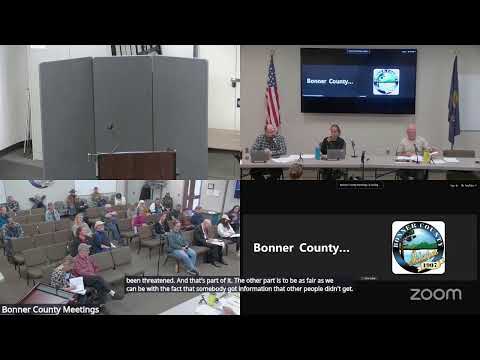
Bonner County commissioners void moratorium after acknowledging open‑meeting error, adopt new MLD moratorium excluding family splits
Summary
The Bonner County Board of Commissioners voted Tuesday to self‑recognize an open‑meetings law violation tied to a March 25 meeting, void the moratorium ordinance enacted at that meeting, and adopt a new moratorium on minor land divisions that excludes family exemptions, effective May 19 through Oct. 1, 2025.
The Bonner County Board of Commissioners voted Tuesday to self‑recognize an open‑meetings law violation tied to its March 25 meeting, void Ordinance 7‑20 that enacted a moratorium on minor land divisions and family exemptions, and adopt a new, time‑limited moratorium on minor land divisions that excludes family exemptions.
The action followed lengthy public comment and legal advice from county counsel Bill Wilson. Commissioner Domke moved that the board “self recognize that we committed an open meetings law violation” tied to the March 25 motion to add an emergency moratorium, and the board voted to void that ordinance. The board then approved a replacement moratorium limited to non‑family minor land divisions, with an effective date of May 19, 2025, and an expiration date of Oct. 1, 2025.
Why it matters: Commissioners and county staff said they want to address what they described as growing public‑safety and infrastructure concerns tied to the way some minor land divisions have been used in Bonner County — particularly when multiple divisions have produced subdivision‑scale density without the infrastructure reviews that a formal subdivision process demands. Supporters of the new moratorium said it will give planning staff and the planning commission time to draft and publicize code amendments; opponents said a stop‑gap moratorium unfairly harms individuals and families who were preparing applications.
County counsel Bill Wilson told the board his review identified three procedural problems with how the March 25 emergency item was handled, and he said the narrow, fix‑oriented remedy was available. "The statute requires that you acknowledge the error," Wilson said, adding that acknowledging the error and declaring the earlier ordinance void satisfied the immediate legal cure.
Commissioner Domke acknowledged in public comment and in his motion that his motion on March 25 did not use the precise statutory language required by Idaho Code 74‑2‑044(c) — language that, in the counsel’s reading and Domke’s admission, should have appeared in the motion and in the minutes. Domke said he would correct the error and partner with planning to move as quickly as possible on substantive code changes.
During public comment, dozens of residents, property owners and agency representatives addressed the board. Some praised the board for acting on what they described as a long‑running problem with developer use of MLDs to create subdivision‑scale density; others urged the board to preserve an avenue for small family‑based splits that help relatives stay in the county. Quinn Wolford, a Bonner County resident, described the family‑split issue this way: "Like a parent giving a parcel to a child, which can make the difference between staying in Bonner County or being forced to leave."
Fire district and emergency‑services officials called attention to access and response concerns when multiple parcels arise without concurrent planning for roads, water or defensible space; Jeff Armstrong, a local fire chief, told the board he had multiple fire sign‑offs waiting that day and said some proposed divisions presented development designs that raised questions about emergency response access.
The board also debated how to treat applications that were submitted or in process during the interval when the earlier moratorium was in effect. Planning director Jake Gabel told the board that a limited number of applications were received from a single surveying firm in the days before the March action; commissioners discussed post‑dating an effective moratorium date to allow applicants who were already in the pipeline a short, explicit window to submit complete applications.
After deliberation the board directed staff to: post the new moratorium and supporting materials on the planning department website and in the newspaper; produce a red‑line drafted code amendment for planning commission review; and schedule workshops so the planning commission and board could consider revisions promptly. Commissioners said they intend to balance the need to protect public health, safety and welfare with the desire to preserve reasonable options for family‑based land transfers.
Votes at a glance: The board first voted to self‑recognize an open‑meetings law violation tied to the March 25 meeting and to void Ordinance 7‑20 as a cure. The board then voted to adopt a replacement moratorium on minor land divisions that excludes family exemptions, effective 05/19/2025 through 10/01/2025. The roll‑call tallies were recorded during the meeting; the moratorium motion carried with a majority of the commissioners present.
What’s next: Planning staff will draft code changes and a red‑lined ordinance for the planning commission and the board to review. The board asked staff to post clear filing guidance and a deadline so applicants who were already working with surveyors can submit within the brief grace period the board discussed. Commissioners said they expect to return to the topic with workshop materials and additional public hearings before making any permanent code changes.
— By staff and county counsel reports