Get Full Government Meeting Transcripts, Videos, & Alerts Forever!
Get email alerts on the Open Government topic
No spam. Unsubscribe anytime.
Town attorney trains Fort Myers Beach advisory members on Sunshine Law, public records and voting conflicts
Summary
Fort Myers Beach town attorney Nancy Stupich led a training for appointed advisory boards on Florida's Sunshine Law, public-records rules and voting-conflict procedures, stressing transparency, use of staff as the records conduit and caution about member-to-member communications outside public meetings.
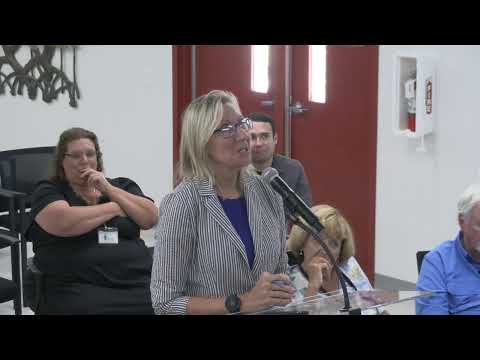
Nancy Stupich, Fort Myers Beach town attorney with the Vos Law Firm, led a training session for the town's advisory boards on the Sunshine Law, public-records requirements and voting-conflict rules, telling attendees that the laws are broadly construed and that transparency is the safest course.
"When in doubt, if you're not sure what to do, go for transparency," Stupich said, outlining obligations for appointed and elected bodies and for subcommittees, ad hoc groups and ex officio members.
Stupich told participants that Florida's open-meetings law (commonly called the Sunshine Law) is found in Chapter 286 of the Florida Statutes and requires public notice and open meetings when "an official act is taken or public business is transacted or discussed." She said the law applies to advisory boards and most subcommittees when those bodies are performing decisionmaking functions or sifting options that may be presented to the town council.
She emphasized practical steps members should follow: route questions and documents through town staff rather than conducting member-to-member discussions about substantive town business; treat individual site visits as factual observations to be disclosed publicly at a later meeting; and avoid private or small-group conversations about matters that are "foreseeable" to come before a board. "If you intend to do that, I would have other people present ... who would be able to say that you did not discuss a matter that was foreseeable to come before your board," she said.
Stupich summarized procedural requirements: meetings must be open to the public, given reasonable notice (she said 48 hours is commonly used), and minutes must be taken and approved at a subsequent meeting. She discouraged holding meetings in locations that could effectively limit access (such as private homes or restaurants where fees might deter attendance) and said that site visits and informal gatherings carry risks unless handled transparently and noticed.
On public records, Stupich said Florida's public-records law (Chapter 119) covers a wide range of formats and devices. She warned that emails, text messages and even sticky notes can be public records if they "perpetuate, communicate or formalize" town business, and advised members to forward any public-records request or relevant material to the town's custodian of records rather than retaining it on personal devices. Town clerk "Amy" (identified in the training as the records custodian) was named as the point of contact for handling requests.
Stupich also reviewed voting-conflict rules and the Form 8B memorandum of voting conflict that must be used when a public officer anticipates a voting conflict. She said appointed members must disclose conflicts before participating in discussions and that Form 8B must be filed within 15 days when a conflict exists. She warned that determining whether a special private gain or loss exists can involve judgment about the size of the affected class and whether the financial impact is speculative or concrete.
The training covered ethics guidance from the Florida Commission on Ethics and practical limits on gifts and solicitation. Stupich advised caution around gifts and fund-raising: small, incidental items are less likely to raise issues, but the law restricts solicitation or acceptance of gifts in ways that could create the appearance of impropriety.
Throughout the session she cited enforcement mechanisms: the state attorney enforces Sunshine Law violations; the Florida Commission on Ethics handles ethics-related complaints; and public-records violations can lead to civil or criminal exposure. For Sunshine Law violations she noted that "knowingly" violating open-meetings requirements can be prosecuted as a misdemeanor and that inadvertent violations may result in civil penalties and in the need to redo any actions taken in violation of the law.
Materials referenced in the training include the Government in the Sunshine Manual from the Florida Attorney General and a 2025 guide produced by the Florida Commission on Ethics. Stupich told attendees that the training slides and handouts are public records and encouraged committee members to work through staff when they need information or documents.
The session included back-and-forth Q&A with members of several advisory bodies (including the Local Planning Agency, Anchorage advisory committee and MURF), and Stupich acknowledged gray areas where members must exercise judgment, especially around social events, dual-service on volunteer groups and online posting. She recommended that, when in doubt, members consult staff or the town clerk and document interactions in public meeting minutes rather than rely on informal or private communications.