Get Full Government Meeting Transcripts, Videos, & Alerts Forever!
Get email alerts on the State Legislative Session topic
No spam. Unsubscribe anytime.
Seattle intergovernmental office outlines late-stage state bills, revenue package as sine die nears
Summary
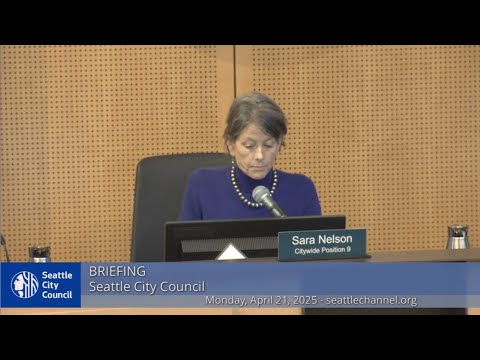
Seattle’s Office of Intergovernmental Relations told the City Council on April 21 that several priority state bills have advanced toward the governor while negotiators are hashing out a multibillion-dollar revenue package ahead of next Sunday’s sine die deadline.
Seattle’s Office of Intergovernmental Relations updated the City Council on April 21 about the state legislature’s approaching sine die date and a negotiated revenue package that could raise roughly $12 billion over four years.
Mina Hashemi, director of the Office of Intergovernmental Relations, told council members the session had reached week 15 with six days left and that several Seattle-priority bills have moved forward while others stalled at the opposite-house cutoff.
“The senate actually held a ways and means committee quickly afterward at 05:30 to focus on new revenue proposals, which underscores the ongoing discussions about the state's fiscal strategy,” Hashemi said during the briefing.
Hashemi and her colleagues listed specific outcomes: House Bill 1112 (pro tem judges) has been signed by the governor; House Bill 2015 (public safety funding) passed the Senate and would create a Criminal Justice Training Commission grant program for recruitment, retention and alternative-response positions and allow a councilmanic sales tax up to 0.1 percent for criminal justice purposes; Senate Bill 5595 (shared streets) has passed both chambers and been sent to the governor; and several housing, economic development and climate bills were described as moving toward final action or already headed to the governor.
On revenue, Hashemi said negotiators’ package includes an excise tax on zero-emission vehicle credits, an increase to the estate tax top tier, a 2.9 percent capital gains increase on gains above $1 million, new sales taxes on some currently exempt services (such as certain IT and advertising services), surtaxes on large businesses’ B&O tax and a proposal to raise the property-tax growth limit to 3 percent. “For this package, it's $12,000,000,000 over 4 years,” Hashemi said.
Council members asked for details about items of local concern. Councilmember Moore pressed for clarification on proposed reductions in state funding for the encampment resolution program; Hashemi said the House and Senate budget proposals each showed $45 million a year rather than $75 million and that city staff would follow up for more detail on how that level would affect shelter capacity.
Hashemi also acknowledged the sudden death of state Sen. Bill Ramos and described his work representing the Fifth Legislative District.
Why it matters: the bills and revenue proposals described by Seattle’s intergovernmental office could affect local funding streams, criminal-justice programs, transportation and housing policy. The city’s advocacy and budget planning over the coming week will depend on how the governor and the Legislature finalize outstanding items before adjournment.
What’s next: Hashemi said negotiators would continue discussions this week before the legislature’s scheduled adjournment on April 27 and that the Office of Intergovernmental Relations would update the council as the budget and revenue package evolve.