Get Full Government Meeting Transcripts, Videos, & Alerts Forever!
Get email alerts on the Ai Detection And Provenance topic
No spam. Unsubscribe anytime.
FPPC panel examines limits of AI detectors, endorses provenance and standards for AB 2355 compliance
Summary
A panel convened by the Fair Political Practices Commission’s Public Outreach and Technology Committee heard technical and policy perspectives on detecting AI-generated campaign content, with speakers urging a combination of provenance standards, targeted detection tools and clearer disclosure guidance to implement California’s AB 2355.
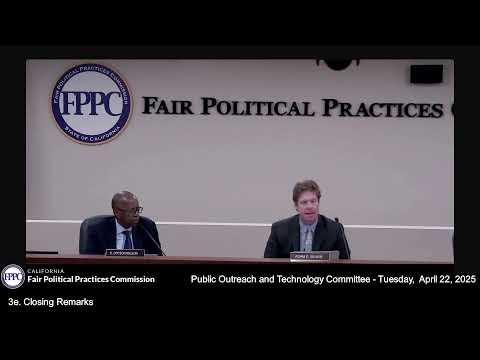
The Fair Political Practices Commission’s (FPPC) Public Outreach and Technology Committee on April 22, 2025, convened a panel of academics and industry vendors to discuss how to detect and disclose campaign advertisements created or modified with artificial intelligence under California’s new AB 2355 requirement. Chair Silver opened the meeting saying, “AI is the defining issue of our time,” and framed the panel as part of the commission’s effort to implement the statute and protect public trust.
The committee heard three technical approaches: (1) automated detection models, (2) cryptographic provenance and content-credential systems, and (3) expert human forensics. Each speaker described strengths and limits and recommended a combined, staged approach for enforcement.
Professor James O’Brien, a computer science professor at UC Berkeley, emphasized technical limits on automated detection and described an ongoing arms race between generators and detectors. “I’m personally not a very big fan of these” [automated detectors] as a sole solution, O’Brien said, arguing that statistical and visible artifacts detectors may work today but will become less reliable as generative models improve. He recommended provenance chains—digital records that trace an image’s origin and edits—where feasible, while acknowledging chain-of-custody requirements limit that approach in many real-world contexts.
Kevin Guo, chief executive officer of Hive AI, argued that high-accuracy automated detectors are a practical near-term solution and described his company’s product as an "AI antivirus" trained on large datasets of real and generated content. Guo said his team’s models are already deployed commercially and in national-security settings and cited benchmark results (high accuracy and very low false-positive rates) to support using detectors as an enforcement signal. He acknowledged no detector will be perfect but said automated classification can be kept current through continuous data and feedback from broad deployments.
Representatives from Adobe outlined an alternative emphasis on provenance and user-directed metadata. Katie Brook of Adobe’s public policy and legal team demonstrated the company’s Content Credentials implementation (based on the C2PA standard) and described it as “a nutrition label” that lets creators attach signed metadata about source, edits and whether AI tools were used. Andrew (lead product manager, Adobe) showed how Content Credentials can be embedded in an image workflow and inspected by third parties. Adobe stressed the system is opt-in, open-standard (C2PA), and designed to let campaigns “show their work” rather than rely exclusively on detectors.
Committee members asked about enforcement practicality. Panelists agreed: detectors can flag likely violations at scale but can produce false negatives when actors edit or re-encode images; provenance works well when creation and toolchains are controlled but is less useful for leaked, archived or deliberately anonymized files. O’Brien urged the commission to be cautious about relying on detectors alone because “the generators will ultimately win” if the goal is pixel-level differentiation in perpetuity. Guo and Hive AI emphasized low false-positive rates are critical for operational enforcement, while Adobe said provenance plus public education would reduce burdens on regulators and campaigns.
The committee directed staff to continue the panel series, invite legislative and elections committees for further consultation, and gather stakeholder input to shape practical compliance guidance for campaigns and vendors. A member of the public who spoke during the meeting also urged the commission to consider protections for complainants and retaliation safeguards; the speaker said, “I strongly urge the commission to consider adopting safeguards for complainants and to treat retaliation seriously when it occurs.”
The meeting produced no formal enforcement rule changes during the session; commissioners said the panel’s findings will inform future policy work, outreach and additional hearings.
Context and next steps: Panelists recommended a mixed strategy for short-term enforcement—use vetted automated detectors with conservative thresholds as a screening signal, pair that with spot expert review, and promote adoption of content-credential provenance standards (C2PA) across major creation and hosting platforms. Commissioners requested follow-up briefings with tool vendors, elections officials, and legal staff to translate technical capabilities into practicable guidance to implement AB 2355’s disclosure mandate.