Get Full Government Meeting Transcripts, Videos, & Alerts Forever!
Get email alerts on the Family Law Custody Jurisdiction topic
No spam. Unsubscribe anytime.
Lawmakers hear broad family‑law package, from custody standards to interstate jurisdiction and protections for disabled parents
Summary
The Joint Committee on the Judiciary received testimony on a suite of family‑law bills including proposals to expand juvenile‑court authority in child‑welfare cases, adopt the Uniform Child Custody Jurisdiction and Enforcement Act (UCCJEA), protect parents with disabilities, and debate presumptive shared parenting.
The Joint Committee on the Judiciary heard a broad set of family‑law proposals Tuesday, ranging from bills to strengthen juvenile‑court authority in child‑welfare cases to efforts to change custody standards and to modernize interstate custody jurisdiction.
Deputy Chief Counsel Daniel Mahoney of the Committee for Public Counsel Services urged support for House Bill H1885, which he said would allow juvenile courts to make orders in a child's best interest and revisit custody and related issues at appropriate intervals during care and protection proceedings. "Vulnerable children in foster care, our clients deserve better," Mahoney said, arguing the bill would give juvenile judges the same authority that probate and family judges exercise.
Senator Joan Lovely and disability advocates supported S1164, a bill they described as prohibiting discrimination against adults with disabilities in family and juvenile court proceedings. "Parents with disabilities are disproportionately involved in the child welfare system and have their children taken away at higher rates," testified Samantha Fine for a coalition of disability and civil‑legal groups. The bill would require courts to make a written finding about whether a parent's disability actually harms a child and whether reasonable supports could mitigate any harm.
On jurisdiction, the Boston Bar Association urged the Legislature to adopt a modern Uniform Child Custody Jurisdiction and Enforcement Act (UCCJEA), which the witnesses said Massachusetts is the only state that has not enacted in its current form. "This is causing significant problems every day in our court, particularly for victims of domestic abuse who sometimes are not allowed to leave because of conflicts between states," Jamie Sabino testified, noting the Senate has already passed related language.
The hearing also included a contentious exchange over bills proposing presumptive or shared‑parenting rules. Grama McLaughlin of the League of Women Voters and other witnesses asked the committee to oppose proposals that would create a rebuttable presumption of equal shared custody in high‑conflict cases, citing longitudinal studies they said show worse outcomes for children in abusive or high‑conflict cases under presumptive shared parenting. "Shared parenting in high conflict cases has proven to be dangerous, traumatic and harmful," McLaughlin said.
Representatives of groups and individuals supporting reforms aimed at increasing parental involvement — including measures described as "child‑centered family law" reforms — said the proposals include protections for victims of domestic violence and were crafted through multi‑year stakeholder work. Dr. Peter Hill described a two‑year consensus process that produced a child‑centered family law proposal intended to keep both parents involved while protecting abuse victims.
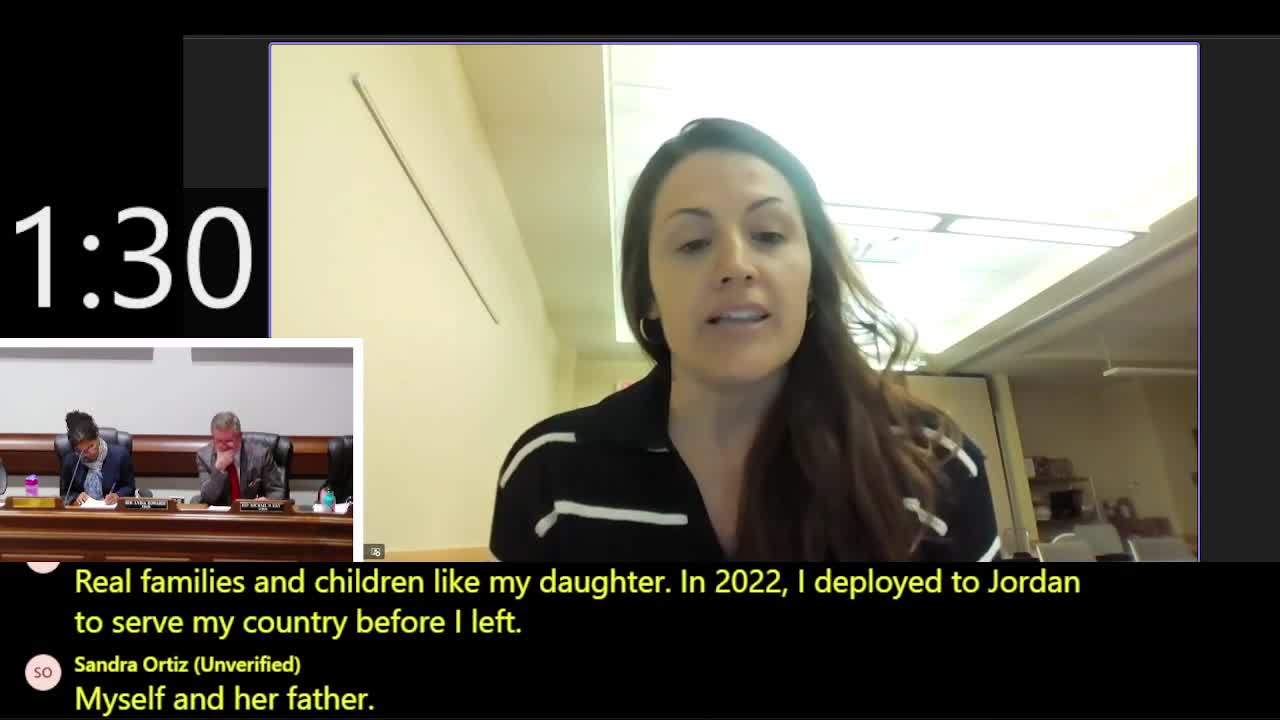
Military families also testified. Sandra Ortiz, a deployed service member, said H1711 would protect service members from losing custody simply because of temporary active duty assignments. "Temporary absences from military duty should never permanently sever the bond between a parent and a child," Ortiz said.
Committee chairs received a mix of technical and policy testimony and indicated they would accept written comments. No formal votes on any family‑law bills were recorded in the transcript portion of the hearing.