Get Full Government Meeting Transcripts, Videos, & Alerts Forever!
Get email alerts on the Sustainability Partners Contracts topic
No spam. Unsubscribe anytime.
Attorney General, auditor and commissioners flag 'Sustainability Partners' contracts as possible long-term obligations; commission schedules special meeting
Summary
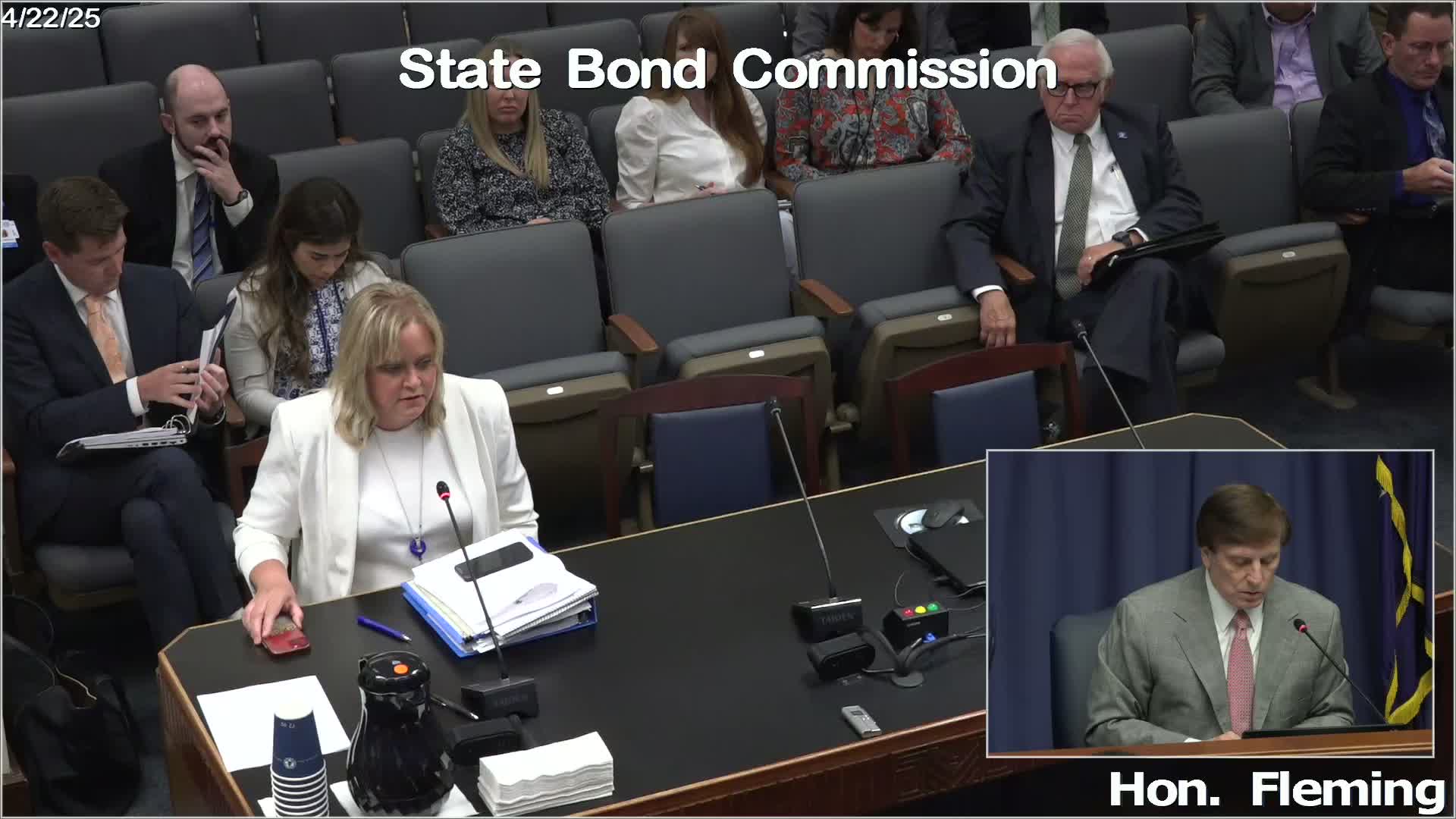
Attorney General Murrell and the Louisiana Legislative Auditor told the State Bond Commission on April 22 that contracts sold by Sustainability Partners appear to impose long-term financial obligations on municipalities and counters that many such agreements were not reviewed by the Bond Commission.
Attorney General Murrell and the Louisiana Legislative Auditor told the State Bond Commission on April 22 that contracts marketed by Sustainability Partners, a private firm that offers "infrastructure as a service" arrangements, appear to create long-term financial obligations for municipalities and political subdivisions that have not been reviewed by the Bond Commission.
"We believe are long term debt," Attorney General Murrell said, describing 20 contracts the attorney general's office identified so far. Murrell said many of the contracts involve water meters and other infrastructure and that several municipalities that signed these agreements are now under fiscal administration.
Mike Waguespack, Louisiana Legislative Auditor, told commissioners the contracts are "very, very difficult, hard to read, very, very fine print" and that termination provisions typically impose deferred payments or buyout formulas that effectively capture remaining payments rather than offering a true walk-away. Waguespack said the audit office calculated an effective interest rate of roughly 11.924% for one contract that was litigated and that contracts have, in some cases, been used to pay off low-interest public loans.
Commission members and staff described other specific concerns: - Public-bid law evasion: Some contracts, Murrell said, used bid documents or proprietary terms ("Infrastructure as a Service") drafted by Sustainability Partners in a way that limited competition to a single responsive bidder. - Sales-tax exemptions: Documents show sales-tax exemption forms being claimed even though Sustainability Partners, not the municipality, retains ownership of installed equipment in some deals. - Lack of disclosure/contract transparency: The attorney general said some municipalities could not produce complete contracts in response to public records requests and in some cases had only signature pages. - Potential constitutional and statutory issues: Murrell and others cited a recent court opinion by then-judge Cade Cole (now Justice Cole) in the Capital Area Groundwater Commission matter, which found the arrangement amounted to an improperly imposed tax and observed the contract created obligations that should have been vetted.
Several speakers said the arrangements can function differently depending on whether the financed items are movable (for example, meters) or immovable (for example, wastewater systems). Murrell and audit staff said movable items may be transferred more easily, while infrastructure such as sewer systems cannot be moved and carry different legal and practical risks.
Commission members asked for more detail and examples. The attorney general's office and the auditor's office cited specific local cases: Murrell noted Simsport had a previously outstanding DEQ loan of approximately $161,000 that Sustainability Partners paid off and built into the contract as a rights or buyout fee, and Waguespack cited the Ville Platte contract where he calculated an effective rate of 11.924%.
Justin Lester of the Attorney General's Office told the commission that the list presented is not exhaustive; staff have found contracts via public records requests but do not yet have a definitive total of Sustainability Partners contracts across the state. Commissioners noted the company had resisted coming before the Bond Commission in past hearings and that three towns identified on the list are already under fiscal administration.
After extended discussion, Attorney General Murrell moved that the commission set a special meeting in June to invite Sustainability Partners and representatives from municipalities that entered into the contracts to present the contracts and explain the agreements. President Henry seconded the motion. The commission approved the special meeting by voice vote and asked the attorney general and staff to continue reviewing contracts and to prepare information for the June meeting.
The attorney general's office and the legislative auditor said the goal of the special meeting is not necessarily to block all such alternative-financing models but to vet the contracts to determine whether they create debt-like obligations, whether they comply with public-bid and sales-tax rules, and whether contract language (for example, an appropriations clause) can be reformed to avoid creating enforceable long-term obligations on taxpayers.
Commission action - Motion to schedule a special Bond Commission meeting in June to invite Sustainability Partners and affected municipalities: moved by Attorney General Murrell; seconded by President Henry; approved by voice vote.
Next steps cited in the meeting include further document review by the attorney general's office and the auditor, outreach to listed municipalities to collect full contracts and payment terms, and an invitation to Sustainability Partners to appear at the June session.