Get Full Government Meeting Transcripts, Videos, & Alerts Forever!
Get email alerts on the Military Guard Lang2052 topic
No spam. Unsubscribe anytime.
Louisiana National Guard unveils 'Lang 2052' 30-year campaign plan and begins review of GOSEP oversight
Summary
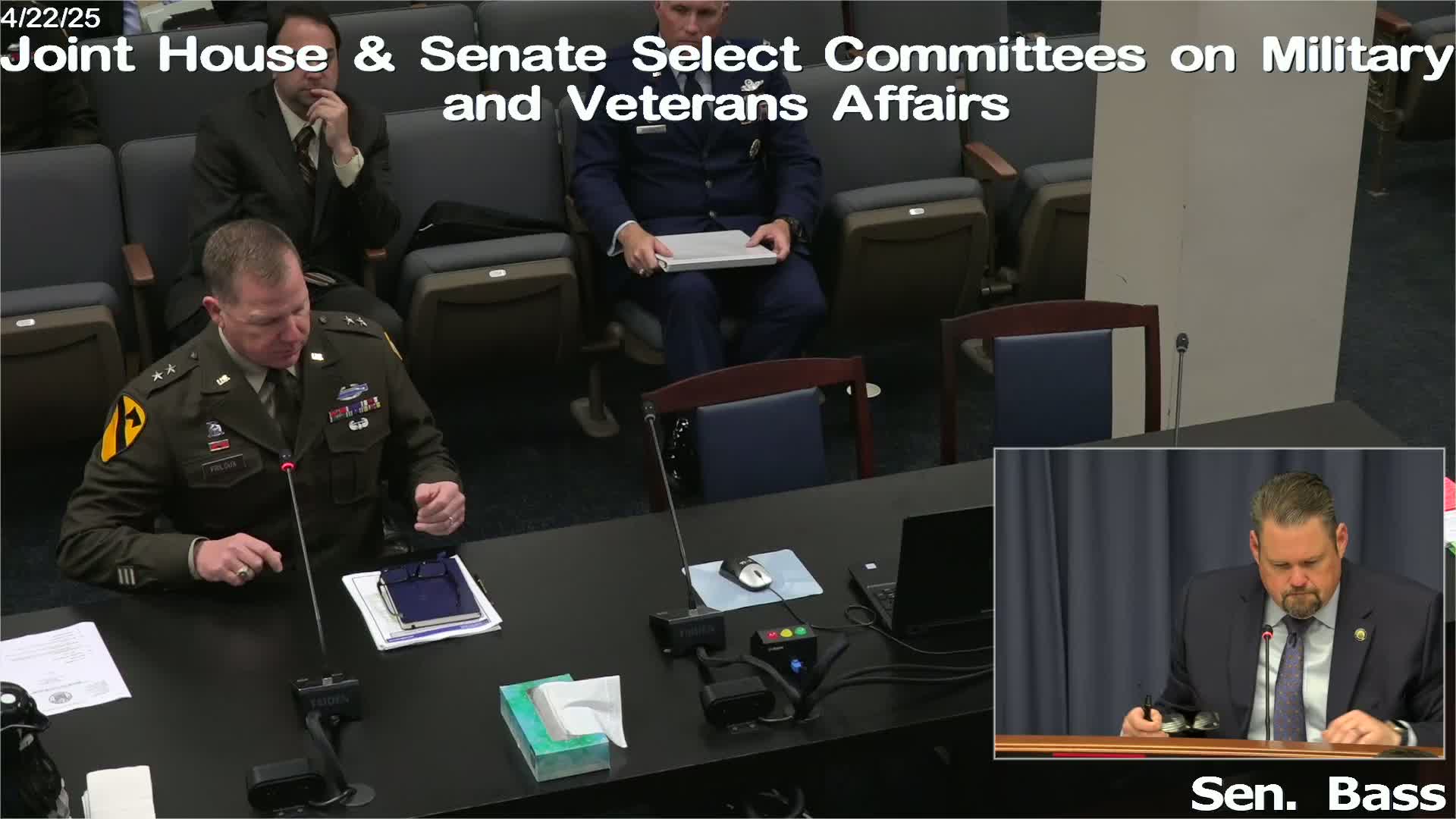
Major General Thomas Freeloo, the adjutant general of the Louisiana National Guard, told the Military and Veteran Affairs Committee that the Guard has adopted a 30‑year campaign plan called Lang 2052 to guide force structure, infrastructure and community programs.
Major General Thomas Freeloo, the adjutant general of the Louisiana National Guard, told the Military and Veteran Affairs Committee that the Guard has adopted a 30-year campaign plan called Lang 2052 to guide force structure, infrastructure and community programs.
Why it matters: Freeloo said the plan will shape long-term requests for federal and state funding and guide realignment of armories and installations, youth programs and all-hazards response. He also told the committee the department has assumed oversight of the Governor's Office of Homeland Security and Emergency Preparedness (GOSEP) and is conducting a 90‑day evaluation that will produce a written report for lawmakers.
Freeloo outlined eight strategic objectives in Lang 2052: campus-style armory realignments; installation mission alignment; guardsmen welfare and quality of life; force‑structure initiatives; diversified funding streams (federal, state and private); partnership relationships; all‑hazards response; and readiness. He said the plan rests on three lines of effort — “people,” “operations” and “infrastructure” — and that “The Lang 2052 campaign plan is gonna chart our course of our decision making in an era of great power competition.”
On installations, Freeloo described a shift away from many older readiness centers toward modern campus-style facilities clustered along major corridors such as I‑10 and I‑20. He said each major installation will get a primary mission to reduce redundancy: Jackson Barracks will remain the headquarters and be developed as a conference center; Training Center Pineville is intended to become a mobilization/force‑generation installation able to host brigade-level training; and the Gillis W. Long Center in Carville would be the consolidated center for Youth Challenge programming.
Freeloo said the Guard has already started construction work on ranges and training infrastructure at Pineville using in‑house engineers and expects that, once built to federal standards, federal sustainment funding will follow. He discussed force‑structure moves already under way, including relocating a roughly 22‑person cyber protection team from Baton Rouge to Bossier City as an initial step toward recruiting larger cyber units in the future.
On quality of life, Freeloo described a private‑public initiative run through the Lang Foundation to fund housing, health and recreation projects for Guardsmen and airmen. He said a developer has proposed a phased demolition and replacement at Jackson Barracks’ Area E, where more than 70 post‑Katrina houses originally intended as temporary remain in service, and would build about 20 new homes available at below‑market rent for service members.
GOSEP oversight and statutory change: Freeloo said the Louisiana Military Department began assuming oversight responsibilities for GOSEP about three weeks earlier and is conducting a methodical, 90‑day review of GOSEP operations; a report of findings will follow. He told the committee that moving GOSEP under the adjutant general’s authority requires a change in state law and that, for now, Brigadier General Mafous is the governor’s interim GOSEP director and will remain interim until either the legislature confirms him or the statute is changed.
Freeloo warned the committee that federal policy changes at FEMA could shift responsibilities to states and said the National Guard will proceed cautiously so as not to disrupt hurricane‑season operations. He said a new common operating picture leveraging ArcGIS and WebEOC will be phased into parish emergency operations centers to improve situational awareness and communications.
Committee members asked about recruitment and retention metrics, consolidation of Youth Challenge programs and protections for GOSEP’s civilian workforce. Freeloo said retention in the Guard is “in the mid‑eighties” and recruitment has improved; he said plans call for consolidating three Youth Challenge locations into Gillis W. Long over 15–30 years and for creating a state program to serve at‑risk youth who do not qualify for the federal program. On staffing, he said GOSEP employees remain largely the same and that legal, contracting and human resources functions are candidates for administrative merges to find efficiencies.
Next steps: Freeloo said the Lang 2052 plan will be reviewed every five years and used to frame future funding requests to the legislature and federal partners. He asked lawmakers to note that statutory change is required to formalize GOSEP’s reporting relationship and that the 90‑day evaluation will provide a basis for any recommended statutory adjustments.
Ending: The committee offered questions and asked staff to follow up on specific data requests, including recidivism and outcome tracking for youth programs and verification of shelter and homeless‑services inventories for emergency planning.