Get Full Government Meeting Transcripts, Videos, & Alerts Forever!
Get email alerts on the Electronic Surveillance topic
No spam. Unsubscribe anytime.
Senate committee advances bill making informant interview optional in wiretap orders
Summary
The Senate Committee on Judiciary B on Tuesday reported Senate Bill 53 favorably. The bill redefines "monitoring post," requires warrants to list the monitoring post location, and changes a judge's duty to require informants to appear from mandatory to discretionary, prompting privacy concerns from defense lawyers.
Senate Committee on Judiciary B reported Senate Bill 53 favorably after testimony from the bill's sponsor and law enforcement and objections from criminal defense advocates.
Senator Jeremy Bass sponsored SB53, which would revise parts of Louisiana's Electronic Surveillance Act to define a "monitoring post" as a secure Department of Public Safety and Corrections facility (including Louisiana State Police facilities) with investigative control over an interception, require orders authorizing interception to specify the monitoring post's location, and change a statutory requirement that judges must require informants to appear and be sworn from "shall" to "may."
The bill's sponsor, Senator Bass, said the change is intended to account for modern communications technology and logistical challenges in rural areas. "The way the current bill reads, it's really very little that we're trying to see changed," Bass told the committee, adding that small or rural parishes sometimes lack internet or suitable facilities and that allowing monitoring from a staffed state facility can reduce risks to officers.
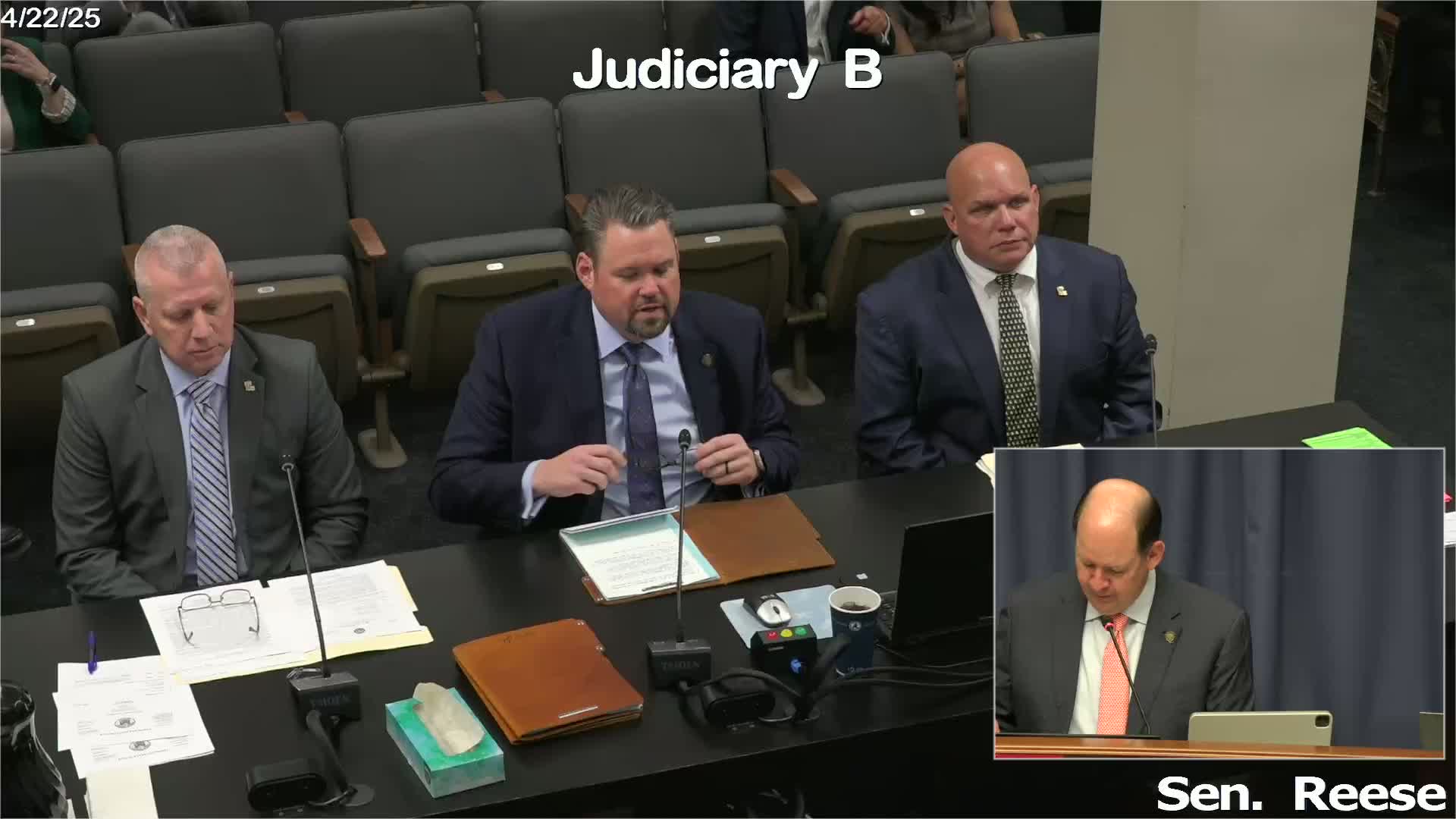
Two Louisiana State Police lieutenants, Glenn Younger and Heath Miller, joined Bass and answered technical questions about current practice and the monitoring-post definition. Younger described the proposed monitoring-post definition as enabling the state police to monitor from facilities they own, lease or operate when local infrastructure is insufficient.
Opposition testimony came from Lisonbee Adger of the Louisiana Association of Criminal Defense Lawyers, who argued the bill would "remove important privacy safeguards currently in the wiretap statute," stressing that the present law requires a judge to make an independent credibility determination of informants used to support wiretap applications. "This bill is a significant erosion of privacy rights under the Fourth Amendment of the United States Constitution and Article I, Section 5 of our own state constitution," Adger said, citing the distinction drawn in State v. Nessler that wiretap orders be treated more restrictively than ordinary search warrants.
Committee member Senator Jay DuPlessis said he was not opposing the bill in committee but voiced concern that changing "shall" to "may" would lower the statutory standard and shift credibility determinations away from an independent magistrate. Senator DuPlessis said he wanted language that would give him "a greater sense of comfort" before voting on the Senate floor.
Senator Talbot moved to report SB53 favorably; the committee voiced no objection and the bill was reported out of committee. The committee record shows supporters included the Louisiana Sheriffs' Association and the Louisiana State Troopers Association; the Louisiana Association of Criminal Defense Lawyers registered opposition and presented the testimony recorded above.
The committee's action was procedural: SB53 was reported favorably to the full Senate without a roll-call vote recorded in the committee transcript.
If enacted, SB53 would leave credibility determinations to judicial discretion while standardizing the monitoring-post definition and requiring the named monitoring location on any interception order. The bill's proponents said the changes would modernize the statute and address operational and safety concerns for investigators; opponents said the changes would weaken preexisting judicial safeguards for extraordinary surveillance orders.