Get Full Government Meeting Transcripts, Videos, & Alerts Forever!
Get email alerts on the Agriculture Gypsum Sb32 topic
No spam. Unsubscribe anytime.
Senate committee moves to approve bill allowing tested industrial gypsum for farm use
Summary
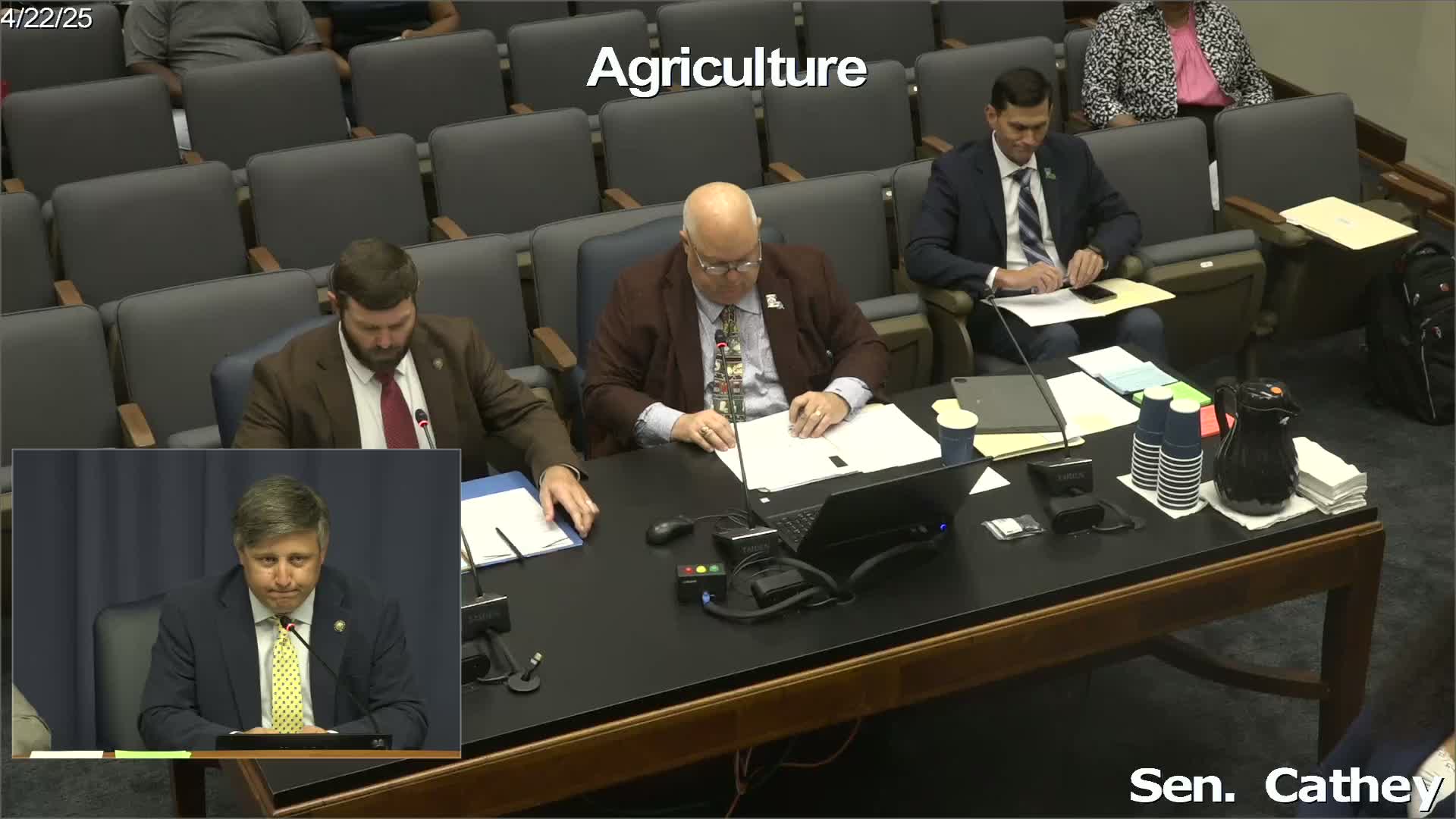
The Senate Committee on Agriculture on April 22 reported favorably on SB 32, a bill to allow certain industrial gypsum to be given free to farmers after testing and to shield farmers from civil liability when statutory conditions are met, supporters and the agriculture commissioner said.
Senator Lahn introduced SB 32 on April 22 to allow industrially produced gypsum to be provided free to farmers for use as a soil amendment if the material is tested and certified safe. "SB 32 is a way to help Louisiana farmers and manufacturing facilities," Senator Lahn said.
The bill would permit gypsum derived from industrial processes to be delivered to farmers at no cost after testing by an accredited laboratory for contaminants. Mike Strain, Louisiana Commissioner of Agriculture and Forestry, told the committee that gypsum is calcium sulfate and said it can address sulfur deficiencies in soils. "Gypsum has been used, as a fertilizer since ancient Greek and Roman times," Strain said, emphasizing both historical use and contemporary testing requirements.
Strain said sulfur is expensive and that, for sugarcane specifically, roughly 300 pounds of sulfur per acre every five years is typical and that approximately one ton of gypsum can supply that amount. He described testing steps the department would use, saying the material must be certified as calcium sulfate and cleared of contaminants such as heavy metals and volatile organic compounds. "The farmer shall not be held liable for any civil damages arising out of the use of gypsum if these requirements are met," Strain told the panel.
Strain cited LSU AgCenter research and collaborators (including named researchers in the presentation) showing yield improvements when gypsum is used on sulfur-deficient soils; he said proper use "can increase your yields up to 20%." Committee members heard that testing could require use of out-of-state accredited labs when the department laboratory is not accredited for the necessary analyses, and that some retesting might occur annually or every two years depending on the source.
Support for the bill was recorded on committee cards from the Louisiana Chemical Association (Patrick Riley), the American Sugar Cane League (Matthew Bradley) and the Louisiana Farm Bureau (Joe Mapes). The committee took the motion to report the bill favorably without recorded opposition; a committee speaker said, "Senate bill 32 will be reported favorably." The committee did not record a roll-call vote on the bill during this session.
The bill aims to reduce disposal costs for manufacturers that generate gypsum as a byproduct while providing an additional source of sulfur and calcium for farmers where soil tests show deficiencies. The committee indicated the measure would move forward; committee minutes and supporting testimony will reflect the record of the discussion and the organizations that filed cards in support.