Get Full Government Meeting Transcripts, Videos, & Alerts Forever!
Get email alerts on the State Budget Omb topic
No spam. Unsubscribe anytime.
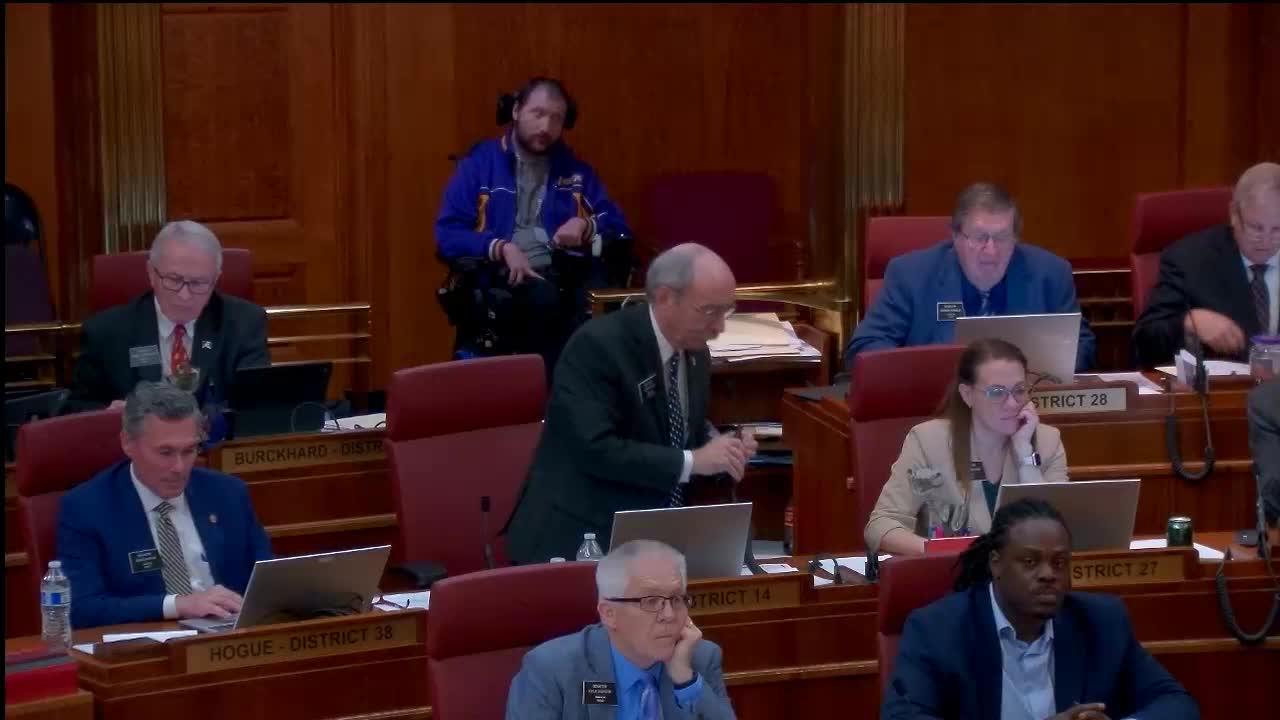
Senate passes OMB budget after rejecting 'life education' amendment; debate centers on state hospital and guardianship funding
Summary
The North Dakota Senate approved amended appropriations for the Office of Management and Budget (House Bill 10‑15) on April 22, 2025, after voting to remove a divided provision that would have created a $1 million "life education" committee. Final passage was 31‑16; the bill's emergency clause failed.
The North Dakota Senate voted to adopt amendments to House Bill 10‑15, the Office of Management and Budget appropriation bill, but rejected Division A — a provision that would have inserted a new "life education" committee and a $1,000,000 appropriation. On a roll call vote, Division A failed 23‑24; the remainder of the bill (Division B) and the amended bill ultimately passed on final passage, 31‑16, with the bill’s emergency clause failing.
The amendment package presented by Senator Tim Wojcik summarized multiple budget changes to OMB’s request, including a $110,114 custodial equity appropriation, replacement of $219,000 in rental revenue tied to changes on the 15th floor, a $1,000,000 increase for guardianship grants (raising base funding from $7.1 million to $8.1 million), a $4,000,000 pool for rent/moving/space reconfiguration, a one‑time $850,000 grant to Prairie Public Broadcasting, a retirement transfer incentive estimated at $959,904 for the biennium (44 employees electing a plan change), a $40,000,000 transfer to a statewide deferred maintenance fund, and revised funding for the state hospital of $285,000,000 (described as $200,000,000 from the Strategic Investment and Improvement Fund and $85,000,000 Bank of North Dakota line of credit). Wojcik said the package passed government operations 5‑0 and the full appropriations committee by a margin he summarized in committee votes.
Senator Janne Myrdal, identified in debate as the author of the life education language, defended the provision as aligning with an existing North Dakota Century Code policy (read in the chamber as "14 o 2 3.01" in the transcript) and described the measure as a public‑health education campaign to make people aware of services for mothers and children. "It's really a public health campaign that supports section 14‑02.3‑01 of our Century Code," Myrdal said. Myrdal said the language and procurement would be handled by OMB, which routinely manages state advertising procurements.
Senator Kevin Clemens moved to divide the amendment and remove Division A, arguing the provision was policy that should have been heard in a policy committee and through standard public notice and testimony. "When is the Appropriations Committee authorized to write bills or amendments without hearings or votes by the House and the Senate chambers? I feel this is in violation of our own rules," Clemens said. Several other senators — including Senator Brad Bechadel and Senator Cleary — raised concerns about transparency and the appropriateness of placing a policy matter as an amendment in an appropriations bill.
Opponents and supporters both emphasized process. Senator Bechadel (chair of Appropriations) acknowledged a lapse in the committee's usual practice: "To some degree, we've crossed that line. ... I'm gonna be one of the people that's going to support taking Division A out based on that myself." Senator Cleary said he feared the campaign could be used for political purposes beyond education and said he would vote against Division A for that reason.
Senators favoring inclusion argued the matter had been presented in committee hearings and that the proposal represented a small portion of the budget. Myrdal noted the amendment amounted to "0.005% of our budget" and framed it as continuation of longstanding state policy to support childbirth and related services. Senator Powers, while personally supportive of the policy, said he would vote against Division A because the process had not followed standard public discussion.
A recorded roll call on Division A ended 23 ayes, 24 nays; Division A was therefore removed. The Senate then voted on Division B (the remainder of the amendment package): that recorded tally was 32 ayes, 15 nays. Later, on the overall amended bill, the Senate recorded final passage of House Bill 10‑15, 31 ayes to 16 nays; the emergency clause failed. The chamber also recorded a verification vote earlier on the proposed amendment package (separate from the division vote) with a 25‑22 tally in favor of the amendment; the amendment's emergency clause failed in that vote.
Debate on the OMB package included extended discussion of the state hospital funding. Senators who worked on the hospital plan urged the chamber to fund a new, secure facility targeted to forensic and specialized psychiatric care. Senator Kathy Hogan, who said she has worked on the state hospital plan for four years, told senators the design targets people with significant psychiatric and forensic needs and stressed security and specialized care needs. Others, including Senator Mathern, urged caution on the total cost and stressed investments in community behavioral health services over the last two biennia.
On guardianship funding, Senator Lee argued the requested increase was aimed at addressing a waiting list of about 100 individuals in skilled nursing homes who lack guardians, and described current pay for guardians as "a little less than $20 a day." Lee warned that reducing the requested increase could exacerbate the backlog of cases.
Key funding and program figures mentioned in debate include: - Custodial equity: $110,114 to reduce turnover and close an average $1,800 annual pay gap for custodial staff. - Rent replacement for 15th Floor: $219,000 shift from special fund revenue to general fund to make the 15th floor legislative space rent‑exempt after House changes. - Guardianship grants: Senate increased House funding by $1,000,000, bringing total to $8,100,000 (requested was $9,100,000). - Space reconfiguration pool: $4,000,000. - Prairie Public Broadcasting: $850,000 one‑time infrastructure grant from SIF. - Retirement transfer incentive: 44 employees elected the transfer; incentive is $10,000 paid over three years (two payments fall in the 2025‑27 biennium), estimated cost $959,904 (amendment appropriated $1,000,000). - Statewide deferred maintenance: $40,000,000 transfer from SIF to a new state facility maintenance fund. - State hospital: amendment moved $285,000,000 (OMB-managed) consisting of $200,000,000 SIF and $85,000,000 Bank of North Dakota line of credit (the House had proposed $330,000,000; prior versions in other budgets showed different totals).
The Senate’s debate repeatedly separated questions of policy from appropriations and highlighted disagreements over committee process and where policy should be introduced. After the votes, the bill passed without Division A; the Senate adjourned to reconvene at 12:30 p.m. on Wednesday, April 23, 2025.
Votes (selected): Division A on proposed insertion of Section 14 — 23 ayes, 24 nays (failed). Roll call on Division B (remainder of amendment) — 32 ayes, 15 nays (passed). Final passage of House Bill 10‑15 — 31 ayes, 16 nays; emergency clause failed.
The chamber’s recorded debate and roll calls took place over multiple hours and included testimony and committee statements recorded in the public journal and the legislative audio/video record.