Get Full Government Meeting Transcripts, Videos, & Alerts Forever!
Get email alerts on the Land Use Rezone topic
No spam. Unsubscribe anytime.
Monroe County commissioners rezone most of Sunset Hill neighborhood, exempt one multifamily parcel
Summary
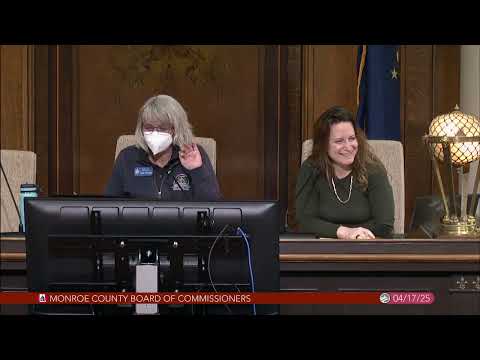
The Monroe County Board of Commissioners voted 2-1 on April 17 to rezone about 100 parcels in the Sunset Hill neighborhood from HD (High Development) to RES (Residential 1), while exempting one parcel that contains multifamily units.
The Monroe County Board of Commissioners voted 2-1 on April 17 to rezone roughly 100 parcels in the Sunset Hill neighborhood from HD (High Development) to RES (Residential 1), excluding a single parcel that contains multifamily units.
County planning staff told commissioners the change — ordinance 2025-11, also filed as REZ-25-1 — responds to neighborhood conditions including sinkholes, older homes on septic systems and a recent adoption of a historic-preservation overlay on 25 parcels.
Planning Director Christopher Myers told the board the rezone narrows permitted uses, increases minimum lot width and lot-size standards, and raises side and rear yard setbacks; most homes will remain legal, pre-existing nonconforming parcels unless or until a property owner seeks new development permits. Myers said staff and the county surveyor’s GIS analysis showed about two-thirds of lots would meet the RES impervious-cover standard as currently written, and staff noted a separate pending ordinance could relax that standard countywide.
Supporters who live in Sunset Hill said the neighborhood is environmentally sensitive, historically significant and contains longstanding single-family households that value larger lots and home-based food production. Susan Brackley, a property owner who described the area as a “depression-era working-class village,” said she has filed for state and national historic-register consideration.
Opponents led by Christopher M.G. of the Greater Bloomington Chamber of Commerce argued the rezoning reduces housing capacity in an urbanized area and could limit smaller-footprint or innovative housing solutions.
County attorney and staff clarified process questions raised during debate: the Planning Commission had forwarded a positive recommendation with one condition to exclude the multifamily parcel at 717–725 South Annalee Lane, and legal staff reminded the board that, as the applicant for this rezone, the commissioners could amend the petition but were not required to do so.
Commissioner Thomas voted with Commissioner Jones to approve the ordinance as recommended by the Planning Commission with the single-parcel exemption; Commissioner Madera cast the dissenting vote.
The ordinance changes zoning design standards and use tables in the county development ordinance; planning staff noted conditional uses would still require public hearings before the Board of Zoning Appeals.
The board set no immediate additional implementation date in the meeting; planning staff said the change would be reflected in county zoning maps and that owners seeking development permits would continue to be subject to the updated design standards and any nonconformity rules.