Get Full Government Meeting Transcripts, Videos, & Alerts Forever!
Get email alerts on the K 12 Schools topic
No spam. Unsubscribe anytime.
Senate approves new intervention powers for chronically low‑performing districts; Shelby County cited as primary example
Summary
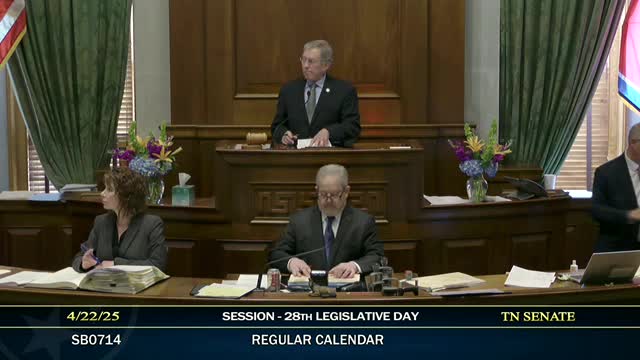
The Senate passed Senate Bill 7 14 on third and final consideration, a package of interventions that gives the state new authority to act when a local district meets a set of performance and poverty thresholds. The motion carried 26‑6.
The Senate passed Senate Bill 7 14 on third and final consideration, a package of interventions that gives the state new authority to act when a local district meets a set of performance and poverty thresholds. The motion carried 26‑6.
The bill defines a “challenged” district as one that (1) has at least 50% of students classified as economically disadvantaged, (2) fails expectations in math and English, and (3) has at least one school on the Department of Education’s priority list for five of the last lists. If a district meets those tests the commissioner of education may recommend or, with the Board of Education’s concurrence, remove the director of schools and seek replacement appointments. The measure also allows the county commission and county mayor greater authority in certain replacement actions and directs the creation of a 9‑member oversight/advisory board to review district needs assessments, major contracts and transformation plans.
The bill removes the income cap for the state education savings account (ESA) program for students zoned to qualifying “challenged” districts, making more students eligible for ESAs in those districts, and it expedites and expands charter conversion authority for designated schools.
Sponsor Senator Taylor said the measure was designed as a “cascade” of interventions that starts locally but gives state and local leaders additional options when improvement fails. “This is about putting in place a list of cascading interventions for a school district that meets the criteria…not the state coming in and taking over, but empowering local governments and giving them the resources and guidance they need,” he said.
Opponents — including Senators Lamar, Yarbrough and Oliver — said the bill improperly removes local control, risks constitutional questions about appointed versus elected officials and will increase costs for local governments who must staff and fund the new advisory board. Senator Lamar said the proposal would “create more bureaucracy” and argued community problems that affect education are broader than governance changes. Senator Yarbrough raised legal and equal‑protection concerns and said the bill singles out one county’s students for different treatment.
The legislation creates specific duties and compensation rules for the oversight board (members are to be paid the same rates as local school board members), requires the board to produce a comprehensive needs assessment and a district transformation plan, and to read its comments on the local school board agenda into the public record. The measure includes provisions about review of contracts above a $50,000 threshold and reporting on underused properties.
Senator Taylor said the bill pairs the statutory interventions with a forensic audit funded in this year’s budget and argued that prior experiments (he cited the Achievement School District) had failed and warranted a different approach.
Where it stands: The Senate adopted the bill on third and final consideration; the clerk recorded the final vote as 26 in favor and 6 opposed. The bill now proceeds to the next legislative steps for transmittal to the other chamber or enrollment as appropriate.