Get Full Government Meeting Transcripts, Videos, & Alerts Forever!
Get email alerts on the Pensions Sb1049 topic
No spam. Unsubscribe anytime.
PERS says major 2019 pension reforms implemented; agency outlines costs and effects
Summary
The Public Employees Retirement System told the General Government Subcommittee that implementation of Senate Bill 1049 (2019) is complete and summarized the program elements, costs (about $77.8 million total), and how the changes affected employer contribution rates.
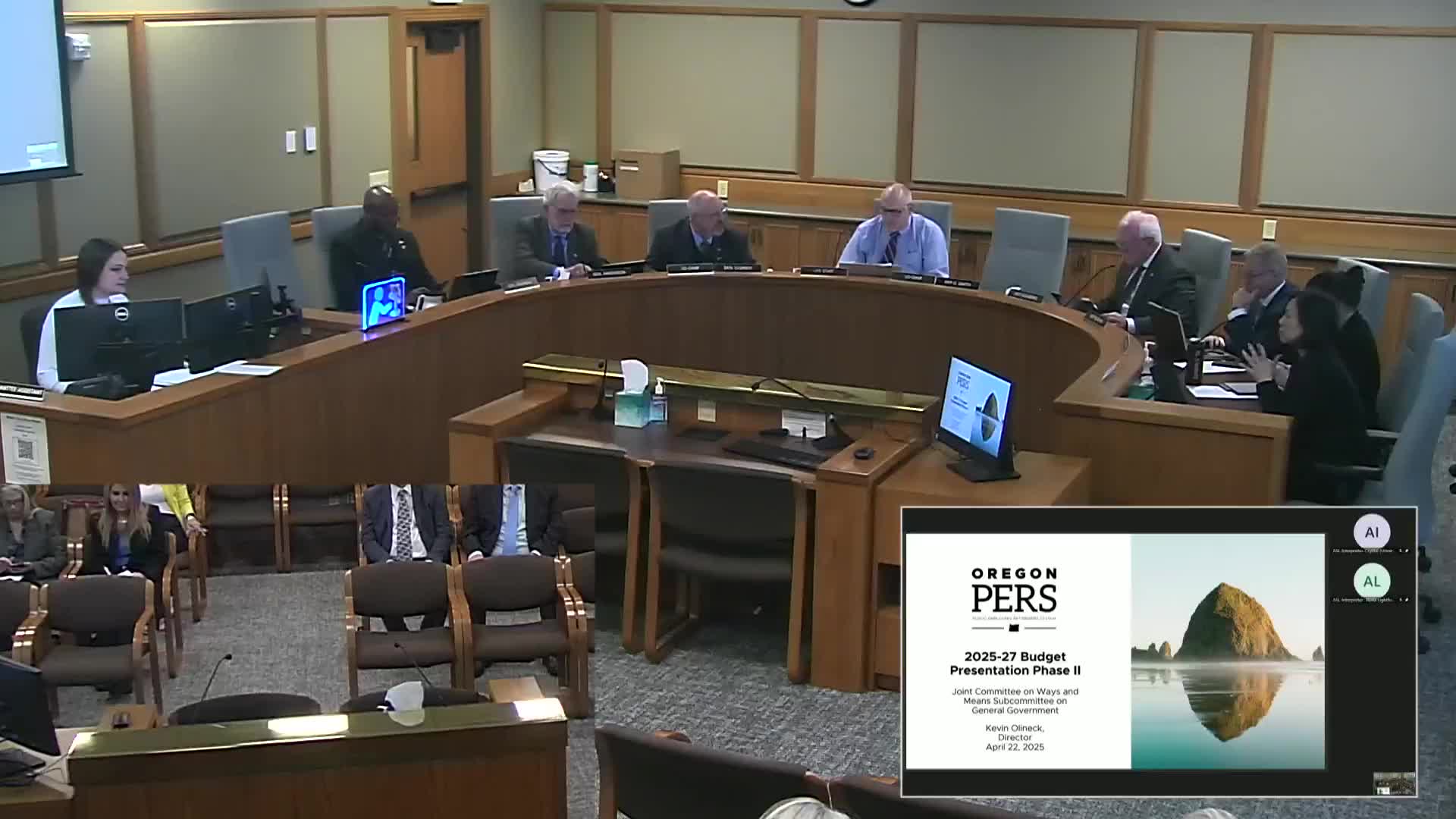
The Public Employees Retirement System told the General Government Subcommittee of Ways and Means on April 22 that implementation of the package of changes enacted in Senate Bill 1049 (2019) is complete and described how the work was organized and funded.
PERS Director Kevin Olynyk said the agency divided SB 1049 into multiple concurrent projects — including employer incentives, salary caps for benefit calculations, changes to work-after-retirement rules, member redirects to fund defined benefits, and the creation of individual account program (IAP) target-date funds — and ran them as parallel work streams with project- and program-level oversight. "As of last Thursday night, we did our final implementation. So all the implementations with respect to Senate Bill 10 49 are complete," he said.
The agency told the subcommittee the bill produced several discrete streams of work. Among them: employer incentive funds that matched employer deposits into side accounts, salary limits that change which earnings count toward final average salary, removal of some limits on work after retirement (with employers effectively paying a proxy contribution on returning employees), and member IAP choice with 10 target‑date investment funds. The agency also reamortized unfunded actuarial liabilities for Tier 1 and Tier 2 over a 22‑year period, which the agency described as a deferral of payments analogous to stretching a mortgage to lower near‑term payments but shift costs forward.
PERS presented a program-level funding summary showing roughly $68,000,000 in external allocations for the various projects and about $8,800,000 in internal resource costs, yielding a stated total of approximately $77,780,000 for the SB 1049 implementation work (director Olynyk; slide referenced). The agency also reported that about $649,000,000 flowed into side accounts as a result of the employer incentive fund and a $100,000,000 General Fund contribution in 2019.
On employer contribution rates, the agency presented before/after estimates from external actuaries and staff updates. Olynyk said reamortization of Tier 1 and Tier 2 liabilities produced the largest single effect on employer rates; other elements—work after retirement and salary limits—had smaller effects. He said the member redirect impact measured about a 1.0 reduction (down from 1.2 in earlier estimates) because the composition of active members shifted toward those in OPSRP, which altered the weighted offsets.
Representative Reschke pressed whether all the subprojects were foreseen when the bill passed; the director said the work became immediately apparent as complex and was managed via parallel project teams, project managers and shifting resources to meet implementation timelines.
The agency said Gartner provided independent quality assurance and quarterly reviews; a final lessons‑learned report was pending. Director Olynyk and staff said they would apply lessons from SB 1049 to upcoming work tied to House Bill 4045 and the PERS modernization program.
Less critical details include that some implementation tasks addressed general ledger and unfunded actuarial liability accounting flows, and that internal staff effort accounted for roughly 130,000 hours of work (agency estimate).