Get Full Government Meeting Transcripts, Videos, & Alerts Forever!
Get email alerts on the State Compensation Salary Study topic
No spam. Unsubscribe anytime.
House Finance committee reviews statewide salary study; Segal finds most ranges near market but notable gaps in several occupations
Summary
State officials and Segal presented a statewide salary study on April 21, 2025, finding that most benchmark pay ranges are near market medians but that specific job families show consistent shortfalls; the Department of Administration says it will develop a project plan to prioritize fixes.
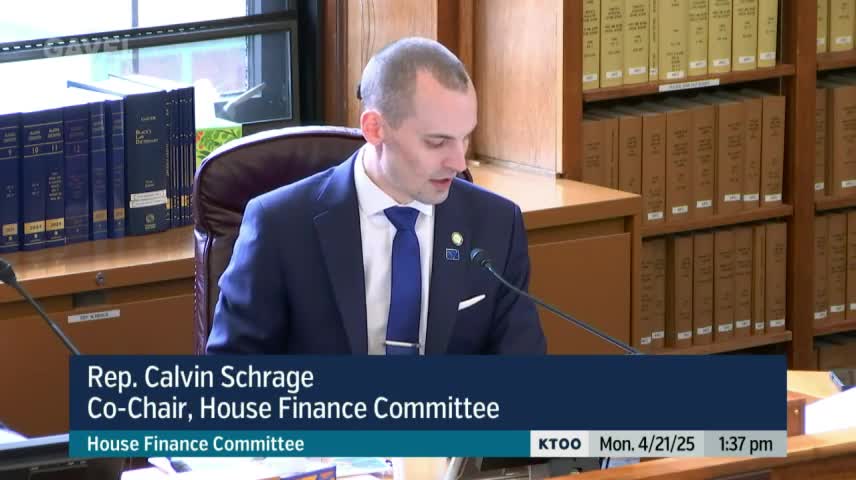
Juneau — The Alaska House Finance Committee on April 21 heard a presentation of a statewide salary study from the Department of Administration and consulting firm Segal that found most formal pay ranges lie close to market benchmarks but identified several occupational groups and individual benchmark jobs that are consistently below market.
The study, compiled by Segal and presented to the committee, compared the state's formal base pay structures for 404 benchmark jobs to public- and private‑sector peers and reported that 72% of employees in benchmark jobs were at or above the market 50th percentile and 57% were at or above the 65th percentile. "This study does not recommend specific pay increases," said Paula Varrana, Commissioner of the Department of Administration. "Rather, it is an important informational tool that gives state leadership a data‑rich foundation for strategic compensation planning."
Segal's presenters and department officials told lawmakers the analysis is intended to guide workforce and budget decisions and to point to where more detailed work is needed. "We began this work in 2024 and all of the compensation data in our report is effective 01/01/2025," Segal senior vice president Patrick Bracken said. He and Segal vice president Mike Verdorn described the firm's methodology and data sources to the committee.
At a glance: major findings and scope
- Scope and data: Segal analyzed 404 benchmark jobs identified by the state; it reported sufficient peer-match data for 384 of those positions. Where fewer than five peer matches existed for a benchmark job Segal excluded that job from the percentile comparisons; Segal said 20 benchmark jobs lacked the five‑match threshold.
- Market comparisons: Segal compared Alaska's pay-range minimums, midpoints and maximums to both the market median (50th percentile) and a leading-market point (65th percentile). For the combined public/private dataset the study reported Alaska pay ranges as roughly 97% of the market minimum, 96% of the midpoint and 103% of the maximum when compared with the 50th percentile; comparisons to the 65th percentile showed larger gaps (about 92% at minimum and 91% at midpoint).
- Response rates and survey work: Segal said it surveyed 68 peer employers and achieved a 62% overall response rate; public sector participation was stronger, about 77% for that subset. To supplement limited private‑sector responses Segal used published private‑sector salary surveys and databases (CompAnalyst/CompAnalyst-like sources, Payfactors, Economic Research Institute and others) and an Alaska compensation survey purchased by the state.
- Adjustments and quality controls: Segal applied standard data adjustments (an annual 4% aging factor to align disparate effective dates to 01/01/2025); geographic cost‑of‑labor adjustments to translate peer pay into an Anchorage‑equivalent market; work‑week adjustments for FLSA nonexempt roles; and a 75% job‑content match rule for job matching. Segal also described manual review and follow‑up with respondents to clean and validate matches.
Which jobs are most below market
Commissioner Varrana and Segal highlighted several occupational families and specific job families that trended below market across comparisons. Varrana said the families that ‘‘were consistently below market’’ included economic research, fish and wildlife, special social services, statistics and research analysis, physical science specialists, and aircraft/automobile/vessel maintenance. Law enforcement, firefighting, corrections, legal/judicial and craft/labor groups were cited as generally at or above market.
Lawmakers pressed Segal for details about how the data were collected and which peers were used. Segal said the peer group was expanded during the engagement in response to requests from the state and that Segal relied on a mixture of direct custom surveys of peer public employers and published private‑sector survey sources. Segal said it obtained additional peer employer data at the state's request and that private‑sector participation is commonly limited, which is why published survey sources are used to represent private market pay.
Policy and technical recommendations
Segal recommended that the state consider adopting a formal compensation philosophy and modernizing pay structures. Specific ideas included occupational family groupings, clearer minimum‑midpoint‑maximum definitions, consistent range spreads, defined pay progression logic, supervisory differentials and targeted incentive options. Segal recommended a refreshed, comprehensive market study at least every three years and more limited market refreshes in intervening years.
Department next steps
Commissioner Varrana told the committee the Department of Administration will prepare a project plan to examine the study findings in detail, prioritizing job families with pay ranges 10% or more below market. "We will review findings by job family to determine if a salary adjustment is indeed warranted," Varrana said. Acting Division of Personnel Director Camille Brill said the department's limited classification staff will use the study to target limited resources and return with implementation proposals; Varrana said the department hopes to present an actionable plan in time to inform the FY27 budget cycle but did not specify dates.
Health benefits, retirement and total compensation
The study examined base pay, paid time off and health insurance value. Segal consultant Richard Ward explained that health benefit comparisons used public‑ and private‑sector data sources and were adjusted for geographic differences in health‑care costs; Segal reported the health‑benefit value for Alaska as modestly above comparable benchmarks after geographic adjustments. Segal and lawmakers agreed that retirement benefits and other total‑compensation elements affect competitiveness; Segal noted the study focused primarily on pay structures and leave and that retirement system evaluation is handled by the Division of Retirement Benefits and the Legislature.
What lawmakers asked and what remains to be done
Committee members repeatedly asked for more granular detail on the largest ("highly populated") benchmark jobs — defined in the report as those with more than 100 incumbents — where Segal reported a lower share of employees at or above market (for example, when compared to the 65th percentile only 17% of employees in highly populated benchmark jobs were at or above the market point Segal used). Members also pressed for documentation on peer selection, private‑sector participation and the 20 jobs excluded for insufficient peer matches; Segal said the excluded jobs are listed in the report and in detailed match sheets provided to the state.
The department said the study gives officials a prioritized list of where to direct limited classification resources; Varrana said the project plan will set timelines and resource needs and that the department will return to the Legislature with specifics as those options are developed.
"This study will enable a robust discussion about compensation and workforce planning," Varrana said. "Ultimately, this study reinforces the importance of improving pay structures, addressing gaps where they exist, and refining our compensation systems to best attract, retain, and reward a high quality state workforce."