Get Full Government Meeting Transcripts, Videos, & Alerts Forever!
Get email alerts on the Gaming Regulation topic
No spam. Unsubscribe anytime.
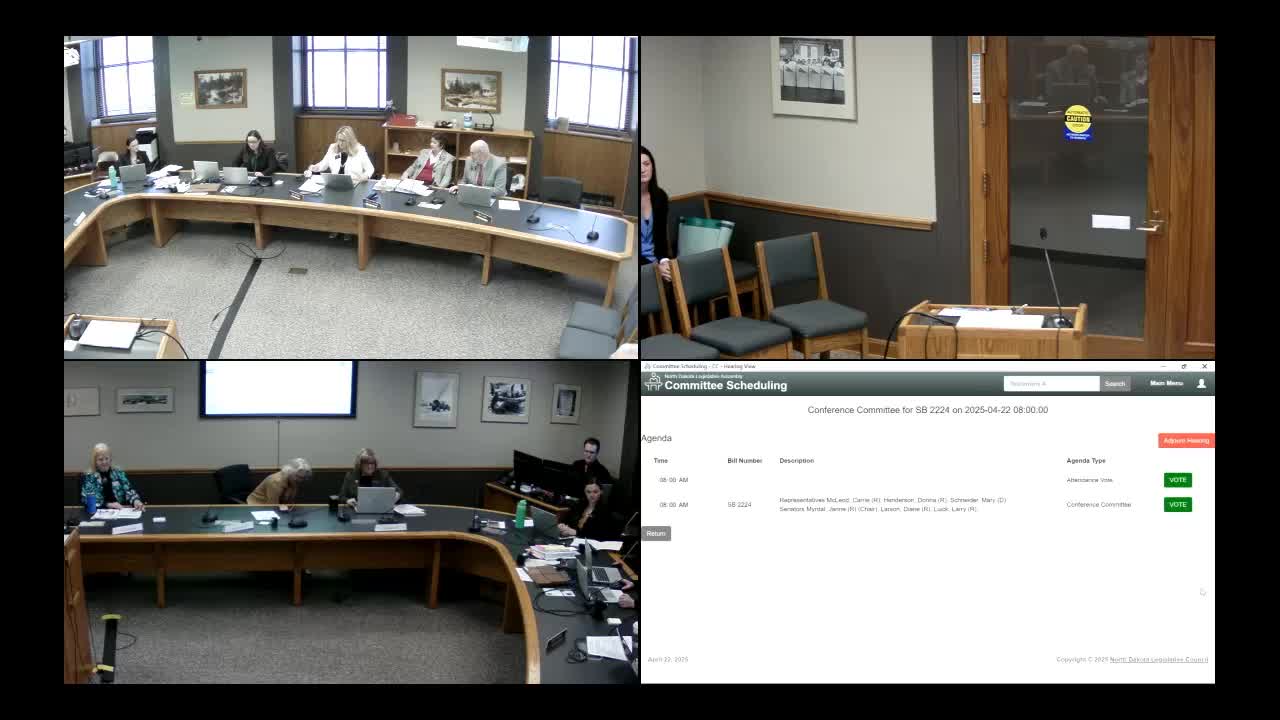
Conference committee debates timeline, hearings language in Senate Bill 22-24 after Senate ‘do not concur’
Summary
A conference committee discussed Senate Bill 22-24, which would alter how charity gaming enforcement and the gaming commission are handled. Senators objected to added timelines and hearing requirements in two sections on page 7; the committee agreed to reconvene to attempt wording changes.
Chair Muehrdle opened the conference committee on Senate Bill 22-24 and noted “we have a do not concur from the Senate on the latest amendments to 22 24,” saying members should discuss the Senate’s objections.
The bill began in the Senate as a measure to eliminate the gaming commission after the panel “wasn't functioning” for several years, committee members said. Representative McCloud, identifying amendments added in the House, said the committee adopted changes proposed by Representative Koppelman and included some language from Senator Murdall.
Senator Larson told the committee he objected to two provisions on page 7, saying the sections “are directing, monetary fines and saying that, the attorney general shall hold hearings, and, the and time limits when all of these things have to happen.” Larson argued those requirements put “the thumb on an agency” by prescribing how the attorney general must conduct those hearings, and he recommended removing sections 2 and 3 on page 7.
Representative Henderson defended the House amendments as an effort to provide clearer timelines because “in the current process it just wasn't spelled out clear enough and there weren't timelines.” Other committee members said the changes were intended to speed resolution for charities and related parties who the sponsors said have waited “way too long.” Representative McCloud attributed the call for timelines to conversations with Representative Koppelman and said the gaming industry had requested a minor wording change from Representative Christiansen.
Supporters of the House language said the amendments also streamline the administrative process, moving quicker review toward district court and giving the attorney general more immediate control. Representative Schneider said the bill “remov[es] the whole administrative process, which is many steps and a long process, and moved it right into district court and off the desk of the attorney general and out of the attorney general's office,” arguing that the change would make the remedy quicker.
Opponents, including Senators Larson and Lueck, said the commission has largely functioned for decades and that one recent incident does not justify broad statutory changes. Senator Larson noted the committee had found “0 in 29 years” of appeals and questioned whether imposing fixed statutory timelines and live-broadcast requirements was necessary.
The committee discussed other statutory elements in the bill, including language on quarterly meetings and recorded hearings. Committee members acknowledged that some of those matters could be handled by administrative rule but said they were not opposed to codifying them in statute.
With no formal agreement reached, committee members agreed to schedule another meeting quickly to try to resolve wording concerns between the House sponsors, the attorney general's office, and gaming-industry stakeholders. Chair Muehrdle said she would set another meeting and adjourned the committee.
Votes and final outcomes were not taken during the session; the chair reported only the Senate’s “do not concur” status and the committee’s decision to reconvene.