Get Full Government Meeting Transcripts, Videos, & Alerts Forever!
Get email alerts on the Opioid Settlement Study topic
No spam. Unsubscribe anytime.
Vertex representative asks Senate committee for study of opioid-settlement funding and alternatives to opioids
Summary
Vertex Pharmaceuticals requested that the legislature consider study language to examine how opioid settlement funds are being used for prevention and education and to assess non-opioid alternatives for pain management; the behavioral health division explained the role of the opioid settlement committee and statutory limits on spending.
A representative of Vertex Pharmaceuticals asked a Senate committee to include study language examining the state's use of opioid settlement funds and how those funds are used for education about alternatives to opioid prescriptions.
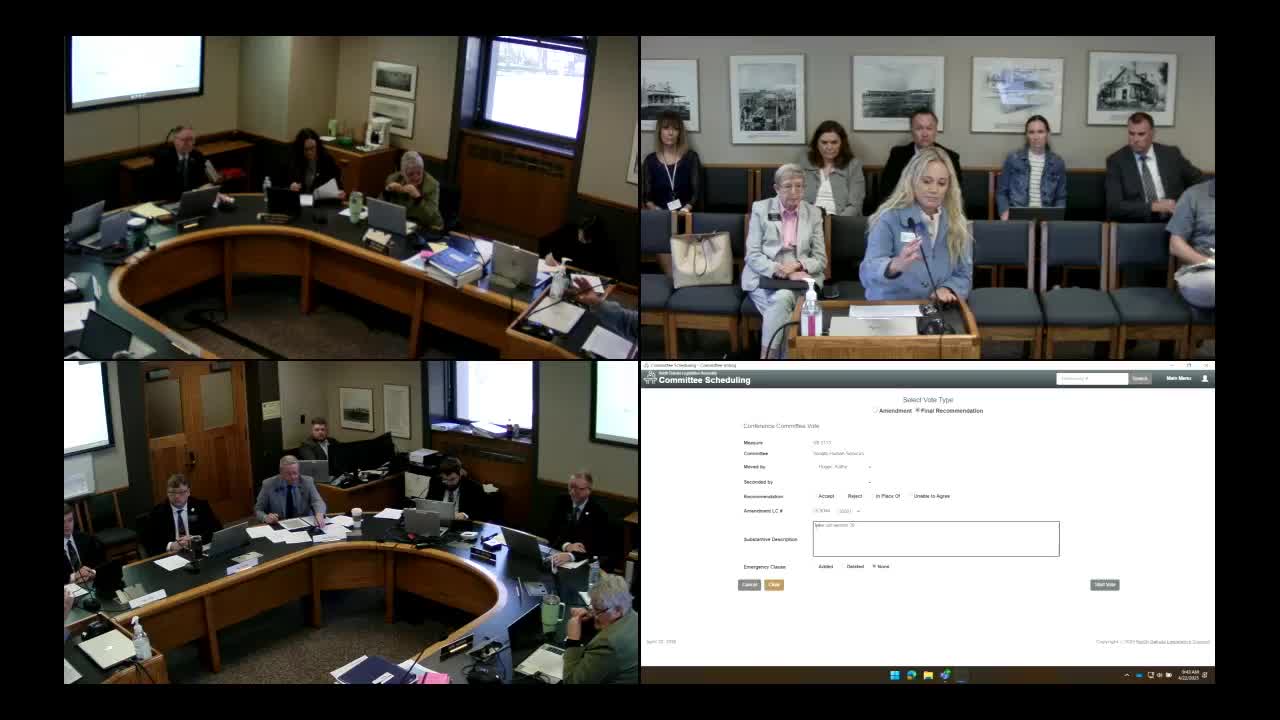
Lacey Anderson, representing Vertex Pharmaceuticals, told the committee her company "manufacturers a non opioid that solves severe pain, issues" and asked lawmakers to consider study language to review what the opioid settlement fund is doing and how it educates clinicians and patients about non-opioid treatments. Anderson said the company's drug was recently FDA approved and the proposed study would look at the broader picture of available alternatives and education efforts.
Laura Anderson, policy director for the Behavioral Health Division, described how the opioid settlement process works in state law: "The opioid settlement committee, which is established in century code, provides recommendations on how that opioid settlement funding is to be utilized. And so they provide recommendations to the behavioral health division and the department, and then we are the ones who grant out the funds." She noted that settlement spending must follow "exhibit E of the settlement" and that state law requires a minimum of 20% of opioid settlement funds each biennium to be focused on prevention.
Committee members questioned whether a separate legislative study would duplicate work already underway through the settlement committee and through existing grant processes. One senator said the study might be redundant given the settlement committee's current recommendation and grant-award procedures; another said legislative management could consider combining this study with other proposed studies. The behavioral health official responded that a legislative study "could potentially change the way the opioid settlement committee would identify how we distribute the funding," but said it was hard to predict the effect without specifics about the study's scope.
No formal committee vote was recorded on creating a study; members indicated a willingness to consider the request and noted logistical questions about how the study would fit with nearly 20 other proposed studies mentioned on the record. A motion related to the study language was discussed during the hearing, and the record shows the committee closed the hearing thereafter.