
House committee debates Port of New Orleans road authority, St. Bernard officials oppose bill
Get AI-powered insights, summaries, and transcripts
Sign Up Free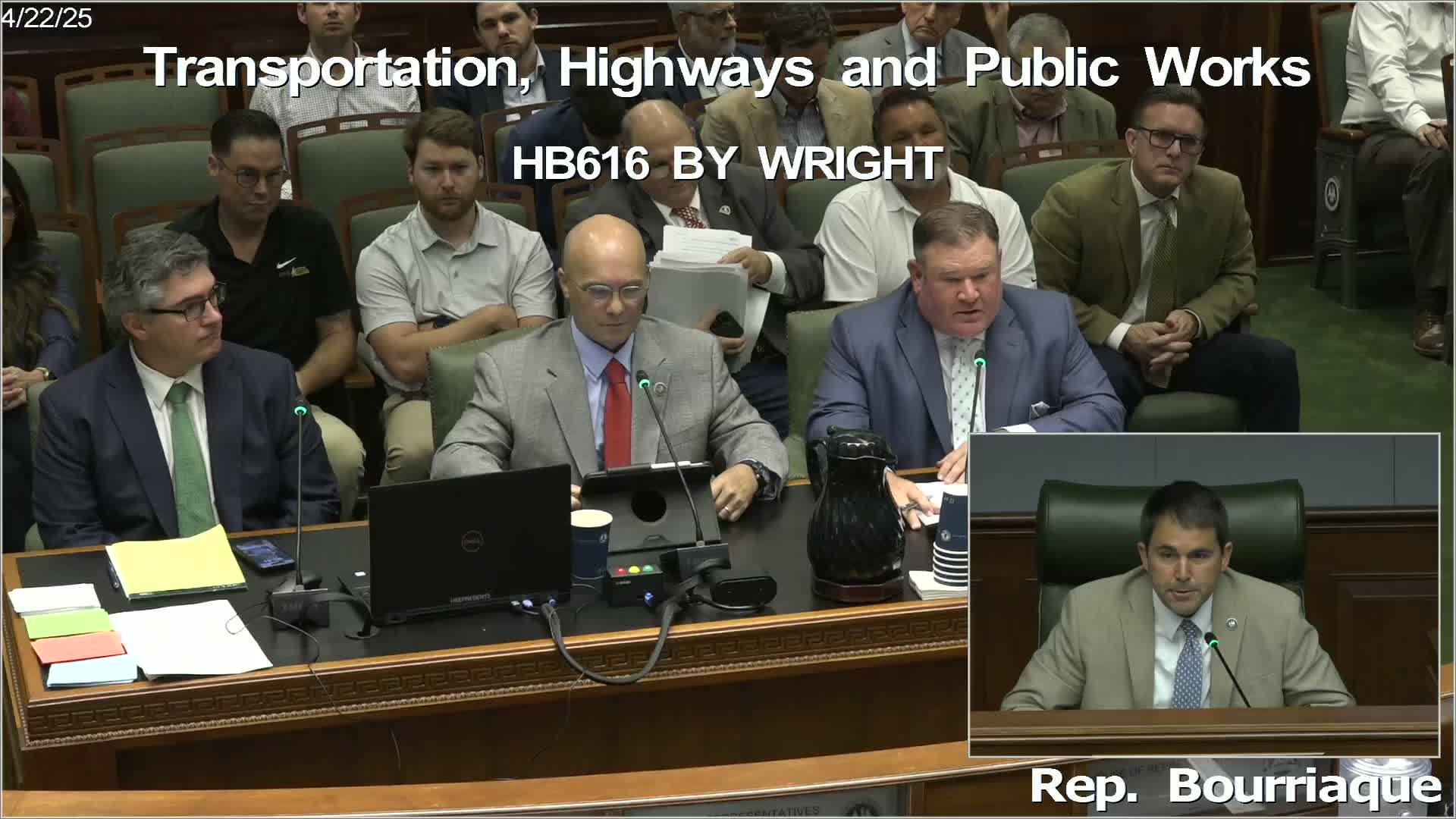
Summary
Representative Wright presented legislation to establish a public–private procurement process for a roadway tied to the proposed Louisiana International Terminal; port and economic‑development officials supported the measure while St. Bernard Parish leaders warned it would give the Port of New Orleans excessive authority and risk property takings.
Representative Talented Wright presented House Bill 6 16, a bill to authorize a procurement and public–private partnership process for construction of a dedicated roadway tied to the proposed Louisiana International Terminal. Supporters said the measure sets an established P3 procurement path for a project that already has state and federal commitments; opponents, largely from St. Bernard Parish, said the bill would strip local control, risk property expropriation and was being rushed while litigation over the terminal remains pending.
Proponents told the House Transportation Committee the legislation is procedural and designed to align the road procurement with private investors and state partners so construction can coincide with the terminal. Chris Kane, representing the Port of New Orleans, said the bill “puts in place a process that allows the P3 market to understand how we're going to move forward with the procurement.” John Paul Escojay, executive counsel for the port, said the port’s existing enabling statutes are broad but the P3 framework helps attract private partners and provides certainty for financing and delivery.
Local officials from St. Bernard Parish urged the committee to reject or rework the bill. Representative Richard Baham submitted resident e-mails and said, “This is imposing something on a parish that the people of Saint Bernard do not want.” Multiple parish officials — including the parish council member who said he represents “at large west” — and the parish district attorney described ongoing litigation with the port and the presence of an active elementary school within parts of the port’s mapped property footprint. District Attorney Perry Nicosha said litigation over jurisdiction and school‑board interests is pending and warned the bill could be used in court to justify expropriation: “Don’t let them expropriate this land,” he said.
Speakers also differed on economic projections. Port supporters cited a market and economic analysis that projects state and local tax revenues and job growth if the terminal and its access road are built. Opponents pointed to unpaid questions about rail access, exact corridor routing and what they called inadequate local consultation. Several St. Bernard witnesses said they had not seen the amendments until shortly before the hearing and asked for more time and clearer routing before the Legislature acted.
The committee heard dozens of in‑person statements and read multiple letters into the record both in support and opposition. After debate the committee considered competing motions: a motion to defer and a substitute motion to report the bill with amendments. On roll call the substitute motion failed and the bill remained in committee. The clerk recorded four yeas and eight nays on the motion to report the bill out of committee; the committee therefore took no further action on the bill at this hearing.
Why it matters: supporters say the road and terminal together are needed to keep Louisiana competitive with other Gulf ports and to avoid traffic and operating inefficiencies if the terminal is built without a dedicated access corridor. Opponents say the bill, as written, gives the port overly broad tools that could override parish authority and lead to property takings in Saint Bernard Parish without sufficient local input and mitigation.
Next steps: the bill remains in the House Transportation Committee. Committee members and witness groups said they expect further negotiation and asked the author and port representatives to continue consultation with St. Bernard officials and other local stakeholders before any future committee or floor action.