Get Full Government Meeting Transcripts, Videos, & Alerts Forever!
Get email alerts on the Privacy Revenge Images topic
No spam. Unsubscribe anytime.
House approves amendment and advances bill criminalizing nonconsensual intimate and AI‑forged images
Summary
The South Carolina House adopted an amendment to House Bill 30 58 and gave the measure a second reading. The bill would create criminal penalties for sharing intimate images or digitally forged intimate images without consent, including provisions addressing AI‑generated content and gradations of felony and misdemeanor penalties.
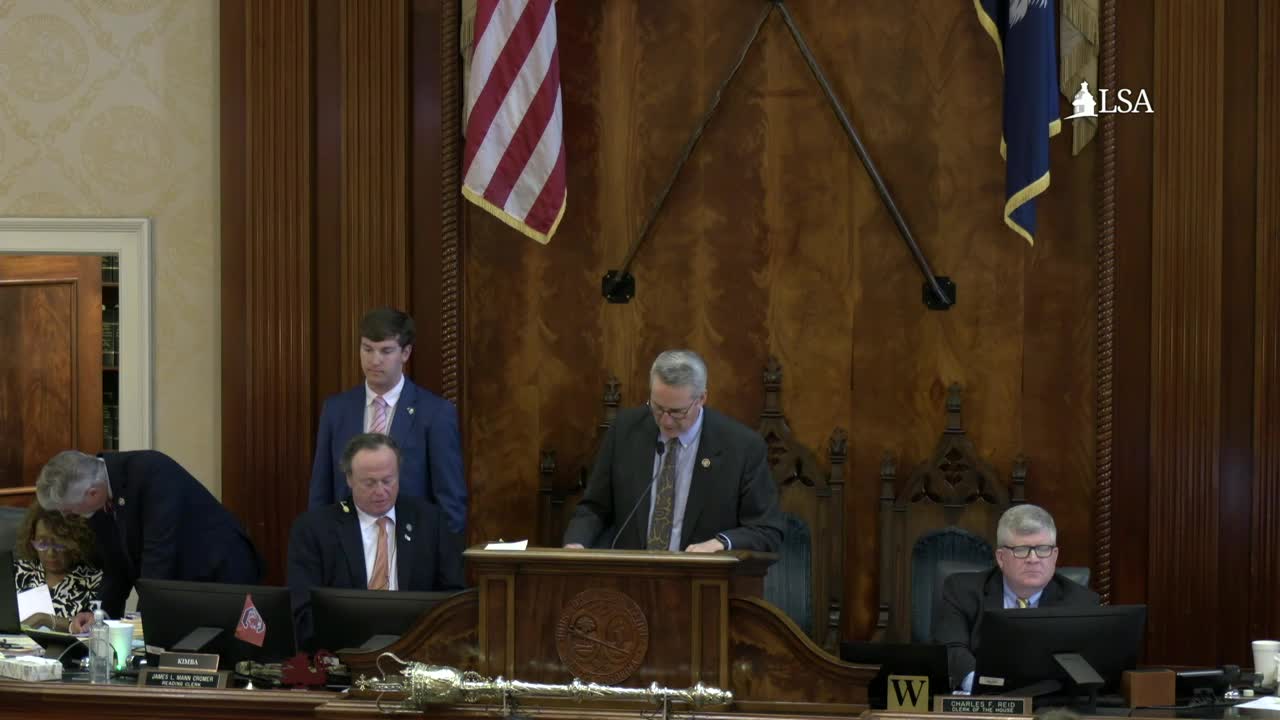
The South Carolina House on the floor adopted an amendment to House Bill 30 58 and advanced the measure to a second reading after debate on definitions, intent and penalties.
House Bill 30 58 would create criminal penalties for the intentional dissemination of intimate images or digitally forged intimate images without the effective consent of the person depicted, including images altered or generated using machine learning. The bill’s sponsor explained the proposal as a tool to address so‑called "revenge ****." "H 30 58 introduces new criminal penalties for the intentional dissemination of intimate images or digitally forward intimate images without the consent of the person depicted," the sponsor said on the floor.
The committee amendment adopted on the floor (amendment 1) makes several substantive changes: it treats multiple images distributed as part of a common act as a single criminal offense (to avoid stacked penalties); clarifies the consent requirement and bars a victim’s prior sharing of an image from serving as a defense; and distinguishes felony versus misdemeanor charges based on the defendant’s intent. As explained on the floor, the amendment makes the unauthorized dissemination of intimate images a felony if done "with the intent to cause physical, mental, economic, or reputational harm or for financial gain," while cases lacking such intent are misdemeanors for a first offense. The sponsor summarized penalties in committee and on the floor: first‑offense felonies could carry "up to 5 years in prison, $5,000 fine," second felonies would carry higher ranges (minimum 1 to maximum 10 years and fines up to $10,000), and certain misdemeanors could carry up to 1 year in jail or fines.
Representative Rutherford asked for clarification about legislative intent and existing charging practices, saying he supported the amendment but was concerned that debate not be read to suggest prior prosecutions under other statutes were improper. In response the sponsor said the intent was to provide a clearer statutory tool for prosecutors and law enforcement, not to retroactively cast doubt on earlier prosecutions.
Procedural outcome: amendment 1 was adopted on voice vote and House Bill 30 58 received second reading; a roll call was required for the second reading and was conducted. The transcript records the amendment adoption and the bill receiving second reading; specific roll call tallies for the second reading are not specified in the transcript.
Why it matters: The sponsor said South Carolina was the only state in the nation without a targeted criminal statute addressing nonconsensual dissemination and that the bill is designed to fill that statutory gap while accounting for recent technological advances in digitally forged and AI‑generated images. The bill includes an exception for law enforcement making images during lawful criminal investigations.
Next steps: The bill will proceed toward third reading and additional floor consideration, with the amended language now part of the bill text.