Get Full Government Meeting Transcripts, Videos, & Alerts Forever!
Get email alerts on the Sheriff topic
No spam. Unsubscribe anytime.
Sheriff’s office presents routine budget overview; staffing near pre‑COVID levels and specialty funds remain small
Summary
County staff and the sheriff reviewed general‑fund revenue timing, staffing levels, and a set of small special funds including the CRT, a benefits administration account for retirees, a canine program and a BearCat vehicle fund.
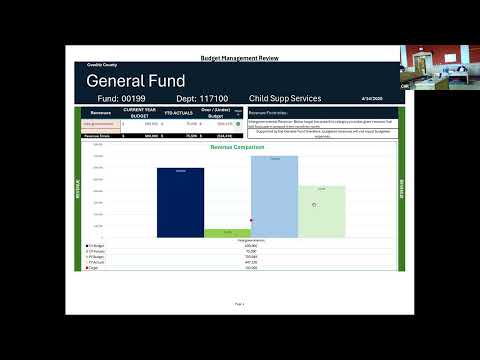
County finance staff and Sheriff Brad reviewed the sheriff’s portion of the county budget, reporting that the sheriff’s general‑fund unit is one of the county’s largest and that some revenue lines—particularly intergovernmental payments tied to criminal‑justice contracts—are subject to quarterly timing.
The sheriff’s personnel and benefits budget was described at about $8.9 million for the year, with roughly $1.9 million expended through the first quarter. County finance staff said internal service charges and some quarterly intergovernmental receipts make early‑year comparisons appear uneven.
Operational details presented to the commissioners included:
- Staffing: the sheriff’s office had about 56 filled positions and one vacancy at the time of the report, and two upcoming retirements in July were noted. Recruitment activity was described as healthy; the office reported a recent applicant pool sourced through a regional hiring portal.
- Contracts and services: the county pays northwest court security as a contract line within the sheriff’s services budget; a county official said that contract exceeds about $400,000. The sheriff’s office also reported $19,000 in unanticipated donations recorded to date.
- Special funds: the crime reduction team (CRT), the legacy drug task‑force successor, and a small extradition fund all reported low activity and small current receipts. The CRT fund had been budgeted for modest revenue and had recorded about $11,850 so far; CRT expenditures were minimal to date.
- Benefits administration: the county maintains a separate fund to cover lifetime‑medical supplements for a small group of long‑service retirees (people hired under an older retirement plan). County staff said the account carries a fund balance above $1 million, receives an annual transfer of $300,000 and currently supports roughly a dozen former employees; one recent full‑time long‑term care case was said to cost about $110,000 annually. The 2025 budget anticipates roughly $645,000 in benefits‑related expenses for the fund.
- Canine program and BearCat vehicle: the canine fund receives small contributions and general‑fund transfers; the county has two operational dogs and modest supply expenses. The BearCat armored vehicles are financed through a shared bond with other agencies; the county budgets about $40,000 in revenues, including a general‑fund transfer, and makes scheduled bond payments (county staff said those payments fall on June 1 and Dec. 1).
Sheriff Brad and county staff emphasized that most of these accounts show normal early‑year timing effects rather than structural overspending. There were no formal votes on new spending at the meeting.