Get Full Government Meeting Transcripts, Videos, & Alerts Forever!
Get email alerts on the Emergency Management topic
No spam. Unsubscribe anytime.
Butte-Silver Bow emergency director outlines duties, warns of funding uncertainty and cyber risks
Summary
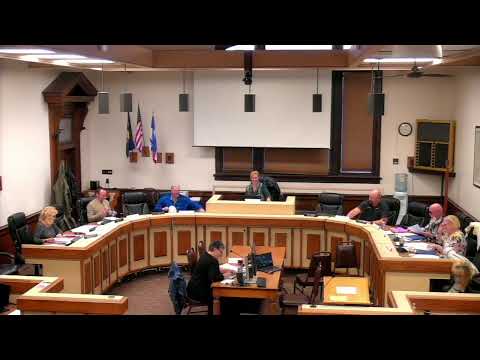
Disaster and Emergency Services Director Lisa Carey described the department's responsibilities, mutual-aid arrangements, mobile command capabilities and growing cybersecurity and staffing concerns at the April 21 Study Commission meeting.
Lisa Carey, director of Disaster and Emergency Services for Butte-Silver Bow, told the Study Commission on April 21 that her office manages planning, the Emergency Operations Center and public alerting systems and is increasingly concerned about unstable federal grants and cyber threats.
Carey, who said she is responsible for developing and implementing “a comprehensive emergency management program that aligns with the National Incident Management System,” described core duties including mitigation, preparedness, response and recovery; maintaining the EOC and a mobile command vehicle; coordinating exercises; and operating public alert systems such as IPAWS (Integrated Public Alert and Warning System).
“The program integrates the core principles of emergency management, mitigation, preparedness, response and recovery through multi agency coordination to protect the lives, property, critical infrastructure and the environment,” Carey said. She added that the office must remain “24/7 operationally ready” to activate the EOC and to issue emergency notifications by text, phone and social media.
Why it matters: The department is the county’s coordination point for major incidents and for public alerts. Carey signaled that uncertainty about federal grant programs could reduce local capacity to maintain that role and to keep equipment and staffing current.
Key details and concerns
- Funding uncertainty: Carey said federal grant programs are being “paused and reformatted” and that some awards have been pulled back. She noted the county has historically supplemented preparedness work with federal and state grants, and said, “we have brought a lot of money in from these emergency preparedness grants over the last, you know, few years and over the last decade. Probably close to $3,000,000 just through our department over the last decade.”
- Staffing and retention: Carey described a very small department staff and turnover among related positions (for example, public-health emergency preparedness staff). She said staffing instability limits the department’s ability to lead continuity-of-operations training and other resilience work.
- Mutual aid and regional assistance: Carey described mutual-aid agreements and informal regional assistance, including state- or EMAC-level responses for major incidents. She said formal mutual-aid documentation and prearranged support help jurisdictions share facilities and personnel when needed.
- Mobile command vehicle and field communications: Carey described the mobile command vehicle as a Winnebago outfitted with base radios, computers, TV monitors and a deployable internet capability (she referenced an upgrade to Starlink-style satellite service). Carey said the vehicle can provide local radio communications and a limited internet hotspot if cell service is down, and that it has been used to support previous incidents.
- Exercises and after-action work: The DES office runs tabletop, functional and full-scale exercises and produces after-action reports to address gaps identified in drills.
- Cybersecurity: Carey said the county and DES have coordinated with IT on backups, network segmentation and cloud options to reduce ransomware and fraud risks. She described efforts to obtain grants and training to harden county systems and increase end-user protections, including employee phishing tests and outside trainings sent to IT staff.
Commission questions and follow-up directions
Commission members asked for more detail about mutual-aid arrangements, mobile-command capabilities and the mobile vehicle's age and equipment. Carey described recent mutual deployments (for example, to Cascade County) and said mutual aid is usually reciprocal, often with lodging and limited cost recovery handled by the requesting jurisdiction. On the mobile vehicle she said it is stocked with radios and computers and noted the vehicle’s ability to receive a satellite internet feed.
Carey also told commissioners she has requested CERT (Community Emergency Response Team) training for the public and will pursue additional training opportunities if sufficient community interest emerges.
No formal action was taken. Carey answered commissioners’ questions and the commission recorded the briefing for its review.
Sources and attribution
All direct quotations and program descriptions in this article come from remarks by Lisa Carey, director of Disaster and Emergency Services for Butte-Silver Bow, at the April 21, 2025 Study Commission meeting.