Get Full Government Meeting Transcripts, Videos, & Alerts Forever!
Get email alerts on the Transportation topic
No spam. Unsubscribe anytime.
La Porte engineer: rising material costs and limited local revenue constrain road and sidewalk work; resident urges bump-out on Indiana Ave
Summary
City Engineer Nick Minnick told the La Porte City Common Council that construction costs have risen sharply while local road funding has stayed roughly the same, limiting how many streets the city can repair. Resident Rick Ogle pressed for a pedestrian bump-out on Indiana Avenue near multiple homes with children.
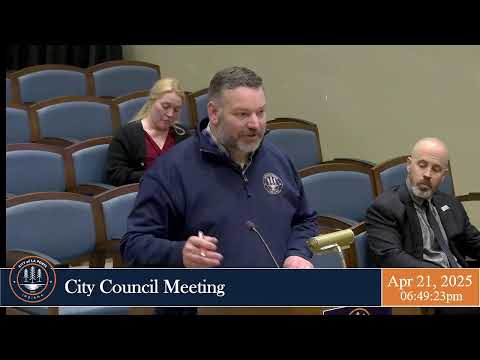
La Porte City Engineer Nick Minnick told the Common Council on April 21 that sharply higher materials and labor costs have left the city able to do far fewer road and sidewalk projects than a decade ago.
Minnick outlined recent and planned work and the city’s funding mix, saying the city’s 2024 Community Crossings project is “a $2,800,000 contract” currently underway and that the city also awarded a $150,000 project on Stevens Road tied to a school transportation project. He said the city’s pavement-condition score has hovered around 5.7 (on a 10-point scale) after years of incremental improvement and a recent pause while larger sewer and water projects used paving dollars.
The engineer stressed rising prices: asphalt costs are up about 81% since 2014 (from about $64/ton to about $116/ton in Minnick’s numbers) and concrete work such as curb ramps has risen roughly 247%–250% in the same period. Minnick also summarized local revenue that supports street work: wheel-tax surtax collections of roughly $498,197 annually, trailer/wheel tax of about $32,617 and a restricted MBH (motor vehicle highway) fund near $470,000, yielding roughly $1.2 million in recurring local road-related funds to pair with state and federal grants.
Minnick said the city tries to maximize matching dollars for state Community Crossings grants and occasional federal aid projects, and that pairing paving with utility work (sewer separation, lead-line replacement) is a common way to multiply benefit and avoid redoing newly paved streets. He warned that a full reconstruction with 4 inches of asphalt, curbs and sidewalks runs about $2 million a mile and is therefore far more expensive than surface treatments.
Resident Rick Ogle, of 1902 Indiana Avenue, used the public-comment period to press the council on a pedestrian safety measure he described as a “bump out” or curb extension near his block. Ogle said roughly 27–29 children live within five houses near his home and that he had consulted city engineering and the traffic commission without receiving a reason the bump-out could not be installed. “No one has yet to tell me or give me a good reason why there cannot be a bump out in 4 tenths of a mile on Indiana Ave,” Ogle said.
Council members asked about sidewalk and Americans with Disabilities Act work. Minnick said the city is spending about $500,000 a year on sidewalk and ADA ramp work but that cost escalation makes progress slow; he estimated a high-end timeline of about 26 years to make all sidewalks ADA compliant if funding and cost trends continued. He also noted seasonal constraints: asphalt plants operate in warmer months, so winter weather can delay projects.
Minnick and councilors reiterated that certain locally controlled grant funds and restricted accounts (for example, tree-grant or MBH funds) are statutorily dedicated and cannot be reallocated to general pavement needs without following legal restrictions. He encouraged continued grant-seeking and efficient maintenance such as crack sealing and other interim treatments to extend pavement life.
The presentation ran through planned resurfacing calls (Maple, sections of Weller, Ohio Street and Lake Shore Drive) and emphasized the city’s strategy of coordinating paving with future utility projects to avoid redoing work. The council did not take formal action on the matter during the meeting.