Get Full Government Meeting Transcripts, Videos, & Alerts Forever!
Get email alerts on the Ethnic Studies Survey topic
No spam. Unsubscribe anytime.
After public outcry over speakers and ethnic-studies rollout, MVLA board greenlights independent student survey
Summary
Following extensive public comment about antisemitic incidents at school events and concerns about a year-long ethnic-studies graduation requirement, the board authorized a contract with Hanover Research to survey freshmen and sophomores; trustees also discussed related data and possible metrics such as AP course outcomes.
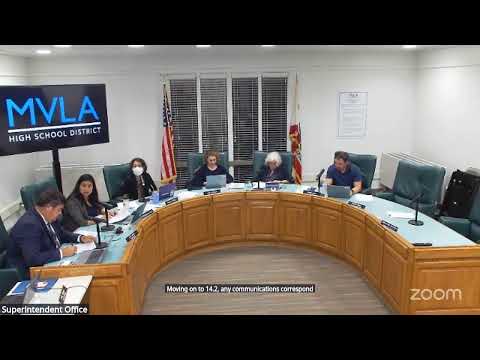
The Mountain View–Los Altos Union High School District Board of Trustees voted April 21 to proceed with an independent survey about the district’s freshman ethnic-studies course after a lengthy public comment period in which dozens of parents and community members raised concerns ranging from course content and mandatory status to reported antisemitic incidents at school events.
Motion and vote: The board voted to proceed with contracting Hanover Research for a student survey of freshmen (and a follow-up/supplemental outreach to sophomores who took the class last year). The motion was moved by Katherine and seconded by Lisa; the motion passed on a board vote recorded in the meeting minutes.
What residents told the board - Concerns about course requirement and timing: Multiple parents argued the district imposed a year-long ethnic-studies graduation requirement for incoming freshmen ahead of state mandate and before broader consensus. Speakers urged that ethnic studies be optional or deferred to a later year; they suggested alternatives such as allowing students to take the course as an elective or integrating content into other social-studies classes. - Academic preparation: Several speakers and parents said students who took the freshman ethnic-studies course felt less prepared for AP World History or other subsequent social-studies coursework; callers asked the board to examine grade and AP-test outcomes as objective data points. - Political content and balance: Public comments repeatedly raised questions about whether ethnic-studies instruction presents diverse viewpoints or advances ideological perspectives. Callers asked whether teachers discourage critical or dissenting views in class and whether the district can measure balance and critical-thinking outcomes. - Antisemitic incidents and outside speakers: A cluster of public comments criticized a recent campus event — an Iftar celebration that included an outside comedian whose social-media presence and past material, according to commenters, contained antisemitic references. Speakers urged more stringent vetting of outside presenters, stronger district responses when incidents occur, restoration or expansion of Holocaust education, and a district task force focused on Jewish student safety.
What the board asked for and what will be studied - Scope of survey: Trustees asked consultants to include questions that go beyond a single likert item — for example, items about whether students felt the course encouraged critical thinking, whether they felt safe to express different viewpoints, whether they learned about others’ histories as well as their own, and whether the course could have been appropriately condensed to one semester. - Comparative baseline: Trustees directed staff and the consultant to administer the survey alongside the freshmen class’s standard English assessment so the results can be compared to a different core course; staff also asked that the survey be offered to sophomores who took ethnic studies in the prior year so the district can pair perception data with objective outcomes such as grades and AP results. - Legal/legislative context: The board discussed pending and existing state legislation referenced by staff — including AB101 and a proposed bill (AB1468) that would require ethnic studies standards — and asked staff to monitor any budget or statutory changes that might alter timing or funding for the course. - Communications: Trustees asked that the district publish information explaining the survey’s purpose and timeline to freshmen and sophomore families before the instrument launches.
Why it matters Public commenters portrayed this as both a curricular and a safety issue: concerns ranged from academic sequencing and workload to allegations of antisemitism at events and social-media activity linked to presenters. Trustees said an independent, professionally administered survey should give the board quantifiable student-perception data to supplement parent testimony and district-collected academic metrics.
Speakers relevant to this topic - Christine Caslow — Parent and Special Education Community Advisory Committee member (public comment) - Marla Wong — Public commenter (spoke on antisemitism) - Tasha Ron — Parent (public comment on timing and ability to defer ethnic studies) - Miriam Permit — Public commenter (raised concerns about outside comedian) - Abby Mullins — Parent (requested clearer vetting and oversight of outside speakers) - Anonymous commenter identified as Alex (public comment; urged objectivity and elective option) - Natalie Syas — Parent (noted state law will require a semester in future; questioned district’s year-long mandate) - Superintendent Eric Valdez — District superintendent (staff responses, legislative context) - Terry Faught — Associate superintendent (staff liaison for survey procurement)
Clarifying details and staff commitments - Hanover Research: Board approved moving forward with an independent contractor (Hanover Research) to administer a short, carefully worded survey to freshmen and to solicit responses from sophomores who took ethnic studies last year; trustees asked that the question set include items on balance, critical thinking, interpersonal connectedness, and perceived ideological pressure. - Data crosschecks: Trustees asked staff to compile objective academic metrics (grades and AP results) for students who took ethnic studies and to provide comparative year-to-year data so perceptions can be compared with outcomes. - Anonymity and reporting: The board emphasized that the survey must be anonymous to reduce fear of retaliation but asked staff and the consultant to include questions that can reveal whether concerns are concentrated in particular sections (e.g., teacher-level differences) without identifying individual respondents publicly.
Ending The board’s vote to hire an outside research firm follows weeks of public testimony and media attention. District leaders said they expect the survey to be completed and results returned to the board before the next academic-year planning cycle; trustees said the findings will inform any adjustment to whether ethnic studies remains a year-long graduation requirement, is moved to a semester model, or is otherwise revised.