Get Full Government Meeting Transcripts, Videos, & Alerts Forever!
Get email alerts on the Elections Redistricting topic
No spam. Unsubscribe anytime.
MVLA trustees recommend Map C1 for trustee-area elections; forward plan to county committee
Summary
The Mountain View–Los Altos Union High School District board voted unanimously to adopt map C1 and its proposed sequencing as the district's recommendation to the County Committee on School District Organization for 2026 trustee-area elections.
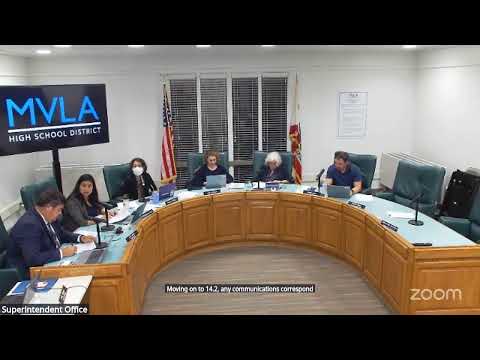
The Mountain View–Los Altos Union High School District Board of Trustees voted unanimously April 21 to adopt map C1 and its accompanying sequence of elections as the board’s recommendation to the County Committee on School District Organization for trustee-area voting beginning in 2026.
The recommendation, moved by Catherine (board member) and seconded by Alex (board member), passed on a 5–0 roll-call vote. The board adopted the map and sequencing as part of a resolution that will be transmitted to the county committee, which must hold its own public hearing and then vote to approve or reject the district’s plan.
The approval follows a fifth public hearing in which district consultants reviewed the three map options and explained the recommended order in which new trustee areas would open for elections. David Saldoni of the law firm AALRR and Ken Reynolds of SchoolWorks were on hand to explain legal requirements and demography-driven sequencing considerations.
Why it matters: The district is transitioning from at-large to trustee-area elections. Consultants and trustees said sequencing matters because it minimizes turnover and reduces the chance that multiple vacant or unrepresented areas will exist simultaneously. As the consultants described, common practice is to begin with an area that lacks an incumbent, then select subsequent areas based on where trustees’ terms naturally expire to limit disruption.
Key details and next steps - Map chosen: C1, with the sequencing attached as an exhibit to the board’s resolution. - Vote: Motion moved by Catherine; seconded by Alex; roll-call tally 5–0 in favor. - County process: Once the district transmits the adopted map and the order of elections to the County Committee on School District Organization, the committee will hold a public hearing in-district and then vote to approve or reject the plan. The consultants advised that if the county committee finds the district’s materials unclear (for example, lacking a clear sequencing on the map), it may send the plan back for more work rather than outright rejecting the concept. - Implementation: If the county committee approves the plan and subsequent procedural steps proceed, district staff will file the needed documents with the registrar so the new trustee-area order is in place for the 2026 election cycle. Consultants reminded the board that shapefiles (not just PDFs) are required for official map submissions.
What the consultants told the board - Sequencing principle: Start with the trustee area that currently has no representative, then phase in areas where terms will expire to reduce turnover; selecting a different sequencing could cause an area to have two incumbents or leave an area without representation for a cycle. - County committee role: The county panel may “send back” a plan if the sequencing or map presentation is ambiguous; in prior districts that has required an extra public hearing and resubmittal.
Speakers relevant to this topic - President Ortiz — Board president (presiding over the public hearing and vote) - Catherine — Board member (mover of final motion) - Alex — Board member (second) - David Saldoni — Consultant, AALRR (assisting with legal guidance) - Ken Reynolds — Consultant, SchoolWorks (demographer)
Clarifying details - Sequencing: District consultants emphasized that sequencing is discretionary but recommended opening the unrepresented area first to avoid leaving a seat vacant; multiple empty areas can trigger a county committee tie-breaking procedure described by the consultants as a lot-drawing process under Education Code provisions. - File format: Consultants said shapefiles (geospatial vector files), not PDFs alone, are required for county submission and for the registrar. - Timing: If the county committee approves the district’s recommendation, registrar filings would follow so the order of elections is operative for the 2026 cycle.
Proper names and agencies - Mountain View–Los Altos Union High (MVLA) - AALRR (law firm) - SchoolWorks (demographic consultant) - County Committee on School District Organization
Discussion vs. decision - Discussion: Consultants reviewed maps and sequencing options and answered trustee questions about alternatives and county committee practice. - Decision: The board formally adopted Map C1 with its sequencing and will transmit the resolution and map exhibit to the county committee for its hearing and vote.
Ending The board’s adoption of Map C1 is a recommendation, not a final legal change; the county committee must still conduct its hearing and vote. District staff and the consultants said they expect the county process to be procedural so long as the map and sequencing are presented clearly on the exhibit and in shapefile format.