Get Full Government Meeting Transcripts, Videos, & Alerts Forever!
Get email alerts on the Emergency Management topic
No spam. Unsubscribe anytime.
OEMHS seeks grant replacements and expands nonprofit-security funding; committee keeps recommendations intact
Summary
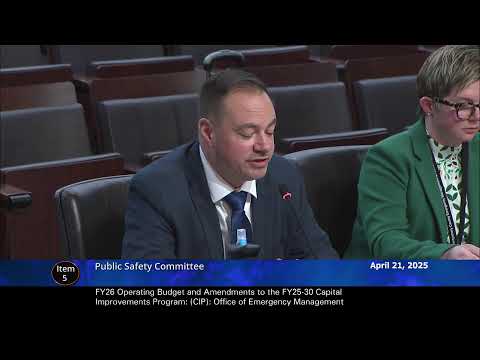
The Montgomery County Office of Emergency Management and Homeland Security asked the Public Safety Committee on May 20 to replace UASI grant-funded positions with county general-fund support, expand nonprofit-security grants and fund EOC maintenance and accreditation; the committee voted 3-0 to leave the executive—s recommendations intact.
The Montgomery County Office of Emergency Management and Homeland Security (OEMHS) presented a FY26 operating request on May 20 that would raise its operating budget by $956,179 (about 20.1%) over FY25, mainly by replacing key grant-funded positions and restoring program support that is losing federal grant backing.
OEMHS Director Luke Kasz, Deputy Director Nicole Markowski and budget and legislative staff outlined the executive—s recommended changes, which include: - Replacement of Urban Area Security Initiative (UASI) grant funding with county general fund support to retain 2.5 FTEs and convert contractors to full-time staff ($893,000 approximate replacement figure shown in packet). - Enhanced funding of $300,000 for the nonprofit security grant program to expand awards for organizations and facilities at higher risk of hate crimes (this brings OEMHS base nonprofit-security funds closer to amounts available last year when requests were significantly higher). - Emergency Operations Center (EOC) maintenance and sustainment ($50,000), emergency-management accreditation ($40,000 for reaccreditation cycle), WebEOC real-time operations platform replacement or sustainment ($30,000), and uniforms/PPE ($20,000).
Council staff emphasized these are largely continuation or replacement needs after recent federal-grant changes. The packet included analysis showing the nonprofit security program last year received about $1.65 million in eligible requests and that 63% of applicants were houses of worship; staff also noted many first-time awardees and changes in program criteria such as adding video integration demands.
Committee members discussed whether portions of the proposed enhancements should be treated as one-time or ongoing. After discussion, members voted 3-0 to leave the OEMHS recommendations as presented in the executive—s submission and to not place the nonprofit-security enhancement or other OEMHS items on the reconciliation list. Council staff said they would provide additional detail about applicant amounts on request.
Next steps: The OEMHS recommended changes move to the full council as part of FY26 budget deliberations; staff said the department will provide additional year-over-year analysis of nonprofit-security criteria and applicant funding as requested by council members.