Get Full Government Meeting Transcripts, Videos, & Alerts Forever!
Get email alerts on the Elections Budget topic
No spam. Unsubscribe anytime.
Committee reviews Board of Elections FY26 budget, recommends packet to full council
Summary
A Montgomery County council committee reviewed the Board of Elections’ proposed FY26 operating budget, heard officials describe increases for overtime, seasonal temps, an election-worker management system rebuild and election judge stipends, and agreed to recommend the BOE budget to the full council.
The Government Operations and Fiscal Policy Committee on [date not specified] reviewed the Montgomery County Board of Elections’ proposed FY26 operating budget and agreed, by consensus, to recommend the packet to the full County Council.
Committee staff member Gazalia, presenting the packet, said the county executive’s recommendation reflects an overall decrease of about $2,900,000 — a 16.96% reduction from the FY25 approved operating budget, while noting targeted increases for specific election needs. “The executive’s recommendation includes a $192,000 increase for the compensation adjustments and required operating expenses,” Gazalia said, and identified five proposed enhancements that total about $1.2 million and several reductions that together account for roughly $4.9 million in decreases.
The enhancements staff detailed include a $463,786 overtime adjustment, $300,119 for seasonal temporary staff, $300,000 to continue rebuilding the election worker management system, $200,000 to restore the election judge stipend, and $21,867 to convert two office services coordinator positions from part time to full time.
David Naiman, president of the Montgomery County Board of Elections, told the committee the board supports the FY26 request and described operational plans for the next election cycle. “Starting this afternoon... over the next few months, our board will be deciding about our plans for the 2026 elections,” Naiman said. He said the board expects to continue roughly the same services used in 2024: 58 drop boxes, 14 early voting centers and about 232 election‑day polling places.
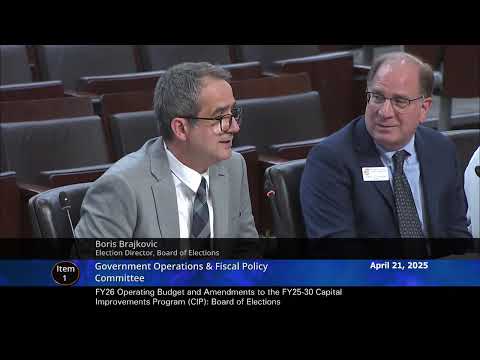
Boris Bratkovich, the Board’s election director, described why the election-worker management system funding is needed. He said the county’s legacy system was built on an outdated platform, and that an external portal used in 2024 recruited and trained workers but internal modules must be completed and maintained for the 2026 cycle. Bratkovich said if internal modules are not operational for 2026, staff would need to perform large manual tasks — for example, processing roughly 7,000 applications and scoring more than 5,000 online quizzes — which would cause operational delays and additional temporary staffing costs.
The board gave data on 2024 turnout and voting methods. Naiman said “a little more than 76% of eligible voters turned out to vote,” and provided counts of each method: about 67,000 mail‑in ballots returned, roughly 55,000 voters during eight days of early voting, and about 72,000 voters at 232 polling places on election day. He also said the county has more than 20,000 voters on the permanent mail‑in ballot list.
Committee members pressed for more detail on the $300,000 system rebuild line. Councilmember Friedson asked whether there is “wiggle room” in the amount and requested a more detailed breakdown from the vendor (referred to in the packet as TABs) before full‑council consideration. Councilmember Fritza also asked for a vendor breakdown and a timeline; staff said TABs is finishing development, moving to testing, and the board expects to be fully operational for 2026.
Board staff and the committee discussed the high number of provisional ballots in 2024 and outreach efforts to reduce them. Bratkovich described outreach steps including emails to voters who requested web‑delivered (print‑at‑home) ballots, targeted contact with senior and day‑care centers, and coordination with local postmasters. Naiman noted the board successfully proposed legislation in Annapolis to move the primary election one week earlier — to Tuesday, June 23, 2026 — and said the bill passed both houses and is awaiting the governor’s expected signature.
On a legal note, Gazalia told the committee that a recommended decrease of $708,598 for “state board of elections expenses” reflects anticipated charges from the Maryland State Board of Elections and that those charges are “a legal requirement per election law nine‑one hundred and 6,” as stated in the staff packet.
After questions and requests for follow‑up information about the $300,000 rebuild estimate and other details, the committee chair said there were no objections to accepting the packet and recommending the Board of Elections FY26 operating budget to the full council.
The committee directed BOE staff and OMB to provide the vendor breakdown and timeline for the election‑worker management system and to supply requested follow‑up figures on provisional ballots and related outreach analytics before the full‑council budget review.