
Yarmouth committees launch multi‑month study of 70‑acre former school site to explore housing and mixed uses
Get AI-powered insights, summaries, and transcripts
Subscribe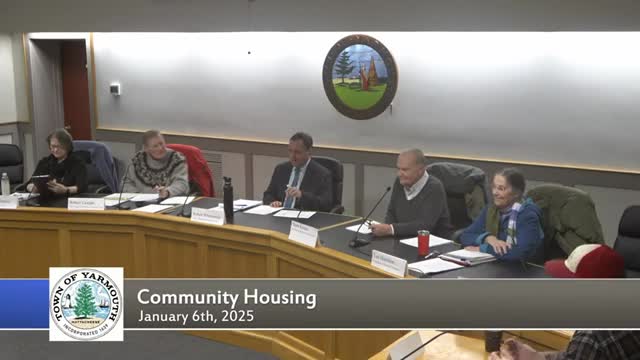
Summary
On Jan. 6, 2025, the Town of Yarmouth’s Community Housing Committee and the Yarmouth Affordable Housing Trust met with the Mattakees Utilization Committee and consultants from Barrett Planning Group to begin a multi‑month process to evaluate reuse of a roughly 70‑acre former school site for affordable housing and other community uses.
On Jan. 6, 2025, the Town of Yarmouth’s Community Housing Committee and the Yarmouth Affordable Housing Trust joined the Mattakees Utilization Committee and consultants from Barrett Planning Group to kick off a multi‑month process to evaluate redevelopment options for a roughly 70‑acre parcel the town recently received from the Dennis‑Yarmouth Regional School District.
The meeting opened with Robert Ritenour, town administrator and chairman of the Affordable Housing Trust, saying the three groups were convening to “explore opportunities presented by this substantial property” and to determine whether affordable housing is feasible at the site. He described the session as the start of a process that could take several months.
Why it matters: committee members and staff said housing could be the financial driver that unlocks infrastructure—especially sewer—that would make other site uses possible. The discussion identified regulatory and environmental limits that will shape any plan, and the town will rely on technical assistance from Barrett Planning Group (30 hours provided through a Barnstable County ARPA program) and on a consultant building‑condition study due in January to inform next steps.
Key takeaways and next steps
- Parcel and constraints: Kathy Williams, town planner, said the property is about 70 acres and includes existing school buildings, athletic fields, wooded areas, wetlands and an area identified by the state Natural Heritage program as documented habitat for rare species. Williams described regulatory buffers that will affect buildable area—standard wetland buffers cited in the meeting included 35‑, 50‑ and 100‑foot zones around resource areas and a potential vernal‑pool protective radius that can extend to about 200 feet if confirmed.
- Drinking‑water protection: The site lies in a Zone 2 drinking‑water/wellhead protection area and the meeting repeatedly flagged a roughly 1,000‑foot well‑protection radius that the town seeks to preserve. Williams said those protections make septic‑based higher‑density housing infeasible and that sewer access will be a key permitting and cost question.
- Zoning and development pathway: Williams summarized that the parcel is in an R‑40 district (40,000‑square‑foot minimum lots, about one unit per acre under existing rules). She noted inclusionary zoning applies to projects that create five or more housing units (a sliding scale with up to about 20% required affordable units) and said higher density would require zoning changes or use of state tools such as a “friendly” Chapter 40B comprehensive permit or a Chapter 40R smart‑growth overlay. She also warned that subdividing large pieces of the property could trigger Cape Cod Commission Development of Regional Impact review and that some projects might trigger MEPA (the Massachusetts Environmental Policy Act) filings.
- Infrastructure and grant strategy: Bill Scott, assistant town administrator and staff to the utilization committee, explained the typical funding logic: housing projects often make municipalities competitive for infrastructure grants (for example, MassWorks and new state housing infrastructure programs). Scott gave an example—citing a prior project where several hundred units helped secure roughly $2 million in infrastructure funding—and said, “Housing is the driver to make the utilities and some of the site costs…be more in state programs than it is in municipal.” He cautioned that larger unit counts tend to yield larger grant awards.
- Building condition and schedule: The group confirmed the town hired a consultant to assess the former school buildings (an ASTM‑type condition and cost analysis). Scott and others said the consultant had begun site video and review; meeting remarks indicated preliminary results might be available by the January follow‑up meeting but the full report will come later.
- Role of consultants and county program: Alexis Lancellata of Barrett Planning Group said Barrett is working with Barnstable County on a pilot regional housing services program funded with county ARPA money and that Barrett will facilitate the three housing‑team meetings set out in the utilization committee’s scope. “We are going to be assisting with the three housing team meetings,” Lancellata said, and she described Barrett’s role as facilitating the initial brainstorming session and later narrowing and scoring ideas.
- Process and timeline: Bill Scott outlined a three‑stage “run amok → down to three → one idea at two levels” approach for the site teams: an initial brainstorming meeting to surface many ideas, a second meeting to refine and rank the best concepts, and a final meeting to develop a single preferred concept at two scale options for an RFP and eventual implementation. The group set a first brainstorming meeting for Jan. 21 at 3 p.m. and agreed to plan a site visit prior to later meetings.
Open questions and constraints raised in discussion
- School program timing and location: Participants discussed the status of Emmy Small Elementary School (referred to in the meeting as “Emmy Small”) and whether the school would remain on the parcel or move; staff said the school’s options and timing are unresolved and could take years, which affects where housing could reasonably be built. Scott said school relocation or construction could take three to five years and that infrastructure work (such as sewer) might proceed in parallel with school planning.
- Solar arrays and contract term: The group discussed roof‑mounted and ground solar installations on the site. One participant noted a ground array lease might be “in year 12 of 20,” and members said the town will need to check contract terms and whether buyouts are possible.
- Environmental limits: Williams repeatedly emphasized the Natural Heritage areas and wetland buffers and warned that some mapped habitat areas will be off‑limits to development.
Formal actions recorded
- Adjournment of the Community Housing Committee meeting: a motion to adjourn was made (mover not specified in the record) and Josh Trott seconded. Vote recorded on the motion included Greg Wheeler (aye), Pamela Sankors (aye), Joshua Trott (aye) and Lee Hamilton (aye); outcome recorded as approved.
- Adjournment of the Affordable Housing Trust meeting: the Trust moved and seconded adjournment later in the session; the motion carried (record does not list a full roll‑call vote).
What participants listed as immediate next steps
- Jan. 21, 2025, 3:00 p.m.: first facilitated brainstorming (the “run amok”) meeting with Barrett Planning Group leading facilitation; invitations planned for housing partners and selected stakeholder groups.
- Between meetings: Barrett and town staff will assemble focused materials to share in advance (maps and a short summary of constraints and the Housing Production Plan) rather than the entire packet; the building condition ASTM analysis will be shared when available.
- Site visit: staff to coordinate one or more public site walks; attendance will be posted as public meetings and coordinated with building access and recreation schedules.
Speakers quoted or paraphrased in this article were present in the meeting record and are named in the article’s speaker list.
Ending
Committees emphasized that the Jan. 21 brainstorming session will not produce a final plan but will produce a set of concepts for subsequent narrowing, feasibility work and an RFP process. Participants repeatedly said housing could unlock infrastructure funding but that environmental, wellhead and zoning constraints will sharply shape what is feasible.