
Yarmouth commission delays Great Island Ocean Club certificate after homeowner flooding complaints
Get AI-powered insights, summaries, and transcripts
Subscribe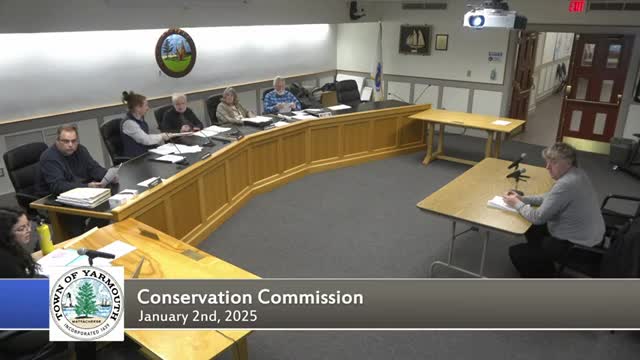
Summary
The Yarmouth Conservation Commission continued a certificate-of-compliance review for Powers Lane roadwork after a resident reported driveway flooding; engineers told the commission the pavement work likely did not cause the problem and the commission asked for beachgrass planting by May 1.
The Yarmouth Conservation Commission on Jan. 2 continued action on a request for a certificate of compliance for SE83-2148, the Great Island Ocean Club Powers Lane road improvements, after a homeowner reported persistent driveway flooding and engineers advised the commission additional stabilization work is needed.
Commissioners said the matter will return to the commission on May 1 so the applicant can confirm required beachgrass planting on a 30-foot sand strip in front of 2 Powers Lane and demonstrate stabilization. The commission voted to continue the certificate-of-compliance request to May 1, 2025.
Diane Ojila, engineer with Down Cape Engineering, told the commission her firm prepared an enforcement/technical letter and reviewed as-built elevations for the paved patch near the speed bump on Powers Lane. Ojila said the as-built plan “doesn't show major deviations from elevations in the area on the roadway,” and in her opinion the small overlay cannot have “substantially changed” drainage patterns that would explain the homeowner's puddling.
Resident Elaine Conbrasio of 19 Powell's (address given during comments) told the commission she has been flooded and is concerned the recent work increased water in her septic and driveway area. Conbrasio asked the commission to review the engineer’s letter and the field conditions.
A second engineer who spoke for the roadwork (representative for the project) said the patched pavement lies west of the speed bump, which is the high point, and that most roadway runoff sheets away from the driveway in question. That speaker noted the developer retained rights to drain the roadway along the shoulder and said the small overlay would be “a non-factor” in creating the resident’s puddle.
Commissioners heard that the north-side sand strip at 2 Powers Lane did not receive the beachgrass planting required by the order of conditions. The commission and engineers discussed planting specifications: beachgrass (beachcrest) plugs at roughly 12 inches on center (the planting density referenced in the order of conditions), to be installed during the upcoming planting season. The commission offered the option of a jute-mat for temporary stabilization but did not require it; members said planting and ongoing maintenance is the simpler remedy to ensure stabilization.
Engineers and commission members explained deed/easement language discussed on the record: a 15-foot water easement and a 10-foot utility easement along the roadway allow stormwater from the roadway to infiltrate onto adjacent lot shoulders. The project representative said, and provided plan references, that the association retained rights to drain the road into the shoulder and that the shoulder infiltration is the designed, historic condition.
After discussion the commission voted to continue the certificate-of-compliance review to May 1, 2025, to allow the applicant to complete plantings and for the commission to confirm stabilization. The commission chair closed the certificate hearing and directed the parties to follow up if additional documentation or inspection is needed before the May date.
The item will reappear on the commission agenda after May 1 with evidence that beachgrass plugs were installed per the order of conditions.