Get Full Government Meeting Transcripts, Videos, & Alerts Forever!
Get email alerts on the Housing topic
No spam. Unsubscribe anytime.
Seattle committee advances interim upzoning plan amid sharp debate over trees, ECAs and affordability
Summary
Seattle’s Select Committee on the Comprehensive Plan on April 16 reviewed Council Bill 120969, interim legislation the mayor proposed to implement state middle‑housing laws including House Bill 1110.
Seattle’s Select Committee on the Comprehensive Plan on April 16 reviewed Council Bill 120969, interim legislation the mayor proposed to implement state middle‑housing laws including House Bill 1110. Committee staff briefed members on density limits, floor‑area rules, development standards and optional affordability bonuses; public commenters urged stronger protections for trees, steep slopes and environmentally critical areas. The committee set a schedule for amendments, a public hearing and committee and full‑council votes this spring.
The bill would implement state requirements to allow middle housing across most residential zones and includes specific local rules: a maximum structure height of 32 feet (plus pitched roof allowances), standardized setbacks, and an increased maximum lot coverage of 50% in neighborhood residential zones. The draft also ties floor‑area ratio (FAR) to the number of units on a lot, exempts certain middle‑housing types from parking within a half mile of a major transit stop, and establishes an optional affordability bonus: developers could build up to six units on qualifying lots if at least two units are kept affordable (80% AMI for ownership; 60% AMI for rentals) for 50 years.
Why it matters: the city must adopt interim rules to meet the state deadline for HB 1110 implementation, while advocates and neighborhood residents warn that the interim bill’s changes to setbacks, lot coverage and other development standards could accelerate tree loss and alter neighborhood character before permanent rules are adopted.
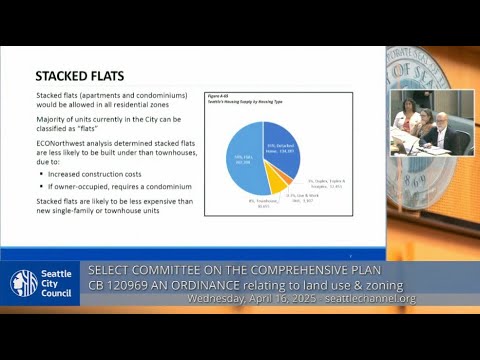
Central staff described tradeoffs and data used to shape the draft. “Stacked flats are less likely to be built than other middle housing types due to increased construction and insurance costs,” said a central staff presenter, adding that the city could use bonuses—extra FAR or density—to incentivize stacked flats. Staff also summarized an Eco Northwest feasibility study and related analyses: middle housing might be feasible on roughly 19% of Seattle’s eligible lots (about 19,000 lots) and the upzone could yield roughly 36,000 total units citywide, with a net increase of about 23,000 units compared with current zoning. The feasibility analysis showed sensitivity to cost: an $18,000 per‑unit cost increase could render roughly 25% of feasible projects uneconomic; a $41,000 increase could make about half infeasible.
Public commenters and advocacy groups focused on tree canopy, slope stability and environmental review. “We’re concerned you have insufficient information,” said Ruth Dutt of Friends of Queen Anne, asking staff to explain zoning capacity calculations for Upper Queen Anne and how environmental impacts were assessed. Sandy Schettler of Tree Action Seattle warned that the interim bill does not address ongoing canopy loss and said builders are already using existing rules to maximize units while removing trees. Susan Fedor and others cited permit‑level tree removals and urged required buffers around creeks and wetlands in any interim standards.
Affordable‑housing tradeoffs and MHA (Mandatory Housing Affordability) also drew attention. Jennifer Thabrack of central staff outlined the voluntary bonus: “This is a voluntary bonus program. It is up to the developer whether or not they would want to participate and provide those two additional affordable units.” Staff explained that MHA does not apply to most neighborhood residential zones under the draft interim bill; extending MHA into those zones is a separate policy choice that could be taken in permanent legislation. Central staff noted MHA has generated about $300 million since inception and supported roughly 4,700 income‑restricted units; projects with 10 units or fewer have contributed more than $108 million in fees to date.
Committee members asked clarifying questions about structure widths, setbacks for row houses, how stacked flats would “pencil” under building code vs. residential code, and whether recently passed state condo‑liability reforms would change insurance availability for small condo projects. Staff said the interim bill is intentionally narrower than anticipated permanent legislation and that permanent rules could provide additional incentives or changes. Staff also warned that allowing construction under an interim regime and then reversing those standards later could create legal and practical challenges for properties that develop during the interim period.
Process and next steps: the committee will receive an executive briefing on April 30, and staff requested amendment concepts by the Monday prior to May 7 so a consolidated amendment packet can be published in advance of the May 7 meeting. The committee is scheduled to hold a public hearing on the interim bill for amendments on May 19 at 9:30 a.m., a committee vote on May 21, and a full‑council vote on May 27. Chair Joy Hollingsworth said the interim legislation would remain in effect for up to one year while permanent legislation is developed.
The record: several members of the public asked staff and council to strengthen protections for environmentally critical areas and tree canopy, to clarify the assumptions in the environmental impact statement, and to avoid rolling out interim standards that could be reversed after developers rely on them. Developers and affordable housing advocates urged expedited adoption to reduce costs and preserve project feasibility. The committee’s work on CB 120969 will continue at upcoming briefings and amendment meetings.
The Select Committee on the Comprehensive Plan is scheduled to reconvene April 30 for an executive briefing and May 7 for amendment consideration.