Get Full Government Meeting Transcripts, Videos, & Alerts Forever!
Get email alerts on the Revenue Forecast topic
No spam. Unsubscribe anytime.
Seattle forecast office adopts pessimistic outlook; April update trims revenues and flags uncertainty from tariffs and markets
Summary
At an April 16 committee briefing, Seattleforecast officials said the Forecast Council approved a pessimistic economic outlook. The office revised general-fund projections downward for 2025—6 and cited tariffs, financial-market volatility and weaker payroll-excise collections as primary risks.
Seattle City CouncilFinance, Native Communities and Tribal Governments Committee Chair Dan Strauss opened a briefing on April 16, 2025, saying the Forecast Council had adopted a pessimistic economic outlook and that "this is not the news we wanted, and it could be much worse." The Office of Economic and Revenue Forecast (OERF) presented revised projections for 2025 and 2026 driven by recent tariff proposals, market volatility and weaker-than-expected collections in key tax bases.
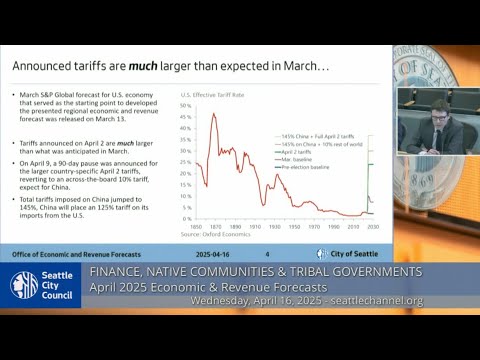
The committee was briefed on three primary inputs: national economic scenarios (including March S&P Global forecasts), 2024 actual revenue collections and regional adjustments for Seattle. Yon Duras, interim director and chief economist at OERF, said the forecast council approved the pessimistic March scenario as Seattle's official April baseline because recent policy developments raised the risk of a larger downturn. Duras and other OERF and City Budget Office staff described heightened policy uncertainty after April 2 tariff announcements and a 90-day pause that left a wide range of possible tariff outcomes.
Why it matters: the April forecast lowers near-term revenue expectations and will feed into the mayors proposal and council budget work. Forecast staff noted two more formal updates are scheduled before final action: an August forecast that will inform the mayors proposal and an October forecast just before the council adopts a final budget.
Key drivers and numbers
- Tariffs and uncertainty: OERF reported that assumed effective tariff rates rose sharply after April 2, producing volatility comparable in some measures to spikes seen during early 2020. Duras said higher tariffs and policy uncertainty could slow consumer spending and business investment.
- Recession risk: OERF cited a recent Wall Street Journal survey (conducted after the April 2 announcements) that put the mean probability of a U.S. recession at about 45 percent, with a wide range among forecasters. S&P Global's April update increased the chance assigned to its pessimistic scenario.
- Revenue revisions: OERF and City Budget Office staff reported a net downward revision of roughly $50 million for general-fund revenues across 2025 and 2026 compared with last year's October forecast. When non-general-fund revenues are included, presenters said the downward revisions are larger: about $100 million for 2025 and about $141 million for 2026 (figures presented by staff as the combined revisions across those categories).
- Specific taxes: Sales tax was revised down by about $9.3 million and the business-and-occupation (B&O) tax by about $10.4 million for the two-year window cited in the presentation. The payroll expense tax showed the largest single variance: 2024 collections were about $46 million below last year's forecast, and OERF reported combined downward revisions that sum to roughly $167 million across 2025—6 for that tax alone.
- Grants and carryforwards: The City Budget Office said an expected $67.9 million in grant-related revenue represents largely carryforward appropriations; timing of spending has caused carryforwards and corresponding revenue to shift across years. Staff emphasized that much of that is a timing issue, not a loss of awarded grants.
Local impacts and vulnerability
- Sector sensitivity: OERF staff pointed to Seattle's greater exposure to trade-related activity: trade-related sales account for about one-third of sales/use tax receipts tied to the general fund. Presenters warned that tariff-driven reductions in port activity and declines in tourism pose outsized risks for Seattle compared with the national baseline.
- Payroll expense tax concentration: Staff noted the payroll expense tax base is highly concentrated (roughly 500 payers, with the top 10 accounting for about three-quarters of revenue). Forecast errors in 2024 were within ranges seen in recent years, but the short record (collections began in 2021) and concentration make the tax hard to forecast.
- Tourism and events: Staff are monitoring hotel occupancy, foot-traffic and reservations data for near-term indicators. They also discussed the 2025 FIFA Club World Cup (three June matches) as a modest near-term event that could provide data for the August forecast; larger effects from the 2026 World Cup would follow in later forecasts. Presenters cautioned headline economic-impact figures for big events usually reflect gross rather than net impact.
Discussion and next steps
Councilmembers questioned staff on port volumes, bond-market behavior, the payroll expense tax shortfall and potential effects of federal funding shifts. OERF staff said the April pessimistic scenario does not assume a full recession but does assume slower growth and some job losses; S&P Global's April pessimistic scenario does include a recession as one alternative. Chair Strauss and several members emphasized the need to use the August and October forecasts to guide budget decisions and to coordinate regionally with King County and state partners.
The committee did not take a vote on budget actions at the briefing. OERF and the City Budget Office said they will continue to update forecasts and respond to council questions as the August and October forecast dates approach.
Ending
Committee members warned that a significant gap remains to be addressed during upcoming budget deliberations and that the city will need to consider a mix of cost savings, revenue options and regional coordination. Forecast staff said they will support council staff with additional data requests and analysis between formal updates.