Get Full Government Meeting Transcripts, Videos, & Alerts Forever!
Get email alerts on the Housing topic
No spam. Unsubscribe anytime.
County study finds limited buildable land in Seaside; infrastructure and affordability gaps highlighted
Summary
Clatsop County and consulting firm 3J presented a parcel‑level housing study to Seaside officials showing roughly 83.5 buildable acres remain after removing wetlands, steep slopes and floodplain—and that infrastructure and high vacancy rates dominated by second homes limit the city’s immediate capacity to add affordable housing.
Seaside — Clatsop County and consulting firm 3J Consulting presented a countywide housing analysis and buildable‑land inventory to the Seaside City Council work session, concluding that physical constraints, ownership patterns and infrastructure limits sharply reduce the city’s near‑term capacity to add new housing.
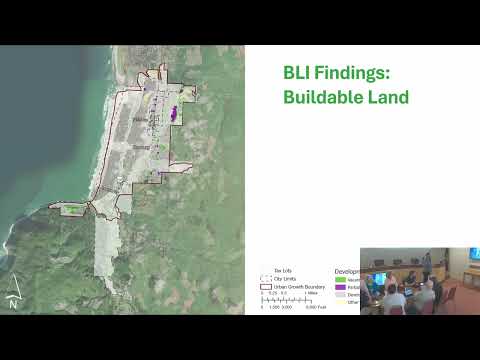
The study showed roughly 83.5 acres of buildable land in Seaside after removing constraints such as wetlands, steep slopes and floodplain. “Once you remove those constraints, what was a big patch turns into more dispersed smaller patches,” Alyssa Gertler, Clatsop County housing manager, told the council. County and consultant staff warned that some parcels that appear vacant in GIS are not fully developable without substantial site work or infrastructure extensions.
The findings matter locally because Oregon now uses a state‑allocated housing capacity analysis to set unit needs. The state allocation gives Seaside a 1‑year target of 42 units and a 20‑year need of roughly 1,800 units, with the largest share designated for households at 0–30% of area median income. “Most of those units are at the lowest income level,” said Steve Foster of 3J Consulting. Foster and Gertler said the numbers are “front loaded” to address existing deficits as well as future growth.
Nut graf: The report combines a parcel‑level buildable‑land inventory with an infrastructure scan and a housing‑supply analysis. It found a mismatch between the types of units available in Seaside and the state‑allocated need—high demand for units affordable to low‑income households, while a large share of physically available units are second homes or short‑term rentals.
Key findings and figures - Buildable‑land inventory: about 83.5 buildable acres after removing constraints; when Thousand Trails (a large privately owned recreational property) is excluded the practical supply drops substantially (presenters estimated roughly 35 acres of viable supply without Thousand Trails). - Parcel sizes: 232 buildable lots in the inventory; 99 of those are under 1 acre. Consultants noted 20 parcels listed as larger than 5 acres but said only about 29 buildable acres remain on those parcels after constraints are removed. - Vacancies and seasonal housing: Seaside’s vacancy rate is roughly 29% (about 1,500 units). Presenters said about 90% of vacant units are second homes or short‑term rentals; only about 4.6% of vacant units are actively available for sale or rent. - Tenure and cost burden: about 46% of occupied housing units are owner‑occupied and 54% renter‑occupied. Roughly 38% of homeowners and about 51% of renters are cost‑burdened (spending 30% or more of income on housing). - Population forecast and need: Portland State University Population Research Center projects roughly 2,000 additional residents over 50 years; county and consultants noted many local officials believe that forecast undercounts recent migration since 2020.
Infrastructure and constraints The report’s second part reviewed water, sewer and transportation system plans and identified system‑level capital needs—wastewater treatment upgrades, water filtration and reservoir work and pump station improvements—but noted planning documents rarely link specific infrastructure work to unlocking particular parcels. Foster said the team will provide maps showing which opportunity sites would require targeted infrastructure work to be developable.
Local review and next steps Seaside staff and the consultants emphasized that the draft maps and datasets are intended for local refinement. “We started with GIS and then worked with Jeff, Seaside’s community development director, to say, ‘Let’s look parcel by parcel,’” Foster said. Officials asked councilors to review the mapping for their wards and return corrections; staff said public works and county web maps will let the city zoom to tax lots for comment. County staff said the project was funded by a grant from the Oregon Department of Land Conservation and Development (DLCD) and that final reports and an executive summary will be circulated for local edits.
Policy context and constraints Presenters noted state rules for buildable‑land inventories: wetlands are rarely removed from inventories unless a city’s code permanently restricts development on wetland parcels, and the state prescribes the method consultants must use. Gertler and Foster said the county and a regional task force are discussing state rulemaking that could make inventories more realistic.
Questions and local concerns Councilors and residents asked about specific parcels raised in public comment, including a long‑disputed tract north of town, the status of mobile‑home parks in inventory calculations and the accuracy of the Portland State forecast for recreational communities. Foster acknowledged some tabular or slide math errors in the draft and said the team would correct them before finalizing the report.
Ending: The consultants and county staff asked councilors to review parcel‑level maps and return corrections so the final report can feed into Seaside’s comprehensive plan and any zoning or code updates. Staff said the city will be able to swap in updated wastewater and water master plan findings as those projects advance, and that an RFP for a wastewater update is imminent.
Votes at a glance (other business during the same meeting) - Approval of agenda: motion seconded and approved by the council (motion carries). - Consent agenda (pay bills; minutes of 03/24/2025): approved (motion carries). - Reappointment: Pam Dyerley and Jim [last name redacted in transcript] reappointed to the Parks Advisory Committee (motion carries). - Liquor licenses: Wine and Beer House (approval recommended; motion carries). Steady Groove LLC / The Lion’s Den (approval recommended; motion carries). - Reconsideration: the council voted to withdraw a prior offer of funding for clean‑up at an unsanctioned homeless camp site; the withdrawal motion passed (vote recorded in the meeting as 4 in favor, 3 opposed).