Get Full Government Meeting Transcripts, Videos, & Alerts Forever!
Get email alerts on the Contaminated Site Cleanup topic
No spam. Unsubscribe anytime.
EGLE tells Senate panel Michigan has about 27,000 contaminated sites; agency urges steady funding, database expansion
Summary
Michigan Department of Environment, Great Lakes and Energy officials told the Senate Appropriations subcommittee that roughly 27,000 properties are classified as contaminated, many are orphaned, and steady funding plus an expanded digital records program and a proposed tipping-fee increase are central to the department's plan to speed cleanups.
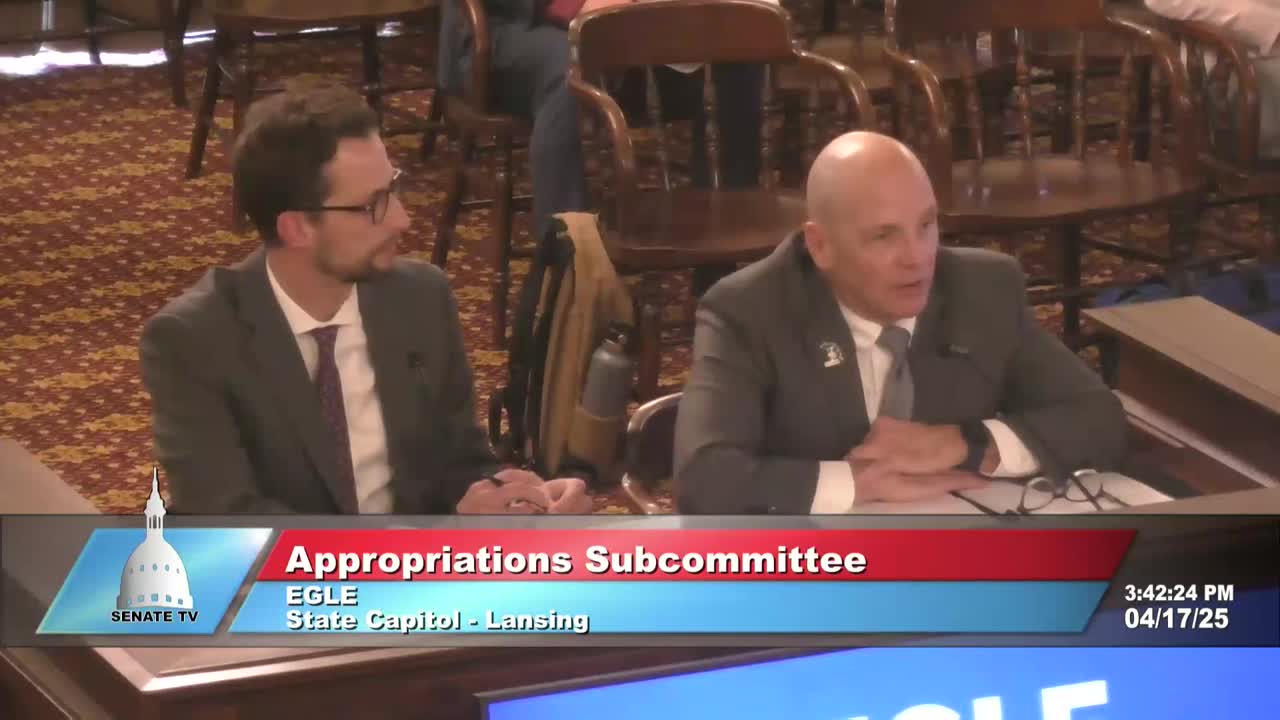
Lansing — Officials from the Michigan Department of Environment, Great Lakes and Energy (EGLE) told the Senate Appropriations Subcommittee for the Department of Environment, Great Lakes and Energy on March 13, 2025, that the state has about 27,000 known contaminated sites and needs consistent funding and improved data access to accelerate cleanups.
Senate Appropriations Subcommittee Chair Irwin opened the hearing by noting the scope of the problem and asking EGLE to present on the agency’s cleanup programs. “I think 27,000, I think was the last number I heard, of contaminated sites in Michigan that we know about,” Chair Irwin said. “Half of which are orphaned sites, which have been left onto the backs of the taxpayers.”
Mike Miller, division director for EGLE’s Remediation and Redevelopment Division, described the agency’s four cleanup programs, three run under state law (Part 201, Part 213 and the Brownfield Redevelopment Program) and one under federal Superfund (CERCLA). He said about 17,000–18,000 sites fall under Part 201 and a little under 8,000 are Part 213 leaking underground storage tank (LUST) releases. “The average time that a site is on the national priority list is 40 years,” Miller said of Superfund sites.
Miller and Deputy Director Travis Bosco said EGLE has focused on three priorities: (1) following a risk-based approach to prioritize sites with immediate risks, (2) maintaining steady funding to avoid starting-and-stopping remedies that can waste earlier work and increase risks, and (3) improving public access to records through a digitization effort. Miller said the department has assigned risk categories to many previously “unknown” sites after an 18–20 month project to clear a backlog of uncharacterized files.
EGLE described several quantitative points for the subcommittee: roughly 27,000 known contaminated sites statewide; about 1,100 sites classified as “risk present and immediate”; roughly 1,700 active cleanups (both state-funded and liable-party work), representing about 6% of the total universe of sites; 64 Michigan sites on the federal National Priorities List with 22 removed since the program began; and an October 2024 snapshot showing Michigan had 8,139 open LUST releases, second-highest in the country at that date.
Miller told senators the Brownfield Redevelopment Program offers grants, loans and tax-increment financing for both Part 201 and Part 213 sites to support redevelopment even when a liable party is not available. He said the state must still prioritize public-health risk when deciding which orphaned sites to fund for remediation.
The agency also outlined a proposal in the governor’s budget to raise the solid-waste surcharge (commonly referred to at the hearing as the tipping fee). Deputy Director Bosco said the proposal would phase in an increase and redistribute revenue differently than prior versions: 55% of the additional revenue would go to contaminated-site cleanup, 20% to formula money for local communities to help with recycling and materials-management planning, 15% to a host-communities fund for municipalities that host landfills, and 10% to designated planning agencies for materials management. Bosco said the changes reflect stakeholder input and would include a phase-in to limit sudden cost impacts.
Senators pressed EGLE on technical and policy points. Senator Altman asked whether Michigan’s high LUST backlog reflects more discovery rather than more releases; Miller and staff said differences in state statutes, program resources and historic density of gas stations in Michigan contribute to higher historical inventories and detection. Senator Singh asked whether the department coordinates cleanups with local economic development and land banks; Miller and Bosco said EGLE’s regional Brownfield coordinators routinely work with local governments and will prioritize sites tied to redevelopment when public-health priorities permit.
On site-assessment data and public access, EGLE staff said the department has digitized roughly 1.6 million documents and that its Remediation Information Data Exchange (referred to in testimony as “BRIDAL”) already provides public downloads. “We’re getting 15,000 downloads from BRIDAL, from the public, monthly,” an EGLE staff member said. The agency asked the subcommittee to consider budget funding to finish digitizing and indexing the remaining records in about five years; without that investment, staff said the work could take a decade or longer.
Committee members also raised questions about cleanup standards and acceptable risk. When asked what cancer-risk threshold the department uses, EGLE told the committee that the statutory criterion is a 1-in-100,000 lifetime excess cancer risk for determining cleanup criteria under state law. “The cancer risk threshold is per the statute, which is 1 in 100000,” Miller said. EGLE staff explained that criteria include conservative uncertainty factors and that decisions consider present and future site uses, exposure pathways (drinking water, vapor intrusion, surface water, direct contact) and special protections for sensitive populations.
Votes at a glance: the committee adopted the minutes of the March 13, 2025, subcommittee meeting by motion of Senator Singh, supported by Senator Bayer, without objection. The committee later adjourned on a motion by Chair Irwin, supported by Senator Bayer, without objection.
The hearing closed with senators indicating broad interest in advancing the governor’s proposed revenue changes and in funding the digitization effort so developers, local governments and residents can access historical site records more quickly. EGLE requested steady, predictable funding to allow long-running remedies to be completed rather than interrupted by budget shortfalls.