Get Full Government Meeting Transcripts, Videos, & Alerts Forever!
Get email alerts on the Contaminated Sites topic
No spam. Unsubscribe anytime.
Michigan EGLE outlines state contaminated-site workload, funding plan and records digitization
Summary
EGLE officials told an appropriations subcommittee the state manages roughly 27,000 contaminated sites, described progress closing leaking underground storage tank cases, backed a governor budget proposal to raise the solid-waste surcharge, and urged funding for digitizing remediation records.
The Appropriations Subcommittee for the Department of Environment, Great Lakes and Energy heard an overview of Michigan’s contaminated-site cleanup programs and a pitch for steadier funding on March 13, 2025. Mike Miller, director of EGLE’s Remediation and Redevelopment Division, and Travis Bosco, deputy director of EGLE, described program scope, recent performance and a governor’s budget proposal that would raise the solid-waste surcharge from 36¢ per ton to $5 per ton and change how the revenue is distributed.
Miller told the panel the department tracks roughly 27,000 contaminated sites statewide, of which about 17,000–18,000 fall under Part 201 of the Natural Resources and Environmental Protection Act and nearly 8,000 are leaking underground storage tank (Part 213) sites. “When you look at this map, it’s a little ominous and alarming,” Miller said, adding that many listed sites are historically contaminated properties that may not pose immediate exposure risks.
The presentation framed why sustained funding matters. Miller said about 1,700 sites are actively being remediated (including work paid for by liable parties and state-funded projects) and that the state currently has about $300 million allocated to 787 state‑managed projects. “Consistent funding allows us to plan,” he said, noting that interruptions can force short‑term, containment-only measures that later require restarting costly work.
Nut graf: EGLE officials asked the subcommittee to consider both steady operating funds for long‑running cleanups and budget authority to accelerate digitizing site records. They also outlined the governor’s proposal to increase the solid-waste surcharge and allocate most of the new revenue to contaminated-site cleanup while directing portions to local recycling and host-community support.
Panel members pressed staff on program details and outcomes. Miller said the federal Superfund program covers sites where no liable party can pay and that Michigan must match about 10% of EPA costs; he said 64 Michigan sites are currently on the national priority list and that sites typically remain on that list decades, with an average of about 40 years. For the leaking underground storage tank (LUST) inventory, Miller and Bosco said organizational and policy changes led EGLE to set a 400-closures-per-year target; the department closed 428 LUST sites in 2024 and was on track to close nearly 600 in the current year.
On how new sites appear, Miller said EGLE receives about 1,200 basic environmental assessments (BEAs) per year tied to property transactions; roughly 600 of those are newly discovered sites. He said EGLE now has far fewer sites without a risk category after a two‑year effort to assign risk levels; roughly 1,100 sites were classified as “risk present and immediate.”
Senators asked about redevelopment links, enforcement against owners and how risk is defined. On redevelopment, Bosco and Miller said EGLE’s Brownfield Redevelopment Program and local brownfield coordinators frequently coordinate with communities and land banks to prioritize sites tied to economic projects. Regarding enforcement, Miller noted EGLE’s compliance and enforcement section handles instances where owners are not meeting statutory obligations but said that some owners can be technically compliant while a property remains underused or blighted.
On health thresholds, Miller said Michigan’s statutory cleanup criteria use a cancer risk threshold of one in 100,000 as the basis for some cleanup criteria: “The cancer risk threshold is per the statute, which is 1 in 100,000.” He explained that cleanup decisions evaluate specific exposure pathways (drinking water, vapor intrusion, surface water and direct contact) and that closures often include restrictions or covenants when future use could change exposure pathways.
EGLE also described work to digitize site files and make them public through the department’s Remediation Information Data Exchange (referred to in the hearing as Bridal). Travis Bosco and an agency staff member identified as Devin said EGLE has digitized roughly 1.5–1.6 million documents so far, is seeing about 15,000 public downloads per month, and has reduced the number of Freedom of Information Act requests the division must manually fulfill. The department’s budget request to the legislature includes funding to finish digitizing and indexing remaining files within about five years, including redaction work and software to speed processing.
On the governor’s proposed surcharge change, Bosco said the administration would phase in the increase and distribute new revenue roughly as follows: 55% to contaminated-site cleanup, 20% as formula money to local communities, 15% to host-community funds for landfill hosts, and 10% to materials‑management planning. Senators raised concerns about giving additional funds to some landfill host communities and asked for further legislative discussion on formula design.
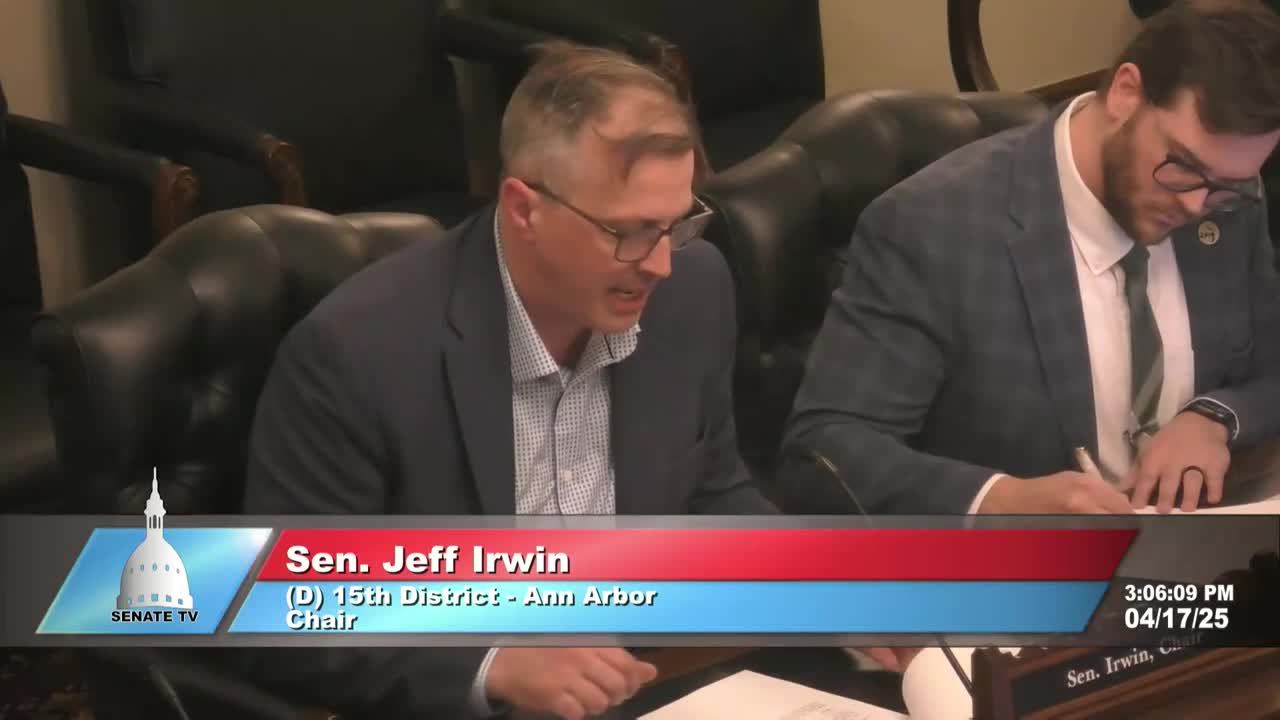
Votes at the meeting were procedural. The subcommittee approved minutes of its prior meeting on a motion by Senator Singh, supported by Senator Bayer, adopted without objection. Chair Irwin moved to adjourn at the end of the hearing; the motion was supported by Senator Bayer and the committee adjourned without objection.
Ending: EGLE officials urged the committee to support steady funding to keep remediation projects moving and to back the department’s records‑digitization proposal so public records and developer due‑diligence can proceed more quickly. Subcommittee members indicated interest in further work on the surcharge distribution and asked for continued briefings as the department implements risk‑based corrective action guidance and completes its digitization effort.