
Appropriations committee advances DOT budget; bill moves with new gas tax, Highway 85 bonding and reworked flex fund
Get AI-powered insights, summaries, and transcripts
Subscribe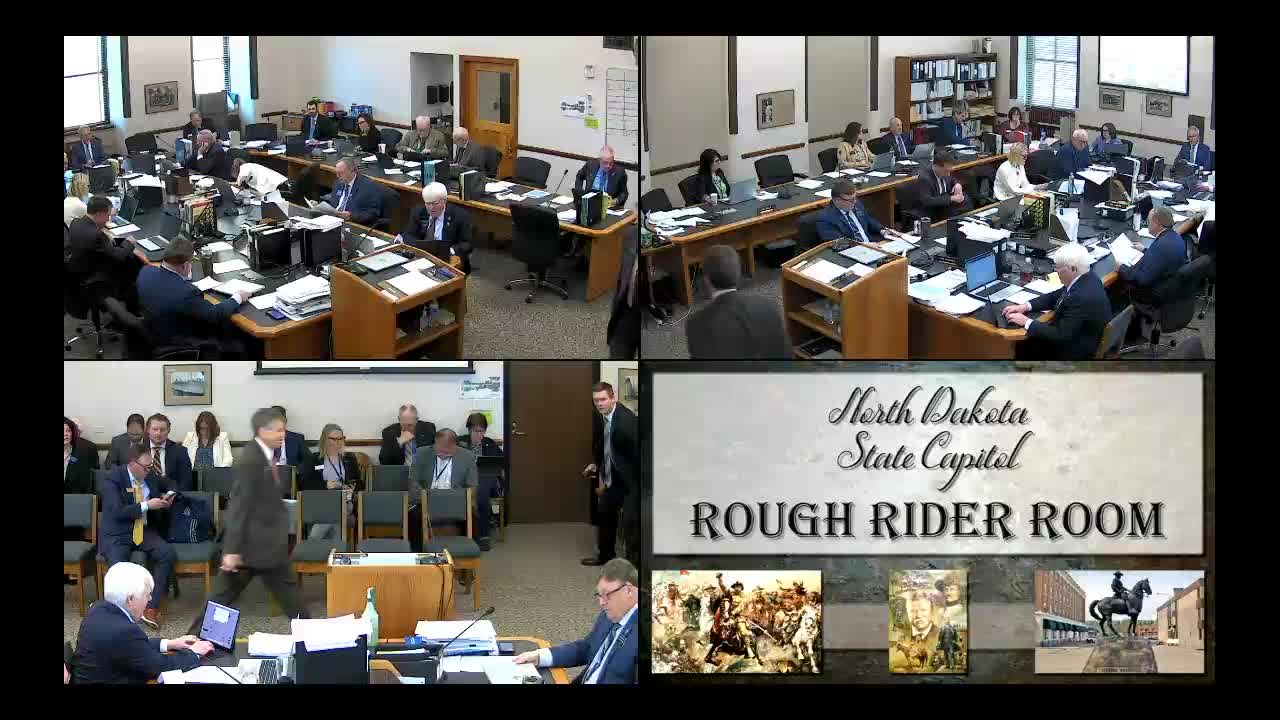
Summary
Senate Bill 2012, the Department of Transportation budget, passed the Appropriations Committee after amendment and a final "do pass as amended" vote. The package includes a 5-cent gas-tax increase estimated to produce about $70 million annually, $155 million in bonding for a 19-mile Highway 85 project, reconfigured flexible transportation funding replacing a prior "prairie dog" bucket, and changes to legacy and SIF distributions.
Senate Bill 2012, the budget for the Department of Transportation (DOT), cleared the Appropriations Committee on a voice/roll call vote after the committee adopted an amendment and then voted to report the bill as amended. Representative Brandenburg carried the bill and spoke at length about funding buckets, program changes and how the proposal would shift revenue streams to stabilize state transportation funding.
The measure reconfigures a previously proposed “prairie dog” bucket into a flexible transportation fund, increases the legacy earnings distribution, authorizes $155 million in bonding for work on Highway 85, and includes a 5-cent increase in the state gas tax that sponsors estimate will generate about $70 million annually for transportation purposes.
Why it matters: The bill changes how oil-related and other transportation revenue is distributed among the DOT, counties, cities and townships; it explicitly funds a federal grant match that sponsors said is required to secure certain highway grants, and it authorizes bonding and spending that supporters say are needed to keep multi-year projects, including NEPA approvals, viable.
Key provisions and committee discussion
- Gas tax increase and revenue flow: The bill adds five cents to the gas tax. Sponsors estimated the increase will produce about $70 million in new revenue, with distribution changes that direct a portion to the DOT, counties, cities and townships. Speaker Robin Weiss said the change was intended to stabilize a variety of transportation revenue buckets and noted the state had not raised the gas tax since the late 1990s. "You have 5¢ gas tax that goes into the distribution fund generate $70,000,000 of new revenue," Weiss said.
- Flexible transportation fund and distributions: The package converts a prior $400 million “prairie dog” bucket into a $370 million flexible transportation fund and a broader set of buckets. Representative Brandenburg and staff walked the committee through percentage splits tied to the new fund. Sponsors cited the need for certainty because the prairie dog pot had historically been volatile. The committee discussion repeatedly returned to the allocation percentages: 43.43% (approximately $159,000,000) for non–oil counties; 13.5% (about $49,900,000) earmarked for statewide projects (a portion that the DOT would allocate for statewide priorities and match needs); 7% (about $25,900,000) for townships; and two 11.5% shares (each about $42,500,000) for counties and for cities, respectively. Representative Brandenburg summarized the intent: the flexible fund combines direct distributions and grant funding scored by a joint committee of DOT, counties, cities, townships and commerce.
- Highway 85 bonding: Section 11 authorizes $155 million in bonding to complete a 19-mile stretch of Highway 85. Committee testimony explained 13 miles of the 19 qualify for a $55 million federal grant, while a remaining 6 miles do not qualify for federal funding and would be financed with state bonding. "You need $155,000,000 to do this whole 19 miles," Representative Brandenburg said, noting that partial construction would create safety and continuity problems.
- Legacy earnings and SIF transfers: The bill raises the legacy earnings distribution from 7% to 8% and allocates the resulting first-biennium receipts after bond payments to both the DOT and the legacy property tax relief fund. Sponsors provided figures: an estimated $688 million in legacy earnings in the first biennium, minus $102 million to cover sinking and interest, leaving $586 million; about 25% of that ($146 million) would go to DOT and 75% ($437 million) to the legacy property tax relief fund. The bill also includes an authorization to transfer $370 million in SIF dollars into a flex funding bucket used across buckets.
- Federal match and grants: Sponsors emphasized that DOT must show matching funds to be competitive for Federal Highway Administration grants. The package includes federal-formula match dollars of approximately $171 million (SIF match) and language intended to ensure DOT can match grants such as the Highway 85 award. Speaker Weiss told the committee matching capacity made agencies more likely to secure federal grants: "If they don't already have that money, the odds of them getting the grama are very slim."
- Townships, criteria and project scoring: The bill keeps a grant-scoring committee consisting of DOT, counties, cities, townships and commerce to set grant criteria and prioritize projects. The bill also contains language that a locality’s adoption of ordinances or policies that exceed state statute or that unreasonably restrict agriculture or energy facility projects could be considered in scoring. Representative Nelson, Representative Mitscog and others debated that provision; Representative Nelson later moved unsuccessfully to strip those lines from the bill.
- Other items: The bill adds 1 FTE for statewide interoperable radio coordination and 1 FTE for state airplane operating expenses; it authorizes small facility improvements, a driver’s license appointment system upgrade, parts tracking and other DOT capital and operating expenses; it contains language allowing limited workplace appliances (coffee makers, microwaves, refrigerators) at DOT facilities; and it identifies unspent and carried forward appropriations from prior sessions for use on awarded projects.
Committee amendments, votes and next steps
- Adoption of amendment 02/2009: Representative Brandenburg moved amendment 02/2009 and Representative Munson seconded. The committee adopted the amendment by voice/roll call; the clerk recorded the result as 19–1 with 3 absent (chair announced "Motion carries nineteen-one and 3 absent not voting"). The amendment text was identified in committee as the printed 02/2009 version; representatives discussed and confirmed several line-item figures during the amendment debate.
- Motion to remove page 7, lines 8–12: Representative Nelson offered an amendment to remove the provision that would allow the grant-scoring committee to consider local ordinances or policies that exceed state statute or restrict agriculture/energy projects. That motion was seconded and failed on roll call (the clerk recorded the result as 5–15 with 3 absent).
- Final recommendation: Representative Brandenburg moved the committee to give Senate Bill 2012 a "do pass as amended" recommendation; Representative Munson seconded. The committee voted to report the bill as amended; the clerk recorded the final tally as 20–0 with 3 absent. The chairman announced Representative Brandenburg will carry the bill forward. The committee recessed for scheduled conference committees; staff said the bill will move to conference committee scheduling and next steps will be set by the chair.
Quotations (from committee speakers)
- Representative Brandenburg (bill carrier): "That's the idea behind all this." (explaining the intent of distributions and allowing townships time to meet eligibility thresholds). Representative Brandenburg also walked the committee through the funding buckets and project details throughout testimony.
- Speaker Robin Weiss (sponsor/overview): "You have 5¢ gas tax that goes into the distribution fund generate $70,000,000 of new revenue for the...township cities, counties and the highway department." He described the bill as an effort to balance multiple revenue buckets and ensure DOT can match federal grants.
- Representative Murphy (questioner): Asked how the change would affect cities that historically received prairie dog distributions and whether the new structure could leave some municipalities with less certainty; sponsors said the bill seeks to preserve core distributions while adding grant eligibility and flexibility.
- Representative Nelson (questioner): Pressed on whether the NEPA study or cross-state coordination could be at risk if construction did not continue; sponsors said the bonding and matching provisions were intended to protect continuity of multi-year projects and the federal NEPA record.
Ending
The committee recommended Senate Bill 2012 "do pass as amended" and the bill will move forward with Representative Brandenburg as the floor/carrier. Committee members and staff said detailed spreadsheets and distribution breakdowns would be shared with members and that conference committee scheduling would determine the next floor consideration. The committee recessed for scheduled conference committees after the vote.