Get Full Government Meeting Transcripts, Videos, & Alerts Forever!
Get email alerts on the 2025 Bond Proposal topic
No spam. Unsubscribe anytime.
Troy council advances plan for up to $112 million bond for library, roads, parks and public safety
Summary
City staff presented a proposed $112 million capital bond focused on replacing the library and funding streets, parks and public safety; council signaled informal consensus to continue community engagement and aim to keep the debt millage at or below 1.0.
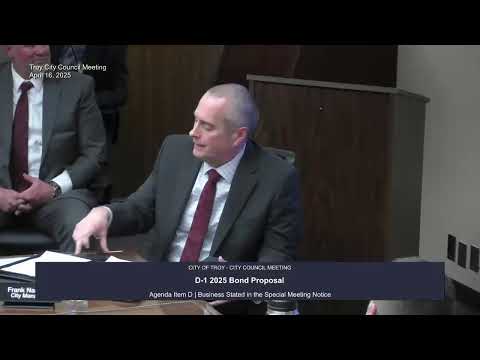
Troy City Council spent a special meeting April 16 weighing a proposal to place a bond question on the November 2025 ballot that would raise about $112 million to fund a new library, street repairs, parks projects and public-safety equipment.
The proposal staff presented allocates roughly $50 million for a new library, $35 million for streets, $17 million for parks and $10 million for public safety, including fire apparatus and police body cameras, City Manager Nastasi said at the meeting.
The bond matter matters because city officials say deferred capital needs have left the community with limited capital reserves. James Vitrano, the facilitator of the city’s January capital conference, told council that staff prioritized library, public safety, streets, City Hall and parks during that session and narrowed the November ballot recommendation to the four categories now before the council.
City staff and consultants described the library proposal as the largest single piece. Vitrano said the existing library, which opened in 1972, provides about 0.6 square foot per resident while national planning benchmarks range from 0.9 to 1.2 square foot per resident. Staff’s cost model used a working figure of about $550 per square foot and an anticipated building in the range of roughly 82,300 to 90,000 square feet to reach the $50 million estimate; Vitrano cautioned the figure will be refined in May when schematic-design cost estimates arrive.
On the question of renovation versus replacement, a city staff member identified as Kurt said architects and previous bids showed interior renovation alone would be costly and might not deliver a functioning modern library given the building’s footprint and layout. Council members and staff cited consultant estimates that renovating the current building could start around $20 million but that adding the additional square footage needed could approach or exceed the cost of a new building.
Public comment included opposition and support. Dave Niven, identifying himself as a fourth-generation Troy resident and HOA president, said, “I’m not anti-library, but rather pro fiscal responsibility,” and urged the city to consider leasing or reusing existing vacant commercial space before building new. Jen Peters of the Troy Historic Village said she supported the bond because a city bond could free general-fund money for other local projects and help preserve city facilities.
Council members pressed staff on ballot language, flexibility and financial scenarios. City attorney Laurie Bloom said state law requires the ballot question to identify the categories for which money will be spent but does not require allocations by line item, a flexibility council could use if project costs change. A finance staff member and consultants ran scenarios showing that, depending on interest rates and taxable value assumptions, the city could structure a bond package that would keep the city’s debt millage around or under one mill; one consultant said a 4% interest-rate scenario could support up to about $124 million under certain assumptions.
Staff outlined next steps and tentative dates: a joint Planning Commission–City Council review of the library on April 28; schematic-design cost estimates to be presented May 30; and a requested direction from council in June (June 9 was mentioned) to prepare formal bond language for an August/November schedule. Staff and council emphasized the city’s obligation to prepare neutral educational materials about any ballot question.
There was no formal vote at the special meeting. Multiple council members and staff said they heard broad support and indicated informal consensus to continue community engagement and aim to keep the debt impact near or under 1.0 mill. Council members also asked staff to continue refining project scopes, pursue cost-containment options, and return with updated cost estimates and proposed ballot language before any vote to place a bond on the ballot.