Get Full Government Meeting Transcripts, Videos, & Alerts Forever!
Get email alerts on the Local Option Sales Tax topic
No spam. Unsubscribe anytime.
Committee moves local option sales tax study resolution to formal session after public comments
Summary
The committee voted to send a resolution authorizing the Legislative Policy Division to contract with the Citizens Research Council to study a local option sales tax ("smart tax"), a proposal public commenters and committee members said could diversify city revenues; legal limits under Michigan's constitution were noted and will be studied.
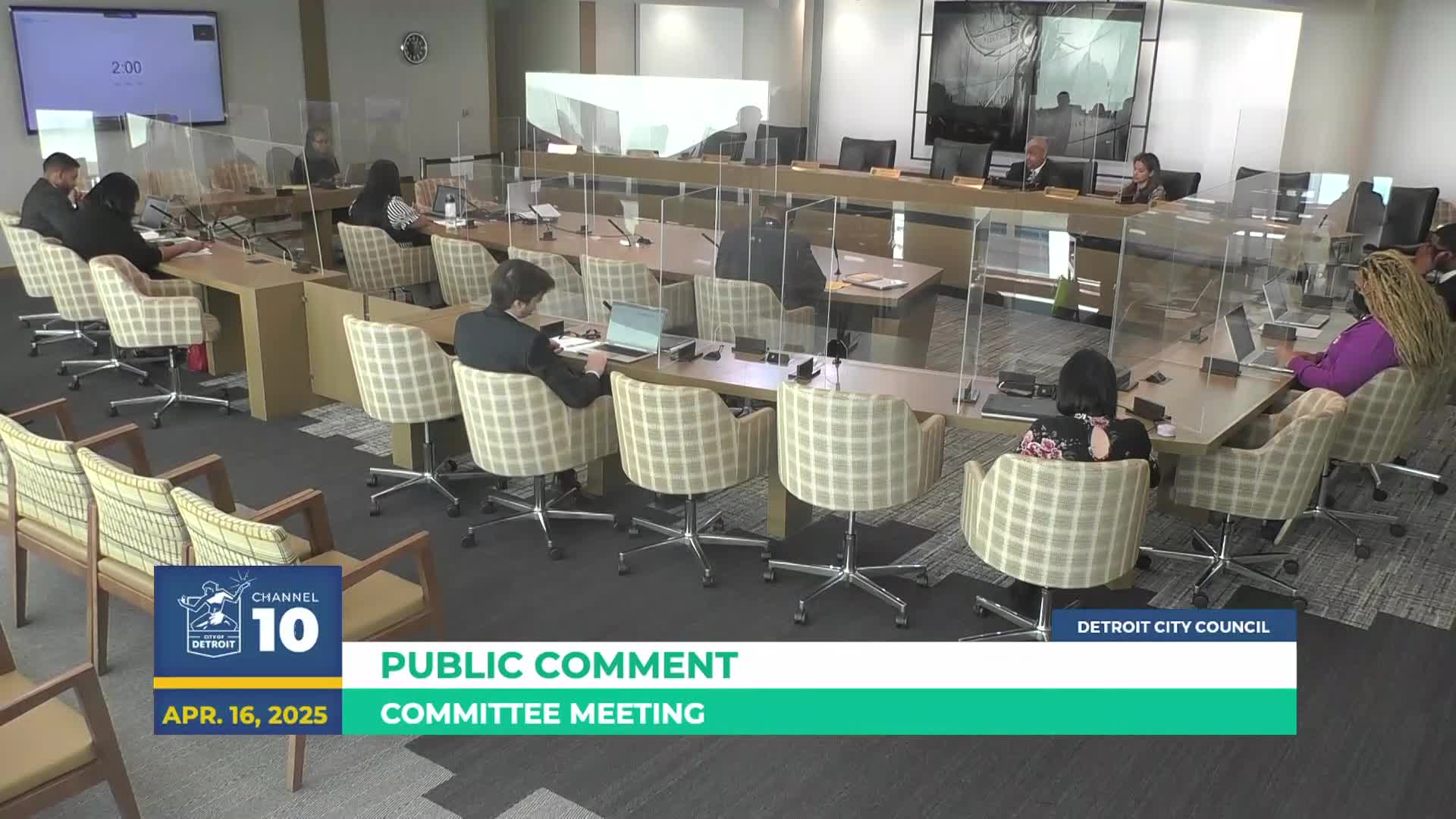
The Budget, Finance and Audit Standing Committee voted to move to formal session a resolution directing the Legislative Policy Division (LPD) to contract with the Citizens Research Council (CRC) to study a possible local option sales tax, often described in public comment as a "smart tax" or LOST (local option sales tax).
Public comment included two callers who urged the committee to support the study. Tony Reeves, identifying himself as a PhD candidate in economics at the University of Michigan and a member of the Equitable Development Task Force, said 38 states have used local option sales taxes and cited examples he said included large revenue gains; Reeves called for a study to examine targeting out-of-state spending and timing/location of levies and closed his remarks, "Let's get lost, Detroit." David Palmer, who chairs the taxation committee for the council's Equitable Development Task Force, also urged support and said he had sent committee members emailed materials; Palmer noted the city receives many visitors and said diversifying revenue streams could offset property-tax pressure.
During committee discussion council members asked whether the study would also examine a local amusement tax and whether state constitutional limits would preempt action. Committee member (identified in the record as) Mr. Corley said the study could include a local amusement tax because entertainment venues and stadiums generate significant event-driven spending. Council member Young raised a constitutional concern and referred to the Michigan Constitution; Graham Anderson from the Law Department said Councilman Young was correct that legal constraints exist and that the law department would review the legal issues if the project moves beyond the study stage.
Council member Gabriela Santiago Romero said she supported the study and moved to send the resolution to formal session with a recommendation for approval. The motion passed with no objections recorded.
The resolution requests LPD to prepare a contract with the CRC to evaluate options and impacts, including (but not limited to) revenue estimates, incidence (who bears the tax), comparisons with other jurisdictions, and legal constraints under Michigan law. The committee discussed that any local-option authority would likely require state authorization or statutory change; Romero said the materials would be used to build a narrative to seek change in Lansing. Action taken: line item 7.11 moved to formal session with recommendation for approval.