
Planning Commission unanimously backs 2025 housing-regulation updates including co‑living and density changes
Get AI-powered insights, summaries, and transcripts
Subscribe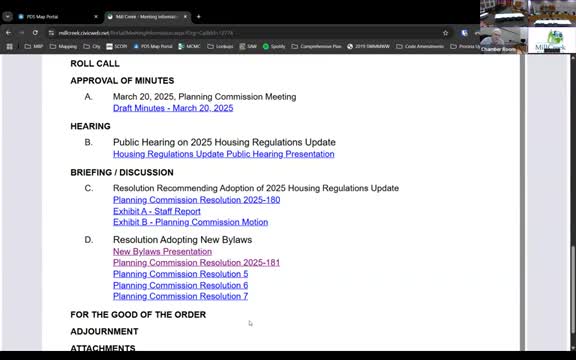
Summary
The Mill Creek Planning Commission voted unanimously April 17 to recommend that City Council adopt a package of 2025 housing regulation updates implementing several recent state bills, including changes to middle‑housing definitions, density bonuses for conversions, and provisions for co‑living/boarding houses.
The Mill Creek Planning Commission voted unanimously April 17 to recommend that City Council adopt a package of 2025 housing regulation updates that implement recent state legislation, including HB 1042 and HB 1998.
Staff told commissioners the package adds changes required by multiple bills, removes accessory dwelling units from the commission's definition of "middle housing," and creates a set of zone‑specific rules for conversions of existing commercial buildings to residential use. "HB 1042 requires that allowed densities be increased by 50% for housing added to existing buildings and limits parking for those new units," staff said, noting the change will primarily affect the Community Business Zone and other non‑Town Center areas because Town Center already lacks a density cap.
The amendments also add boarding‑house or "co‑living" uses in higher‑density zones as required by state law. Staff read the statutory definition into the record: "Co‑living housing is residential development with sleeping units that are independently rented and lockable and provide living and sleeping space, and residents share kitchen facilities with other sleeping units in the building." Staff said cities may use alternate local terms such as "boarding house" or "rooming house."
Commissioners asked whether homeowners' association covenants (HOAs) can block boarding‑house or co‑living development. Staff said the bills as drafted do not expressly preempt HOA covenants and that the city will seek additional guidance from the state commerce office. "Reading through the bill now, there are no references to HOAs. So I would assume that HOAs are not prohibited from banning these housing forms," staff said.
Other code edits presented include: clarifying that distances used in standards are walking distances rather than straight‑line measurements; exempting parking requirements for units created when converting commercial buildings to residential; adding a 50% density bonus in the density calculation for building conversions; and adding boarding‑house allowances in MDR and Mixed‑Use High‑Density chapters. Staff also noted minor code cleanup items and invited commissioners to submit nonpolicy edits (grammar/formatting) before the City Council review.
A commissioner asked whether the package would create a pathway for three‑bedroom apartments to be sublet room‑by‑room and then used as short‑term rentals. Staff replied that the city currently defines short‑term rentals but has not enacted broad prohibitions; the city is collecting data to determine the scope of short‑term rental activity and whether separate regulation will be necessary.
After discussion, a motion recommending that City Council adopt the proposed code amendments was moved and seconded. The commission voted unanimously to forward the resolution to Council with staff's recommended language.
The commission's recommendation covers the regulations implementing multiple bills named during the meeting (including HB 1042 and HB 1998) and will be considered by City Council in its adoption process. Staff said the commission may submit minor wording changes before Council acts and that staff will follow up with state commerce on the HOA preemption question.