Get Full Government Meeting Transcripts, Videos, & Alerts Forever!
Get email alerts on the Labor topic
No spam. Unsubscribe anytime.
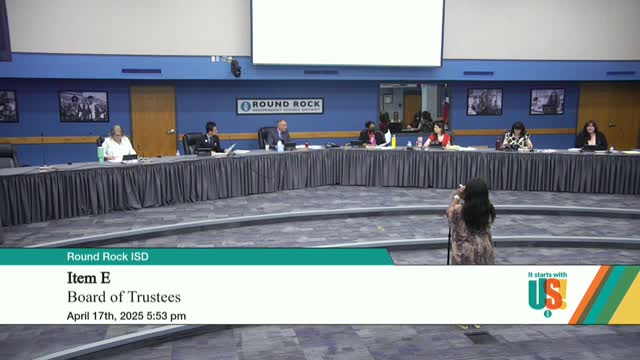
Round Rock ISD public commenters press board on nonrenewal process and ask trustees for a 3% pay raise for all staff
Summary
During the public‑comment period a Wells Branch teacher described being recommended for nonrenewal despite classroom performance claims; Education Round Rock’s president urged a 3% across‑the‑board raise for district employees and highlighted low minimum wages for support staff compared with neighboring districts.
Two public speakers used the board’s public‑comment period to raise personnel and pay concerns for Round Rock ISD employees.
Tamay Tisdell, who identified herself as a teacher at Wells Branch, told trustees she had grown 90% of her dual‑language students in math and completed four service‑learning projects but did not receive a formal evaluation this year and was recommended for nonrenewal. Tisdell said district nonrenewal decisions “should not be based on personal preference” and should rely only on professional judgment she said is best for students.
Tammy Conrad, president of Education Round Rock (the local affiliate of the Texas State Teachers Association and the American Federation of Teachers), urged the board to approve a 3% raise for all employees next school year. Conrad said the state per‑student allotment has not kept pace with inflation since 2019 and described the passage of vouchers as a new pressure on district revenue. She contrasted the district’s minimum wage for lowest‑paid staff ($15.25) with a neighboring district (Austin ISD) that sets a $20.25 minimum and argued the pay gap and inflation risk staff retention. “Education Round Rock is asking for a 3% raise for all employees for the next school year,” Conrad said.
Why it matters: The comments raised two distinct governance issues: board and administrative decisions on personnel actions, and district compensation levels amid uncertain state funding. The board did not respond during public comment, consistent with policy.
Ending: Trustees acknowledged the comments and the budget presentation that followed, which staff said would include compensation modeling in mid‑May after state legislative changes are reconciled.