
Planning commission approves variance allowing second dwelling on 2.5‑acre Santa Fe County lot over staff objection
Get AI-powered insights, summaries, and transcripts
Subscribe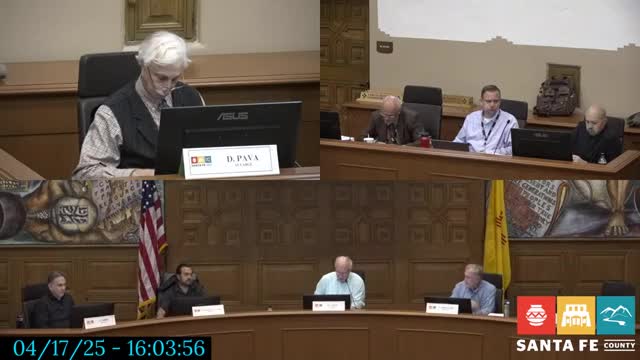
Summary
The Santa Fe County Planning Commission on April 17 approved a variance (Case 24‑5270) to permit a second two‑story residence on a 2.5‑acre parcel belonging to Robert and Denise Sherwin, despite staff and a hearing officer recommendation of denial. Commissioners voted 4‑1 with conditions including address wayfinding signage.
The Santa Fe County Planning Commission on April 17 approved a variance that allows a second two‑story residence on a 2.5‑acre parcel at 28 Estrella Estano, granting the property owners relief from the Sustainable Land Development Code density limit of one dwelling per 2.5 acres. The vote followed extended staff presentation, public testimony both for and against the request, and legal discussion about nonconforming uses and “grandfathering.”
The decision matters because it changes how the county enforces single‑dwelling density on the affected lot and sets conditions on a property that has operated short‑term rentals and a home‑occupation wellness business. Staff, the county hearing officer and several neighbors had urged denial, citing code, septic and road and water‑use concerns.
John Lovato, Building Development Services supervisor, presented staff analysis and told the commission that the structure in question had characteristics that prevented it from qualifying as an accessory dwelling unit under the SLDC: the unit is two stories, measuring about 19 feet 6 inches in height, and it had a separate septic system whose registration status was initially unclear. "Staff recommends denial of the request for a variance to allow the 2 dwelling units on the 2.5 acre parcel," Lovato said, citing the hearing officer's finding that the application did not meet the SLDC variance criteria.
Applicant representatives argued the guest house predates the current code and should be treated as a lawful, nonconforming structure. Danny Martinez, the applicants' agent, said his review of records and state files indicated the guest house and septic work date to about 1989–1991 and that Construction Industries Division records are limited that far back. "We firmly believe that this is a legal conforming structure," Martinez told commissioners, adding that the applicants are prepared to submit after‑the‑fact permits to clarify documentation if required.
Robert Sherwin, the property owner, described long‑running short‑term‑rental operations on the guest house: "We've been renting it out for 9 years since 2016," he said, and noted the main house and guest house share a driveway and utilities. The Sherwins and their agent told the commission they would comply with reasonable conditions and had already removed or agreed to remove some exterior uses that neighbors complained about.
Neighbors opposed the variance at the public hearing. Terry Graves, a resident who said she lives directly across the street, told the commission the neighborhood already shares a private well and maintains an unpaved road that has seen increased traffic. "We in turn share a well. We maintain the road ourselves," Graves said, and said the group had safety and water‑use concerns tied to guests and increased vehicle trips. Another nearby resident emphasized the fire‑risk concerns connected to an on‑site fire pit and said some neighbors have faced insurance impacts in the ZIP code.
Commission discussion centered on three core SLDC variance criteria: whether the request is contrary to the public interest, whether it maintains the spirit of the SLDC, and whether extraordinary or exceptional conditions of the property justify the variance. Commissioners asked staff whether the studio label on the original 1991 plat and the absence of a retrievable building permit meant the structure was lawfully constructed at the time. Lovato said staff recognizes the structure as previously labeled a studio on the legal lot of record but that the burden to demonstrate a lawful nonconforming status rests with the applicant.
Commissioner Dan Pava moved to approve the variance with a revised set of conditions; the motion replaced a previously noted condition requiring an OSE/NMED septic permit (staff stated that documentation had since been provided) with a requirement that the property post its 911 address at the gate or otherwise provide wayfinding/address signage consistent with county rules. The motion passed by roll call 4‑1. The commission did not identify every individual vote on the record beyond those who verbally indicated yea or nay during the roll call; the final tally announced on the record was four in favor and one opposed.
If the commission had denied the variance, staff said the property owner’s remedies to bring the accessory structure into compliance could include removing the loft or otherwise altering the outbuilding so it met single‑story ADU height and plumbing standards, or submitting after‑the‑fact permits for review by county staff and the Construction Industries Division. The approved variance carries the conditions set at the hearing and the replacement condition requiring visible address/wayfinding signage for emergency response and guest navigation.
The planning commission action resolves Case 24‑5270 for now; the decision may be appealed according to county procedures or revisited if subsequent compliance steps or permit reviews change the factual record.