
Sammamish planning commission backs package of minor Title 21 code amendments, sends them to council
Get AI-powered insights, summaries, and transcripts
Subscribe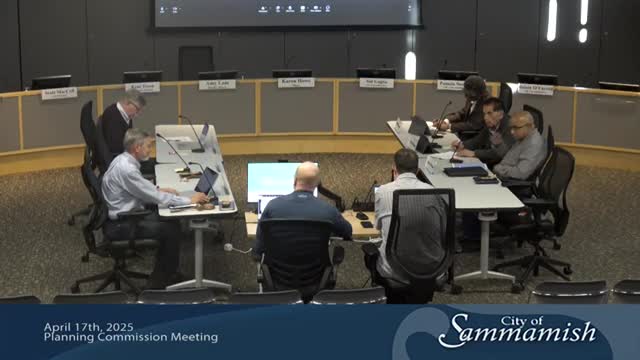
Summary
The Sammamish City Planning Commission on April 17 recommended a set of mostly technical changes to Title 21 — including who signs off on final plats, how building height is measured, and how fences on retaining walls are handled — and forwarded the package to the City Council with several edits.
The Sammamish City Planning Commission on April 17 recommended a set of mostly technical changes to the city’s land-development regulations and will forward the package to the City Council for final consideration.
The commission voted to send a group of edits intended to clarify definitions and measurement methods, move final subdivision approval from City Council to the hearing examiner, simplify building-height measurement, and update fence-and-retaining-wall measurement rules. Staff also proposed removing some occupancy and spacing restrictions for permanent supportive housing and emergency shelters after guidance from the Washington State Department of Commerce; the commission approved a narrower spacing change instead of eliminating spacing entirely.
Planning staff presented the package as seven exhibits that refine language added during the comprehensive-plan update. Evan, a city planning staff member, summarized the work as “fairly minor code amendments” meant to clarify administration, add missing definitions and correct calculation methods. He told the commission the changes are intended to make enforcement and permitting more predictable and to reflect state law changes that allow delegation of the final plat step to an appointed hearing examiner.
Why it matters: the edits are procedural and drafting fixes, but several affect how development permits are processed and measured. The change moving final subdivision approval from the City Council to the hearing examiner removes a ceremonial council step and makes the hearing examiner the final local authority before the county records a plat. Evan said the amendment reflects state law and “the hearing examiner is the one who does the preliminary approval process and understands the project.” Commissioner discussion clarified the examiner’s decision is then recorded with the county and susceptible to the same appeal route (superior court) as before.
Other notable technical changes approved: - Definitions: add a definition for a “hedge” and for area median income (AMI) tied to HUD data; staff noted they would consider whether shrubs should be included under the hedge definition after public feedback. - Building height: replace the current “crown of the street” measurement with an average existing grade plane method and clarify sidewall-height limits when a wall is within a short distance of a side lot line. - Fence/retaining-wall measurement: clarify when fence height and retaining-wall height are measured together or independently; the commission amended staff language to require a maintained 2-foot setback from the back of the retaining wall (rather than a 2-foot “plantable” zone) so the two elements can be measured independently. - Critical-facility spacing and occupancy rules: in response to Commerce, staff recommended removing occupancy and spacing limits for shelters to ensure the city can demonstrate capacity; the commission supported removing occupancy limits but kept a reduced spacing requirement (quarter-mile) rather than eliminating spacing entirely. Commission discussion also removed a strict “walking distance” requirement that staff had recommended deleting; the final language says facilities should be located near transit “when feasible” and the commission restored a quantifiable half-mile walking-distance reference in the text.
Staff noted the Department of Commerce raised the issues because the city must demonstrate regional capacity for emergency shelter and permanent supportive housing. As Evan described it, the earlier occupancy caps and wide separation distances would have made it difficult to show that capacity.
Final step and timing: planning staff said the package will be presented to City Council at a workshop on May 6 and considered for adoption on May 20. The commission recorded motions and votes on April 17 to forward the exhibits (with the commission’s amendments) to Council.
Quotes from the meeting: resident James Eastman said during public comment that recent plats had not used all allowed density, noting “they're allowed 18 units of density, but they only used 12.” Community Development Director David Pyle noted staff republished the packet to incorporate written comments and typo corrections the commission had received.
What the commission did and did not change: these are drafting, administration and measurement clarifications; they are not new land-use entitlements. The commission removed some code ambiguities and adjusted a couple of policy-adjacent items (shelter spacing, fence/retaining-wall measurement). The commission left other operational protections and conditions in place and instructed staff to include clarifying language where appropriate.
Next: the City Council will receive the commission’s recommendation and the packet with the commission’s amendments for its May workshop and potential adoption on May 20. If Council adopts the ordinance, the hearing-examiner and administrative procedures described in the amendments will take effect as written in the ordinance the council signs.