
Lindbergh teaching-and-learning team adopts a Compass document linking priorities to measurable success measures
Get AI-powered insights, summaries, and transcripts
Subscribe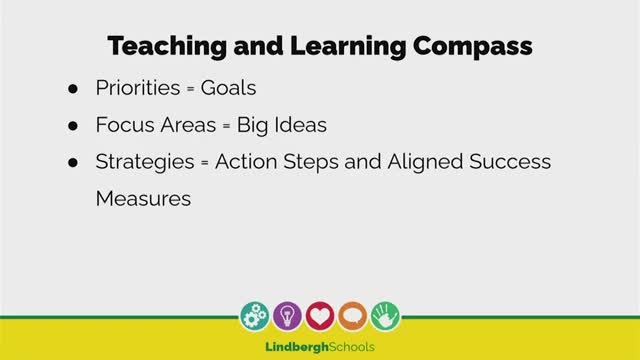
Summary
District leaders described a revised 'Compass' document aligning three priorities (inclusive environments, professional growth, guaranteed and viable curriculum) to measurable success indicators including attendance targets, Panorama social-emotional screeners and curricular scorecards.
District teaching-and-learning leaders presented a redesigned Compass document that maps three priorities to specific strategies and success measures meant to align building- and district-level work.
The document organizes district priorities into three areas: (1) safe, supportive and collaborative environments tied to social-emotional learning and attendance intervention, (2) professional growth and instructional leadership, and (3) guaranteed and viable curriculum and academic achievement. Presenters said the Compass ties strategy to measurable outcomes so buildings can align their action steps and scorecards to district targets.
Examples and measures
- Priority 1 (inclusive environments): The team described a tiered attendance intervention and listed a success measure of building attendance rates at 95% or higher. Leaders said attendance will be tracked in teaching-and-learning meetings and used to decide adjustments.
- Social-emotional screening: The district will use Panorama for grades 3 through 12 and set success measures that include achieving the 40th percentile or better on Panorama benchmarks and 90%+ student participation in fall and spring administrations.
- Priority 2 (professional growth): The Compass documents strategies for instructional models, collaboration, communication and sustainable professional learning. Success measures will include both data points and artifacts to show measurable professional development outcomes.
- Priority 3 (curriculum and achievement): The Compass links guaranteed and viable curriculum to academic achievement targets. District leaders said they will measure progress with iReady for grades 3'8 and NWEA for ninth-grade English I and algebra. The document also highlights a blue asterisk to flag strategies that principals are required to include in building plans.
Real-world learning and scorecards
Leaders said the district will track enrollment and retention for real-world learning opportunities (client-connected projects, internships, capstone experiences) and noted that some initiatives are high-school specific. Each building will maintain scorecards to monitor progress against district goals.
Ending
Presenters said the Compass is a working document and that buildings will replicate the district structure locally to provide clearer alignment between action steps and expected outcomes. Board members praised the alignment and the emphasis on measurable success indicators.