
Small independent distributors urge investment in refrigerated cross‑docking, meat packaging and business support to keep Vermont food flowing
Get AI-powered insights, summaries, and transcripts
Subscribe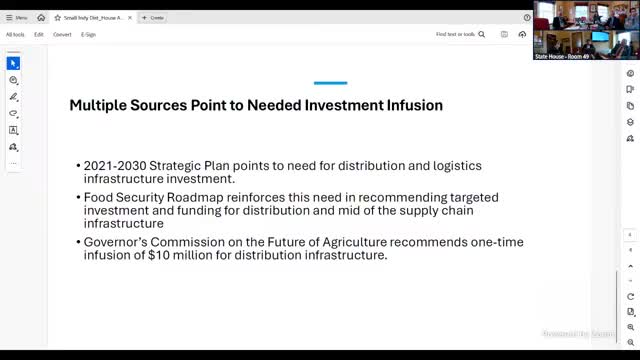
Summary
Jake Claro, a staff member, convened a panel of small independent food distributors on Tuesday to describe how local logistics gaps threaten Vermont producers’ access to markets and to outline practical investments that could strengthen the middle of the state’s food supply chain.
Jake Claro, a staff member, convened a panel of small independent food distributors on Tuesday to describe how local logistics gaps threaten Vermont producers’ access to markets and to outline practical investments that could strengthen the middle of the state’s food supply chain.
“[They are] playing a crucial role in helping Vermont reach its food system strategic goals,” Jake Claro said, summarizing why small distributors matter to farm viability and market access.
Annie, founder of Myers Produce, said her business has operated since 2013 and now works with roughly 200 producers and 200–300 customers per season. Myers runs six trucks and three vans, maintains a primary warehouse in western Massachusetts and rents aggregation space from the CAE food hub in Hardwick. “We offer distribution, refrigerated transportation, and storage and cross‑docking,” Annie said, describing services that allow small farms to sell beyond local markets without taking on full self‑distribution.
Seth, owner of Pumpkin Village Foods, said his firm buys and resells about $600,000 of product annually, delivers to roughly 80 locations and works with about 32 producers; the business also performs $300,000–$350,000 in custom delivery work. Kathy Killam, owner of Killam Sales and Distribution, described a one‑vehicle model focused on very small producers and farm stands that relies on fast inventory turnover and extensive hands‑on assistance with labeling and merchandising.
Panelists told lawmakers that three areas pose recurring bottlenecks:
- refrigerated aggregation and cross‑docking space, especially in mid‑state corridors such as the Middlesex/White River Junction radius, where producers lack easy places to consolidate product for regional trips; - meat packaging, labeling and inventory systems that make it difficult to sell catch‑weight or mixed cuts to wholesale customers; and - business supports and funding outreach that do not always align with the needs of distribution businesses (grant programs tend to be framed toward farms rather than small independent distributors).
Annie suggested that relatively small refrigeration units—“refrigeration that could fit 6 to 12 pallets”—could materially improve aggregation and reduce the number of separate pick‑ups distributors must make. She also said independent distributors regularly translate catch‑weight invoices and inconsistent packing conventions into sellable cases, and that the sector could benefit from shared packaging standards or grant support for packaging equipment.
Seth described how distributors sometimes must find markets for byproducts or co‑products to make certain wholesale deals work: when one restaurant asked for 60 pounds of pork chops each week, the supplying farm needed to ship ground pork as well; Pumpkin Village Foods found supplemental buyers for the ground pork so the weekly order could proceed.
Panelists repeatedly flagged the broader industry shift toward consolidation. Jake said the national wholesale market has concentrated around a few large broad‑line distributors, noting that three broad‑line wholesalers accounted for 34% of market share in 2020 and that Performance Food Group has a Vermont footprint after a series of acquisitions. That consolidation, the panel said, leaves small farms vulnerable when national buyers change buying patterns.
Speakers also listed smaller but tangible operational pressures: rising insurance costs, staffing constraints, and retailer requirements for barcodes and tighter inventory tracking. Kathy said many small producers need hands‑on help with labeling, barcodes and merchandising to meet store requirements.
Policy context discussed by panelists included the Farm to Plate strategic plan, the state Food Security Roadmap and recommendations from the governor’s Commission on the Future of Agriculture. Jake told the panel that the commission’s earlier recommendation included a one‑time infusion targeted at distribution infrastructure—roughly $10,000,000 in the original framing for meat, maple and produce distribution—though the money did not appear as a single line in the state budget and portions of it were split into smaller allocations.
Panelists proposed several near‑term, concrete options for policymakers to consider: targeted grants or technical assistance for refrigerated containers or small cross‑dock sites; packaging and labeling grants or shared services for meat producers to produce saleable wholesale cases; and outreach or eligibility changes so small distributors can apply for existing Working Lands or Ag Development funds. “If the infrastructure existed,” Annie said, “it could be less staffed and less kind of… if there could be one organization managing a lot of different locations.”
The panel did not propose any new regulatory change; presenters emphasized operational and funding gaps. Lawmakers asked clarifying questions about geographic gaps, frequency of trips to urban markets and how independent distributors coordinate last‑mile sales in New York City and Boston.
Jake closed by saying the discussion would inform further ideas and that organizers would collect the recommendations shared by distributors for follow‑up with agency staff and programs.
Ending: Panelists asked lawmakers to consider small, targeted investments—refrigerated cross‑docks, shared packaging resources and clearer grant outreach—to shore up the middle of the food supply chain so Vermont producers can maintain and expand wholesale market access.