Get Full Government Meeting Transcripts, Videos, & Alerts Forever!
Get email alerts on the Referendum Budget topic
No spam. Unsubscribe anytime.
Marion County Schools reports third-quarter referendum revenues, program spending and safety investments
Summary
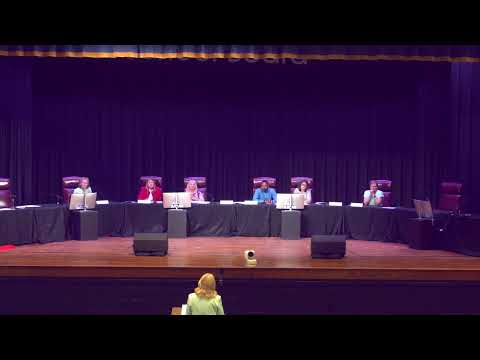
At an ICRCOT committee meeting, Marion County Public Schools presented a third-quarter report on the voter-approved one-mill referendum, showing cumulative revenue of $236.2 million (including the 2024–25 budget) and program-level spending and planned safety investments such as bus gateway cameras and the Raptor visitor/volunteer platform.
Marion County Public Schools presented its third-quarter report on the voter-approved one-mill referendum to the ICRCOT Committee, reporting $199,000,000 collected through the 2023–24 fiscal year and a combined revenue figure of $236,200,000 when the 2024–25 budget is included.
The presentation, given by the district’s finance lead and program coordinators, outlined how referendum funds are being used across physical education, kindergarten paraprofessionals, vocational (CTE) pathways, library/media services, visual and performing arts, professional learning and school safety. The district also described safety technology purchases and ongoing legal and operational questions around bus stop enforcement cameras.
The referendum funds support recurring salaries and benefits and program-level purchases; presenters emphasized that unspent money rolls forward in the referendum fund rather than being redistributed automatically to programs. “This is cumulative, but this particular worksheet provides you a summary of all the funds that have been collected and spent,” the district finance presenter said, describing the July-through-March (third-quarter) reporting period.
Why it matters: the referendum provides a dedicated local funding stream for activities the district said state or federal dollars do not fully cover (for example, certain safety equipment, paraprofessionals and program specialists). The report shows how those local dollars are being allocated and what remains in fund balance heading into the next fiscal year.
Key figures and program details - Revenue and expenditures: presenters reported $199,000,000 collected through 2023–24 and a total revenue figure of $236,200,000 when including 2024–25 budgeted revenue. Actual expenditures through 2023–24 were reported as $186,800,000; the 2024–25 budgeted expenditures for the referendum were listed as $43,300,000. The presenter said the district had collected 90.94% of projected revenue for 2024–25 and spent 57.34% of the year’s budget to date. - Fund balance: the beginning fund balance for 2024–25 was reported as $11,800,000; presenters said some funds typically remain unspent at year-end and roll forward into the next fiscal year. - Physical education: total referendum budget $9,600,000; $6,200,000 spent to date; $3,400,000 remaining. The program covers physical education teachers, PE technicians and a $2-per-student allocation for elementary supplies. Presenters said there are two vacancies among PE teachers. - Kindergarten paraprofessionals: budgeted $6,100,000; $4,600,000 spent to date; about $1,500,000 remaining. The district reported 169 filled positions and eight vacancies in that category. - Vocational/CTE programs: budgeted $2,400,000; $1,500,000 spent to date; roughly $900,000 remaining. Presenters said the program employed about 20 teachers with one vacancy and that funds may be used for salaries, capital outlay, materials and supplies. - Library/media: budgeted $4,000,000; $2,600,000 spent to date. Presenters said the district has certified media specialists who led countywide literacy initiatives and reported 61,753 physical book checkouts and 94 digital checkouts this quarter; the presentation included both a 49-count and a 48-filled-positions figure, which presenters did not reconcile during the meeting. - Visual and performing arts and music: total music budget and positions were described in the presentation (music budget shown as $5,200,000 with $3,300,000 spent to date). Presenters highlighted countywide student participation in art shows, choirs, dance festivals and state-level competitions. - Professional leadership and learning: total budget $628,000; $6,500 spent to date. The district described a mentoring and new-teacher induction program (mentors earn supplements for documented hours; 233 novice teachers currently assigned one-to-one mentors). - Safe schools: referendum budget $9,700,000; presenters reported about 31.52% of that budget spent to date. The district noted it also receives roughly $3–$4 million annually from the state specifically for safe-schools activities and uses referendum money to cover recurring capital and personnel costs not fully funded by the state.
Safety technology and procedures discussed District staff described several safety investments paid for from referendum or related funds: a gateway camera system installed on buses to record interior and selected exterior views (distinct from stop-arm enforcement cameras), two handheld metal detectors per school for administrative searches, the Raptor visitor and volunteer management platform for identity screening and a volunteer background-check workflow. The district also described recently installed doorbells at Marion After School Program (MAPS) entrances so staff can monitor and admit caregivers after-hours.
On enforcement cameras for vehicles that illegally pass stopped school buses, presenters said the district is monitoring legal developments and that Florida statute requires a 30-day public-warning period before citations begin; they also said any move to deploy stop-arm cameras would require cooperation from law enforcement agencies and a strategic public notice campaign.
Charter schools and reporting Presenters said a Florida statute now requires charter schools to be included in referendum calculations and that participating charter schools had a combined budgeted expenditure of $848,000 and actual expenditures of $699,000 for the period, which included a prior-year payment of $102,000 owed after the law changed. The transcript did not include a precise charter-student headcount; presenters said they would provide that number by email on request.
Committee business and follow-ups Committee members requested supplemental spreadsheets (referendum-funded units, examples of expenditures by program and a summary sheet requested by a committee member). Presenters said they would distribute those documents and answer outstanding questions via email. The committee approved the minutes from the previous meeting by voice vote earlier in the session.
What the presenters said: Dr. Gulick, speaking at the start of the meeting, thanked committee members for their oversight of student needs. The finance presenter summarized the referendum structure and time window: "This is the third quarter report. So July through March... this is cumulative." The district repeatedly emphasized that unspent budgeted dollars roll into the referendum fund balance and are available for the following year’s budgeting process.
Ending: The committee was told the remaining referendum balances are expected to be spent before the end of the fiscal year as capital and recurring expenditures are executed; presenters said they would provide additional requested detail by email and that the district is monitoring state-level legislation that could affect future funding priorities.