
Harwood Union reports higher engagement, fewer disciplinary claims after year of phone-free routine
Get AI-powered insights, summaries, and transcripts
Subscribe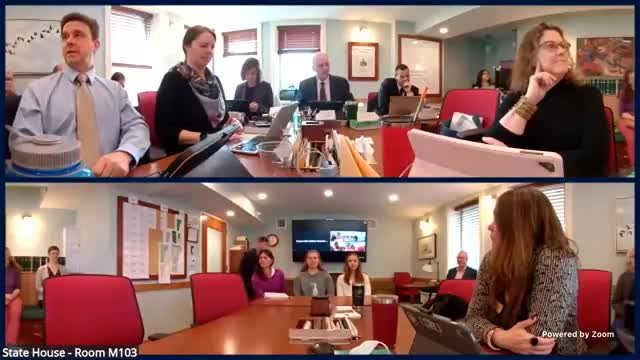
Summary
Megan McDonough, principal at Harwood Union Middle High School, told the Vermont House Education Committee on April 18, 2025, that after a year operating as a cell phone–free community students and staff reported higher engagement, improved academic measures and far fewer substantiated harassment claims.
Megan McDonough, principal at Harwood Union Middle High School, told the Vermont House Education Committee on April 18, 2025, that after a year operating as a cell phone–free community students and staff reported higher engagement, improved academic measures and far fewer substantiated harassment claims.
McDonough said the decision was made collectively by staff and the school community and implemented at the start of the school year. "On day 1, I kept looking around the building trying to figure out like where there was a potential challenge, but I wasn't seeing any," she said. Student representatives Eliana Buckingham and Celia Wang described widespread student adaptation and changes to daily interaction.
The school collected survey and administrative data to evaluate the change. McDonough reported that, in an October survey, 63% of students said they felt more engaged in class and 55% said their learning environment had improved; staff responses were higher, with 93% reporting increased engagement and at least 81% reporting improved learning environments. The school recorded a library circulation increase of more than 100 additional checkouts in the first month compared with the previous year. Harassment and bullying records fell sharply: "Last year over the course of the entire year, we had 9 substantiated hazing and harassment and bullying claims, and 11 in addition were investigated but not substantiated. In comparison, this year, we have had 1 substantiated claim, and 1 that was investigated but not substantiated," McDonough said. She also said semester‑to‑semester academic averages rose across the measures the school tracked, while acknowledging multiple factors could contribute to those gains.
Implementation details presented to the committee: Harwood bought Yondr pouches with leftover ESSER (Elementary and Secondary School Emergency Relief) funds; McDonough said the pouch purchase and magnets cost about $20,000, "and that includes the magnets." Each student is assigned a personal pouch; magnets at building entrances and at the main office are used to lock and unlock pouches. McDonough described the procedure as a school practice, not a formal board policy, and said adults in grades 7‑12 also committed to the practice.
The school emphasized trust and targeted enforcement rather than universal checks: McDonough said staff "do not engage in power circles. We don't ask every single student when they walk into the building to show us that they are putting it in the Yondr pouch." Students and staff reported emergency access procedures: the main office magnet can unlock a pouch for a student who needs to call home.
Committee members asked about logistics and side effects. McDonough said the school adjusted authentication systems so staff did not rely on phones for logins. Students and staff described occasional technology blocks (for example, a blocked New York Times article behind school filters using GoGuardian) but said they generally found alternative ways to access materials. Student representative Eliana Buckingham said about 200 students responded to the school survey and that many had initially pushed back but later reported benefits: "I'm gonna be completely honest in the school year, I don't just don't think about my cell phone." Student Celia Wang said not having phones in class helped students separate school time from personal device time.
McDonough noted accommodations for students with individualized education plans: about 14 students have specific allowances such as Velcro pouches or noise‑canceling headphones, and staff may allow a student to go to the front office to make a phone call if needed. The school reported roughly 490 high school students and 36 middle school students; magnets and unlocking stations are placed to handle dismissals and team departures.
Representatives on the committee thanked the Harwood guests for the data and the school's documentation of its experience. McDonough and others offered a short video of staff reflections; the committee agreed to go off the live stream to view it.