Get Full Government Meeting Transcripts, Videos, & Alerts Forever!
Get email alerts on the Parking And Parking Structures topic
No spam. Unsubscribe anytime.
Commission debates parking formulas for assembly uses and whether work trucks with logos can be parked in driveways
Summary
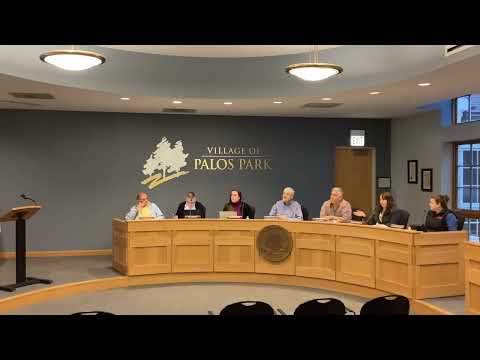
Palos Park planning commissioners reviewed proposed parking rules and debated whether assembly uses should be required to show parking that matches fire-code occupancy or a congregate-area metric, and whether passenger-size work trucks with company logos may be parked in residential driveways.
Palos Park planning commissioners reviewed several parking-related sections of the draft zoning ordinance and discussed two high-priority issues: how to set minimum parking for assembly uses (schools, places of worship, community centers) and whether residents may park work vehicles with company names or logos in their driveways.
Why it matters: minimum parking requirements shape traffic patterns, on-street parking, neighborhood safety and the feasibility of new or expanded assembly uses such as churches, schools and community centers.
Staff presented a revised parking table that largely relies on square-footage ratios (for example, 1 parking space per 230 square feet for many eating-and-drinking establishments). Commissioners and members of the public questioned whether square-foot rules adequately capture peak assembly demand. Commissioners flagged the Islamic Center as an example where parking demand during services has overwhelmed available spaces and spilled onto adjacent streets. A commissioner said the draft formula "is going to result in a very underestimated number" of required spaces for places of worship.
Several participants suggested basing parking for assembly uses on occupancy calculations tied to the fire code or on a congregate-area metric (for example, 1 parking space per 20 square feet of congregation area) rather than a generic per-square-foot standard that treats office area and worship area equivalently. Staff noted that many municipalities use a per-capita or occupancy-linked standard for assembly occupancies but also warned about nonconformity and practical enforcement for existing sites.
On schools, staff said converting the standard to "per classroom" rather than an office-plus-classroom formula could be clearer; staff will continue reviewing typical practice and numbers.
The commission also debated parking-structure allowances and perimeter landscape/setback rules, and considered requiring more robust planting buffers and surfacing (concrete/asphalt rather than loose gravel) for new off-street lots.
Separately, commissioners considered written public comments asking whether residents may park a work truck with company signage in a driveway. The village's draft rule carried an existing restriction that certain commercial vehicles must be stored in a garage; staff noted the rule was intended to avoid persistent, visible commercial equipment in residential neighborhoods. Residents urged a practical approach for common passenger-size work vehicles such as pickups with modest company decals. One resident objected strongly to a strict prohibition, saying, "We should not be determining who's allowed to live here based on what type of vehicle your job requires you to have." Other commissioners emphasized the difference between a family pickup with small signage and large panel vans or heavy trucks.
The working outcome from the meeting: commissioners signaled support for revising assembly-use parking rules to better reflect occupancy or congregate-area demands (staff to propose options), and to allow passenger-sized work vehicles with modest signage to park in residential driveways while retaining prohibitions on larger commercial vehicles and panel vans that function as on-site advertising. Staff did not record a formal vote; they will draft revised parking calculations and clearer language on commercial vehicle parking for a future meeting.