
Senate committee drafts H.398 amendment to add forest-products businesses to disaster loan fund and clarify 'non-declared' events
Get AI-powered insights, summaries, and transcripts
Subscribe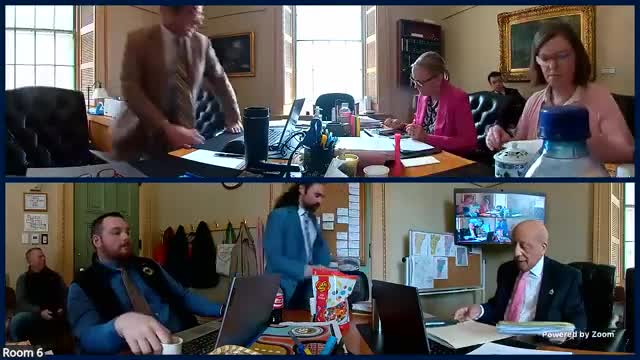
Summary
During a Senate committee meeting Friday, April 18, legislators reviewed a draft amendment to H.398 that would expand a disaster recovery loan fund to include forest products enterprises and add language covering "non-declared" disaster events.
During a Senate committee meeting Friday, April 18, legislators and legislative staff reviewed a draft amendment to H.398 that would expand a disaster recovery loan fund to explicitly include forest products enterprises and add language to cover smaller-scale or "non-declared" disaster events that do not meet criteria for a statewide emergency.
The amendment review, presented by legislative staff, would also change two section headings—relabeling "state projects" and "state bonds" as "authority projects" and "authority bonds," reflecting that the projects and bonds are issued by an authority rather than the State of Vermont. The amendment text was circulated to committee members by email before the meeting.
The change to the loan fund subsection would replace a narrower listing of businesses with a formulation that refers to "businesses, including agricultural and forest products enterprises," and would require consultation with the secretary of commerce, the secretary of agriculture, and the commissioner of Forest Parks and Recreation before funds are made available following a local disaster event. Committee members discussed that the consultation requirement was requested by the administration and intended as a check before the agency could expend monies from the fund.
Committee discussion emphasized that the amendment would not give the agency the power to declare a statewide disaster. Cameron Wood of the Office of Legislative Council summarized the intent: "It's not a declaration. It's just a determination whether funds are made available and they have to consult," and said he did not view the language as intended to usurp the governor's authority.
Members noted the loan fund's limited size: committee discussion referenced that there is only $2,000,000 in the disaster fund. That figure was cited as a reason members wanted a consultation requirement before disbursing funds for localized losses such as a farm losing poultry to avian flu or localized flood damage that would not qualify for a gubernatorial or presidential disaster declaration.
Committee members debated wording to avoid implying that only large-scale natural disasters would qualify. Options discussed included "weather event," "emergency event," "non-declared disaster event," and "undesignated disaster." Participants expressed concern that substituting other terms could introduce ambiguity; one compromise the group settled on during the meeting was to add wording indicating coverage for "non-declared" disaster events so that localized calamities could be considered for loans without requiring a statewide declaration.
No final floor vote on H.398 or on the amendment was recorded in the meeting transcript. Committee members agreed to draft the amendment language adding the "non-declared" qualifier, add committee members' names as signatories, and bring the amendment forward for consideration; one participant asked to have colleagues' names listed alphabetically on the amendment. The amendment will return to the Senate floor or the next procedural step per committee rules and was not adopted during this meeting.
Background: discussion on the draft linked the amendment to prior House consideration; participants said the House Commerce Committee had previously reviewed similar language and that related emergency funds exist in other contexts, such as municipal emergency transportation funding, which can be triggered without a statewide emergency declaration.
Looking ahead, staff said they would review consistency with other statutes over the weekend and advise whether to change the draft wording before the next committee action. The amendment sponsor indicated they would add colleagues' names and present the amendment in the appropriate procedural forum.