Get Full Government Meeting Transcripts, Videos, & Alerts Forever!
Get email alerts on the Graduation Requirements Sam Yero topic
No spam. Unsubscribe anytime.
District proposes lowering Sam Yero Continuation School credit requirement to 180 to boost graduation rates
Summary
Staff presented a tiered credit model that would keep comprehensive high schools at 230 credits, set Sam Yero Continuation School at 180 credits and keep the adult school at 135 credits. Staff said the change aligns with regional continuation schools and is intended to raise Sam Yero's graduation rate toward an 80% LCAP goal.
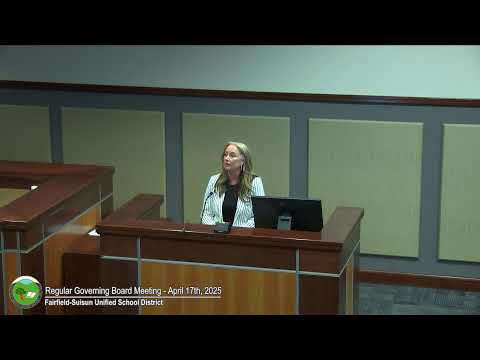
District staff presented an informational proposal to the Fairfield‑Suisun Unified Governing Board to adjust graduation credit requirements for Sam Yero Continuation School from 230 credits to 180 credits.
The staff presenter, identified in the meeting as the senior director of secondary education, described a three‑tier model: comprehensive high schools would remain at 230 credits; Sam Yero Continuation School would be set at 180 credits; and the adult school would remain at 135 credits. Staff said the model is intended to preserve rigor while creating a more attainable path to graduation for students served in the continuation setting.
Staff cited regional data showing continuation schools in Northern California with 180‑credit requirements report an average graduation rate of 83.77 percent, compared with Sam Yero’s current rate of 74.5 percent. The presentation said 91.3 percent of Sam Yero staff (24 of 26 staff members, per the slide) support the proposal. Staff also noted that for the 2029–30 school year, students will be required to complete one semester of ethnic studies and one semester of financial literacy under new state requirements.
The board discussed concerns about lowering core English and mathematics credits. Trustee Flynn said, “My concern is that if we did reduce history and social science, that we would fall below the state minimum for it.” Dr. Tully praised the design as ‘‘brilliant in its design’’ while suggesting possible adjustments — for example, trimming social science electives and returning some credits to English or mathematics — to ensure students get stronger math and English preparation.
Board members and staff described ways the district expects to maintain rigor and support. Staff said the continuation program integrates writing and other skills across courses, operates satellite classes on comprehensive campuses, and provides opportunities for students to take Career and Technical Education classes at Solano Community College, including dual‑enrollment options. Staff also clarified that the financial literacy course is separate from the mathematics credit requirement under current state guidance.
Staff said they will update board policy 6,146.1 (high school graduation requirements) and bring the policy revision to the May governance subcommittee meeting for review. The item was informational; the board did not adopt policy changes at this meeting.