Get Full Government Meeting Transcripts, Videos, & Alerts Forever!
Get email alerts on the Water Supply topic
No spam. Unsubscribe anytime.
Punta Gorda utility director warns supply shortfall, outlines $37.7 million RO expansion and staffing needs
Summary
Utility Director Tom Spencer told residents the city faces supply limits tied to state minimum flows and levels and peak demand that already exceeds prior projections; he outlined a $37.7 million reverse-osmosis expansion, infrastructure replacement projects, a lead-service-line inventory and steps to fix metering and billing problems.
Tom Spencer, the utility director for Punta Gorda City, told residents at a public briefing that the city’s water system is operating close to supply limits and that officials are planning a reverse-osmosis (RO) plant expansion and other capital work to avoid shortages.
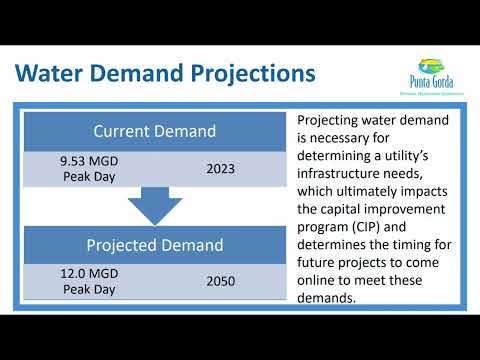
Spencer said the city’s current peak day water demand reached about 9.53 million gallons per day in 2023, while regulatory minimum flows and levels (MFLs) restrict withdrawals from the Shell Creek Reservoir during the most restrictive period to about 3.4 million gallons per day. The city’s RO plant can produce about 4.0 million gallons per day; combined, Spencer said, that gives roughly 8.22 million gallons per day of dependable supply in the most restrictive period.
The situation matters because planning and plant sizing depend on peak demand, which Spencer said already exceeds earlier projections: "The projected demand for 2050 is 12,000,000 gallons a day," he said, and a 2015 report that forecast an 8.5 million gpd peak by 2030 has been outpaced.
Spencer summarized the staff-recommended response: expand the RO plant and the well field to add redundancy and resilience. "The project to do the RO expansion in the well fields is about $37,700,000," he said, citing the city’s 2024 estimate. He said the expansion would bring the well field capacity to about 11 million gallons per day and—with the RO expansion—provide the additional 4 million gpd the city needs to reduce dependence on emergency interconnects.
Why it matters: legal and physical constraints limit what the city can withdraw from Shell Creek Reservoir during dry months, and peak demand drives capital planning. Spencer said the city receives emergency water through its interconnect with the Peace River Regional Water Supply Authority and repays water received during wetter months, but that is intended for emergencies rather than long-term supply.
Other near-term priorities and constraints
Spencer described several ongoing compliance and infrastructure efforts: the city must complete a lead-service-line inventory under updated sampling requirements for the lead and copper rule. He said crews have verified about 9,300 service lines and that roughly 4,900 remain to be field-verified, with a completion target of "by November." He directed residents to a dashboard on the city utilities web page for details.
On metering and billing, Spencer said the automated meter-reading system (AMI) and the associated drop-counter service proved unreliable and was discontinued. "The physical meter works. It's the automated part ... that actually sends it back across a wireless network," he said. He described plans to restore accurate reads by rehiring meter readers or procuring a contract to read meters and said the city is pursuing options in the next one to two weeks.
Distribution and wastewater work
Spencer gave project and operations data for the distribution and collection systems. He said the city has approximately 14,342 water service connections and that distribution crews responded to 266 leaks, 251 line breaks and about 60 larger water-main events in 2024. New-main flushing removed nearly 2.2 million gallons; routine flushing connected to the DEP dead-end program accounted for other sampling and disinfection work.
Wastewater work includes a wastewater treatment plant (WWTP) under construction that Spencer said is ahead of schedule and under budget, with initial testing expected in June or July (no year given in the briefing). He said the treatment facility sits on roughly 800 acres and that in 2024 the system handled about 1 billion gallons of influent; the city applied about 7 million gallons of biosolids under its land application permit but is studying hauling biosolids off site and installing additional dewatering equipment.
Spencer also described several capital projects and upgrades: a Bell Harbor water main replacement and upsizing projects on Val Harbor and other corridors; a Henry Street force main and port-main replacement (about $2.5 million reported as completed); a Lift Station 64 rehabilitation (about $101,000); and a recently awarded contract to CDM Smith for upgrades to the master booster pump, pumps, VFDs, controls and switchgear. He warned the city is evaluating an older ductile-clay force main under I-75 that could cause major disruption if it failed.
Operational programs and staffing
Spencer said the utilities department will pursue a utility master plan and an asset-management/maintenance system tied to GIS, and that the department plans to add staff including a second locate technician, a restoration crew, an engineering technician or project manager, and additional project-management capacity. He said the city has started a meter study and a rate study to evaluate revenue sufficiency to fund projects.
On grease control, Spencer said the fats, oils and grease (FOG) program covers 18 regulated food-service establishments with a 90% compliance rate in 2024; crews removed roughly 300,000 gallons of grease and oil that year.
Public questions and staff response
Residents raised questions about meter accuracy, boil-water-notice notifications and reuse options. A resident complained about receiving delayed boil-water signage; Spencer described the city’s current practices—door hangers, signage, direct knocking and plans to expand notification through regional alert systems—and invited affected residents to the utilities table for follow-up.
On reuse, Spencer said the city’s 2018 study concluded reclaimed water to serve distant developments would require a treatment and distribution investment of about $60 million (the study’s cost estimate) plus meter and distribution costs because the WWTP’s location and high chloride levels complicate reuse. He also told residents the city does not sell water outside its service area and has no buy-sell agreements with other municipalities beyond the emergency interconnect through the Peace River Regional Water Supply Authority.
What was not decided
The briefing included no formal council motions, vote, or adoption of new ordinances. Spencer described policy options under consideration—new development requirements for irrigation ponds, restricting potable irrigation for new projects, developer reservation-capacity fees, and updates to application fees—but said these would require ordinance changes and future council action.
Ending
Spencer closed by urging residents to consult the utilities web page for the lead-service-line dashboard, to use 811 "call before you dig" locates for private work and to visit the utilities table for billing or project questions. He stressed that functioning meters are vital to revenue and to funding needed upgrades: "The meters are our cash register. It's what pays for the utility," he said.