Get Full Government Meeting Transcripts, Videos, & Alerts Forever!
Get email alerts on the Public Works topic
No spam. Unsubscribe anytime.
Punta Gorda public works director outlines hurricane response, seawall program and plan to restore staffing
Summary
Public Works Director Ron Evers summarized the department’s responsibilities, storm preparation and recovery work, seawall manufacture and repair programs, paving and sidewalk planning, sandbag distribution, and a proposal to increase staffing back to pre-2004 levels.
Ron Evers, Punta Gorda public works director, gave a wide-ranging presentation on the city’s Public Works operations and storm response, and told residents he will propose a plan to restore staffing to earlier levels.
Evers opened by describing the department’s divisions — canal maintenance, engineering, facilities maintenance, sanitation, right of way, parks and grounds — and said the office provides customer service to roughly 20,000 residents. “Public works are recognized by the federal government as first responders,” Evers said, adding, “We are the first in. The only difference is we’re the last out.”
Why it matters: Punta Gorda owns and operates an extensive seawall and canal system that requires continual maintenance and is a primary factor in the city’s storm-preparedness and recovery workload. Evers’ staffing proposal could reduce contract spending and increase the city’s capacity to manufacture and install replacement seawall panels, perform dredging, and speed routine maintenance.
Key facts and operations: Evers said canal maintenance inspects seawalls with GPS and sonar-equipped boats, schedules dredging and works with mangrove contractors and navigational sign crews. The city manufactures seawall panels in-house; Evers said the crew typically pours roughly 10 panels per day and stacks panels in storage. He described studies that examined alternative materials (vinyl, fiberglass, different rebar configurations) and said engineering analyses show the city’s current concrete panel method offers the best cost-lifetime performance for Punta Gorda’s conditions.
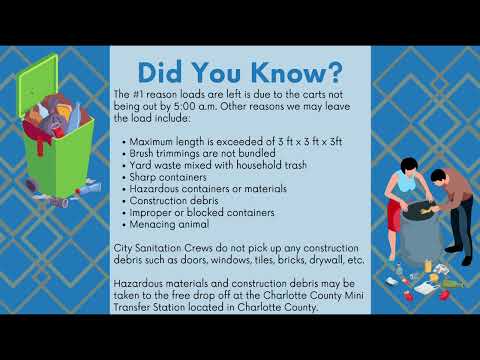
Evers described two canal districts: one he called “PGI District” (he gave a budget figure that was unclear in the record) and a BSI district with about nine miles of canal and roughly 18 miles of concrete seawall; he said the BSI district aims to replace older panels with a target completion year of 2045. Right of way maintains sidewalks, signs and street features; Evers said the department covers about 60 miles of sidewalks, 21 miles of streets, 230 miles of stormwater drainage and more than 5,000 signs. Sanitation has 19 employees and collects twice weekly; residents were reminded that hazardous materials are not collected with household trash and can be taken to the mid-county transfer station.
Paving and asset management: Evers described a pavement condition study that uses a camera-equipped truck to score segments with a Pavement Condition Index (PCI) so the city can prioritize a five-year paving plan tied to available funding. He said engineering’s operating budget and an annual paving allocation were discussed during the presentation.
Storm preparedness and sandbags: Ahead of storms the city secures facilities, fuels equipment, clears drains and operates a sandbag station at 3130 Cooper Street. Evers said the city has sometimes run short of sand during heavy demand, and that availability can vary by storm; residents were told to call the public works phone line for current stock.
Accessibility, sidewalks and alternative transportation: Residents raised repeated concerns about sidewalk width, bicycles riding on sidewalks, downtown sidewalk encroachment by restaurants, and drop-off areas for people with disabilities. A resident asked for larger shared paths; Evers said the city standard sidewalk width is five feet and that the urban design department maintains an Alternative Transportation Plan (identified by staff as an “alternative transportation plan, 2030/35” on the city website) that lists missing sidewalks and places for future paths. He said some corridor improvements may be constrained by limited right-of-way.
FDOT roundabout at U.S. 41: When asked about the new roundabout on U.S. 41, Evers clarified that the project is an FDOT undertaking and said the city has worked with the agency on how the roundabout will affect school traffic and congestion; he said the roundabout is intended as a traffic-calming and safety measure for the area near schools.
Staffing proposal and contracting: Evers described an ongoing staffing shortfall dating to the 2008 recession and said the current staffing plan is below the city’s 2004 levels. He said slow, multi-year hiring has not kept pace with increased storm-related workloads and expanded park features, and that restoring staff would allow the city to reduce contracts for tasks such as mowing, sidewalk concrete replacement and janitorial work. Evers said he will present a staffing proposal to city council on the 16th.
Questions and public comments: Residents asked about bicycle lanes on Marion Avenue, speed bumps and enforcement on neighborhood streets, drainage or pavement “dips” on Olympia that are under FDOT jurisdiction, designated downtown drop-off areas for people with mobility impairments, and whether sandbags can be stockpiled prior to storm season. Evers responded with operational details, reiterated the public works contact (pubworks@pgorda.us and (941) 575-5050) and encouraged residents to contact their council members about policy and long-range planning.
Ending: Evers closed by thanking staff across public works divisions and describing ongoing efforts to document storm damage, maintain assets and improve the city’s infrastructure. He reiterated that the staffing proposal will be presented to council on the 16th and that the public can find job postings and plans on the City of Punta Gorda website.