Get Full Government Meeting Transcripts, Videos, & Alerts Forever!
Get email alerts on the Food Labeling Cultured Meat topic
No spam. Unsubscribe anytime.
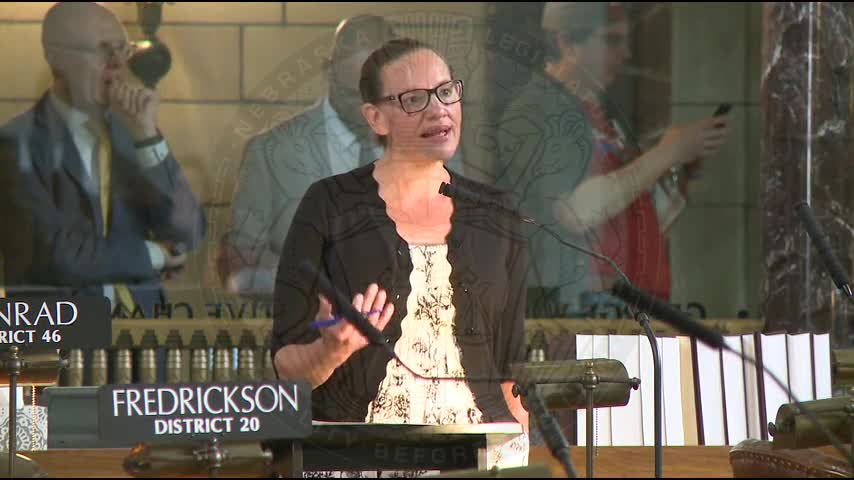
Senators debate labeling vs. ban for cell‑cultured and alternative protein products; Conrad offers labeling amendment
Summary
Senator Conrad offered AM882 to amend the Nebraska Pure Food Act so manufactured protein foods—cell‑cultured, plant‑based and insect‑sourced meat analogs—must be clearly labeled; the proposal prompted floor debate over a labeling approach versus an outright ban or moratorium.
Senator Conrad offered AM882 to replace LB246 with a labeling‑focused approach under the Nebraska Pure Food Act, prompting an extended floor debate about whether the state should ban cell‑cultured or other alternative “meat” products or instead require clear consumer labeling.
“AM882 would amend the Nebraska Pure Food Act to establish labeling and advertising requirements for manufactured protein foods,” Senator Conrad said when she introduced the amendment, describing it as a consumer‑education approach that mirrors measures adopted by neighboring states.
Supporters of the labeling approach—Senator John Kavanaugh, Senator Dungan and several others—argued the market and labeling requirements provide a middle ground that preserves consumer choice while ensuring transparency. “People have a right to know what they’re buying,” Senator John Kavanaugh said on the floor, endorsing labeling over an outright ban.
Opponents urged greater caution or a moratorium. Senator DeKay (State Senator) and others raised questions about incomplete safety data, possible contamination risks in scaled production, and whether existing research is sufficient to call these products safe for mass consumption. Some senators referenced reports and reviews from the UK Food Standards Agency and the World Health Organization noting gaps in empirical data on nutritional profiles, stability and allergy risks.
Additional practical concerns surfaced in debate: market viability and investor activity, regulatory oversight, and how restaurants would disclose the presence of cultured products. Senator Raybould cited investment trends and examples of start‑ups scaling back, noting AgFunder data showing a sharp decline in funding for cultivated‑meat startups in 2023 compared with earlier peaks.
Sponsor Conrad and others said labeling gives the state a flexible option: if future evidence shows cultured products are safe and commercially viable, laws can be adjusted. Several senators described AM882 as a “consumer‑education” policy that many agriculture stakeholders support, while others preferred an explicit moratorium pending robust safety studies.
No final floor vote on AM882 or on LB246 was recorded in the transcript excerpt; debate continued across multiple speakers and the day’s business concluded with other items on the agenda.