Get Full Government Meeting Transcripts, Videos, & Alerts Forever!
Get email alerts on the Trade Economy topic
No spam. Unsubscribe anytime.
Panel warns tariffs and trade uncertainty cloud Arizona outlook; exporters and consumers could be affected
Summary
FAC panelists said recent tariff announcements and uncertain federal trade policy are raising business and consumer uncertainty in Arizona. Panelists flagged potential price increases, disrupted supply chains and risks to export‑reliant industries including semiconductors, aerospace and agriculture.
Panelists at the Finance Advisory Committee meeting flagged tariff policy and trade uncertainty as immediate drivers of economic risk for Arizona businesses and consumers.
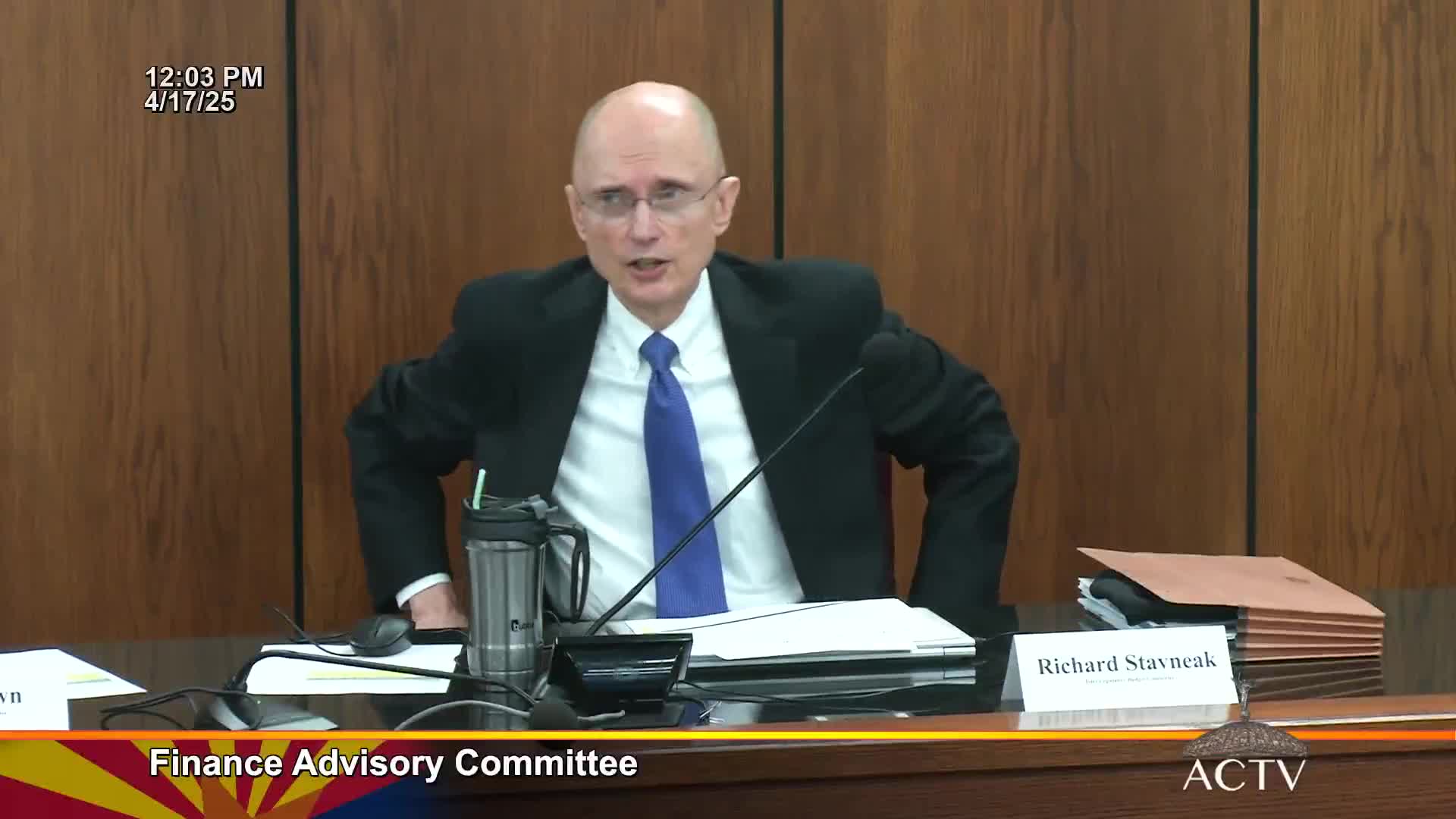
Richard (FAC member/presenter) opened the topic by noting that tariff policy is among the primary federal uncertainties affecting the state’s outlook. Danny Court (economist, Elliott Pollack & Company) said the policy environment has shortened the useful life of forecasts: “I basically put a 24 hour shelf life on anything that I present right now.” He and other panelists described how rapid announcements, pauses, exemptions and retaliatory steps make planning and investment decisions difficult for exporters and importers.
Panelists described Arizona’s economic exposure to trade. Danny and others noted large export sectors — semiconductors, aerospace, medical devices, mining and agriculture — that rely on stable trade relationships. Alan Maguire (economist, private sector) said the direct price impact of tariffs is generally smaller than the multi‑year inflation spike experienced in recent years, but cautioned that tariffs raise business costs for intermediate goods and that supply‑chain re‑routing takes time.
Lorenzo Martinez (regional economic policy representative) framed the policy shift as a major trade shock for U.S. partners: “The reaction from the rest of the world, I think, could have long term ramifications. I think it there's a high risk of whether the world views us as, a reliable trading partner. And I anticipate that a lot of the discussions that are happening with world leaders right now are looking to see, how they can develop optional alliances that will rely less on The US.” The panel repeatedly stressed that uncertainty — not just the tariffs’ direct price effects — is curbing investment and may depress consumption.
Panelists urged policymakers and budget planners to treat trade policy as a high‑risk variable in near‑term forecasting and recommended stress‑testing revenue plans against plausible tariff scenarios.
The FAC meeting did not propose or adopt policy changes; it presented possible economic effects to inform budget and contingency planning.